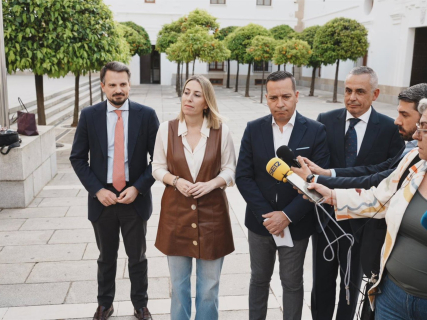

The director of the public school Gonzalo Encabo, in Talayuela (Cáceres), has raised his voice after learning that the Arabic Language and Moroccan Culture program will cease to be taught next academic year, a measure linked to the regional agreement between PP and VOX in Extremadura.
“We will try to do our best and talk to whoever it takes for the program to continue and this outrage to be removed,” stated Luis Alfonso Corrales, who warns of the impact the disappearance of these teachers will have on the center’s day-to-day operations.
A program with more than two decades in operation
The initiative is part of an agreement between Spain and Morocco signed in 1980 and active since the mid-80s. In Talayuela, it began to be applied around 2002 and, since then, has operated continuously in the Gonzalo Encabo and Juan Güell schools.
The program has native teachers sent by Morocco, who teach classes in the afternoon and also carry out mediation work during school hours. According to the center, their work goes far beyond the classroom.
“In the school there are no Moroccans or Spaniards”
Corrales defends the educational and social value of the initiative: “At school there are no Moroccans or Spaniards, only boys and girls”. Currently, around 140 students participate in these classes, where content on language, culture, and geography is taught, without a religious component.
The director insists that the program contributes to improving integration, communication with families, and the learning of Spanish, especially in students who arrive with linguistic difficulties.
Criticism of a decision "without consultation"
From the center they criticize that the measure was adopted without counting on the educational community or the City Council, even though it directly affects two schools in the municipality.
“They have included in a regional agreement something that only affects Talayuela and two teachers in all of Extremadura,” laments Corrales, who considers that the decision responds to a “populist” approach far removed from educational reality.
A "free" service that could disappear
One of the arguments most emphasized by the center is that the program does not entail any cost for the regional administration, as it is financed within the framework of the bilateral agreement with Morocco.
Despite this, the forecast is that it will disappear next academic year, which would leave both students and teachers and families without this resource.
Call for review of the measure
The educational community has asked the authorities to reconsider the decision and has opened the doors of the center so that they can learn firsthand about the program's operation.
“They are going to take away something very useful and with zero cost from us”, insists the director, who still holds a “minimal hope” that the measure can be reversed. Meanwhile, the case has become a new focus of debate on education, integration, and regional policies.