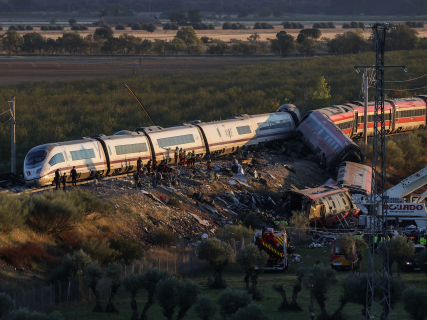

At nine o'clock on Wednesday morning, the political parties had ahead of them a new day of pre-campaigning, with the general elections of November 29 a little over a month away and the candidacies just recently set up. Barely a few minutes earlier, a Renfe AVE had struck from behind an Iryo train stopped in the vicinity of Urda (Toledo), causing a tragedy that, as the hours have passed, has raised its toll to at least 68 dead and dozens injured. The news has interrupted electoral activity, has forced the Government to focus on the emergency, and has returned railway safety to the center of the debate, barely nine months after the Adamuz (Córdoba) accident.
PSOE, PP, Frente Amplio and Podemos have suspended their pre-campaign events, while their leaders conveyed their condolences to the victims and called for the circumstances of the accident to be clarified. The exception has been Vox, whose president, Santiago Abascal, has kept his appearance in Valladolid and has rejected the mourning serving to "muzzle" his party. A decision that has turned the final stretch of the day into a contrast between those who have chosen to interrupt their electoral commitments and those who have defended the continuity of political confrontation.
The suspension of the events has not meant, however, a truce in the statements. Pedro Sánchez has promised to go "to the end" in the investigation; Alberto Núñez Feijóo has called for an independent review of the entire railway network; Frente Amplio has demanded political responsibilities, and Abascal has directly held the Executive responsible for a tragedy whose causes have still not been determined. Among those positions, the Minister of Transport, Óscar Puente, has offered the first explanations about the sequence of the accident and has acknowledged that a decision adopted from the Adif control center is "inexplicable".
From a morning of pre-campaign to a national emergency
The accident occurred around 8:53 a.m., when a Renfe AVE traveling toward Seville collided from behind with an Iryo train that remained stopped on the track. The violence of the impact has caused serious damage to both trains and has forced the deployment of a large emergency response operation in the vicinity of Urda.
The first reports have given way to an increasingly serious toll of victims. At least 68 people have died and more than fifty have been injured, while rescue teams continued working on the remains of the trains and medical services attended to the survivors.
The Civil Guard has mobilized more than 300 personnel to collaborate in the rescue, victim identification, and investigation tasks. The operation includes specialized units and family assistance offices in Madrid, Toledo, Córdoba and Sevilla, intended to collect information that facilitates the location and identification of the passengers.
High-speed rail traffic between Madrid and Andalucía has been interrupted, with major consequences for thousands of travelers. Renfe has activated its crisis committee and the victim and family assistance device, while the operators have begun reorganizing their services in the face of the impossibility of using the affected corridor.
In parallel, the first images of the accident site and the testimonies of the survivors have accounted for the magnitude of the collision. The passengers have described the impact, the damage to the carriages, and the help provided by other travelers and local residents during the first moments of the emergency.
Puente points to an "inexplicable" authorization by Adif and avoids clarifying whether he will resign
The first detailed reconstruction of what happened came during the appearance of the Transport Minister, Óscar Puente, who has placed one of the main unknowns in the decision of the Adif control center to authorize the AVE to resume its journey when the Iryo train remained stopped on the section.
According to the minister, around 8:30 a communication failure occurred between the computers of the LZB safety system, which left this rail protection unavailable on a stretch of approximately 63 kilometers. The incident caused the automatic stoppage of several trains and forced the Adif control center in Atocha to take over traffic management.
At 8:36, the AVE received authorization to continue despite having a red signal and the track circuit being occupied, a decision that Puente has described as "inexplicable" and "erroneous". The train traveled approximately 25 kilometers before reaching the Iryo at 8:53.
"According to both the regulations and Adif's own protocols, it could not resume normal operation," the Transport minister has acknowledged, who has warned that circumstances still remain to be clarified.
The Guardia Civil has taken testimony from the control center operator who authorized the resumption of traffic, as part of the proceedings aimed at reconstructing what happened. The investigation must determine the origin of the breakdown, the communications between the traffic managers and the train drivers, and the specific circumstances in which the collision occurred.
Puente's explanations have also opened the debate on his political continuity. Asked about a possible resignation, the minister has avoided speaking about his future and has assured that his priority is to clarify the facts and deal with the consequences of the tragedy.
"At this moment what I am thinking about is clarifying this and trying to resolve it, I am not thinking about myself," he has responded.
Sánchez decrees three days of mourning and promises to act if negligence is proven
The President of the Government, Pedro Sánchez, has suspended his pre-campaign schedule, including the event he had planned to hold in Vitoria, and has traveled to the site of the accident, where he has spoken from the Advanced Command Post accompanied by the Interior Minister, Fernando Grande-Marlaska.
From there he has announced three days of official mourning, from Thursday, October 29 to Saturday, October 31, and has committed to a thorough investigation to determine the causes of the accident and the possible responsibilities.
"We are going to get to the end," the head of the Executive has assured, who has promised to act with "total forcefulness" if it is proven that there were negligence or failures in the safety systems.
Sánchez's intervention has been marked by the memory of the Adamuz railway accident, which occurred last January and in which 46 people died. The president has acknowledged that the succession of two tragedies of these characteristics in a single year is difficult to bear, although he has warned that the first indications point to different causes.
"Very probably, everything indicates that the origin of the two accidents has nothing to do with each other," he has pointed out, before insisting that it is up to the investigators to establish what happened in Urda.
The president has also thanked the work of the emergency services and the collaboration between administrations, especially that of the Government of Castilla-La Mancha, chaired by Emiliano García-Page, and that of the municipalities near the scene of the accident.
Attention to the victims, the recovery of the injured and support for the families have been the priorities that Sánchez has placed ahead of any other consideration, while the Executive tries to respond to a crisis that once again calls into question the safety of the Spanish railway system.
Feijóo interrupts his schedule and demands to know the state of the entire network
The national leadership of the Partido Popular has suspended its electoral commitments, while Alberto Núñez Feijóo has returned to Madrid from Barcelona to follow the evolution of the emergency and later appear from the party headquarters in Génova.
The opposition leader began his intervention by conveying his condolences to the relatives of the deceased and his support for the injured, in addition to asking for respect for the victims and encouraging citizens to donate blood.
His main demand has been a complete and independent review of the Spanish railway network, which would make it possible to know the real safety conditions of the infrastructure and determine the destination of the economic resources invested in its maintenance and modernization.
Feijóo has defended that citizens have the right to know in what state the tracks and safety systems are, as well as where the money committed to guarantee their operation has been spent.
Unlike other parties, the president of the PP has avoided attributing specific responsibilities during his appearance. He has called for an immediate and rigorous investigation, as well as for the action of Justice without interference, and has defended that the conclusions must be based on the facts that can be verified.
The review of the infrastructure and transparency regarding the investments have thus become the two main pillars of his political response, along with the demand to clarify the circumstances of the collision.
Frente Amplio claims political responsibility and suspends the pre-campaign until further notice
The reaction of Frente Amplio has gone beyond the request for a technical investigation. The candidacy has called for political responsibilities to be clarified for what happened and has considered it "inadmissible" that Spain has registered two railway accidents of such seriousness in the same year.
In a statement released after Sánchez and Puente's appearances, the formation has requested an independent audit on the state of the railway network and the associated services, in addition to demanding clarity and transparency about the circumstances of the accident.
"Beyond technical responsibilities, we demand the assumption of political responsibilities. Out of responsibility and out of humanity", Frente Amplio has said, which has conveyed its condolences to the relatives of the deceased and its recognition of railway workers and emergency teams.
The candidacy has announced the suspension of its pre-campaign agenda until further notice, which includes the postponement of the event scheduled for this Saturday in Barcelona with the participation of Ada Colau and of the lead candidate for Madrid, Emilio Delgado.
Podemos has also suspended its electoral activity, while its candidate, Irene Montero, has conveyed her solidarity to the affected people and has asked that attention to the victims and the work of the emergency services be prioritized.
From Compromís, the deputy Alberto Ibáñez has likewise expressed his consternation over the accident and has defended that the immediate priority must be to accompany those affected and support the teams working on the ground.
"Afterwards there will be time for investigations and political responsibilities", he has said.
Abascal maintains the Valladolid event and accuses the Government of wanting to "gag" Vox
The exception to the suspension of electoral activity has come from Vox, which has kept the pre-campaign event planned in Valladolid with Santiago Abascal as the only speaker.
The gathering has begun with those attending standing and singing "La muerte no es el final", before the president of Vox acknowledged that the circumstances made it impossible to hold an event like the usual ones and conveyed his condolences to the relatives of the victims.
"We are in mourning like the rest of decent Spaniards", Abascal stated, who defended, however, that the seriousness of what happened should not prevent criticism of the Executive.
"We are not going to accept mourning that silences us when Spaniards die", he warned, justifying the continuation of the electoral activity as a way of expressing his party's indignation at the Government's management.
The leader has accused the Executive of neglecting infrastructure and has politically linked the Urda accident with that of Adamuz, the electrical blackout and other emergencies recorded during the last few months.
"This did not happen by chance", he stated, before asserting that "corruption kills and climatic fanaticism also kills". These are accusations made by the president of Vox, while the investigation has not yet established the definitive causes of the accident or the possible responsibilities arising from the collision.
Abascal has also directed his criticism at Óscar Puente for his previous comments about Renfe and for his activity on social media during the day, while he has taken advantage of his intervention to call for a change of Government in the elections of November 29.
The formation has also announced its participation in the minute of silence called in Valladolid, an initiative of tribute to the victims that it has made compatible with the holding of the rally.
Mourning spreads across Spain while the investigation continues
Beyond the decisions of the parties, the tragedy has provoked an institutional response throughout the country. The Government has decreed three days of national mourning, while communities such as Andalusia, Extremadura, Madrid, Catalonia and Navarra have announced their own mourning measures and other regional administrations have adhered to the state declaration.
The Spanish Federation of Municipalities and Provinces (FEMP) has called a minute of silence at 20.00 hours before the town halls, to which institutional representatives and citizens have joined in different parts of Spain.
The tributes have coincided with the continuation of the rescue and identification work of the victims, as well as with the progress of the first judicial and technical proceedings. The investigation is being carried out with the participation of the Civil Guard and the Railway Accident Investigation Commission, who must reconstruct the sequence of decisions adopted after the failure of the LZB system.
The accident has also had immediate consequences on mobility. High-speed traffic between Madrid and Andalucía remains interrupted, Renfe has temporarily suspended the sale of new tickets for the corridor until December, and Ouigo has announced the cancellation of its services, at least, until Monday, November 2, inclusive. The date set by Renfe for ticket sales does not necessarily imply that the infrastructure will remain closed until then, since its reopening will depend on Adif.