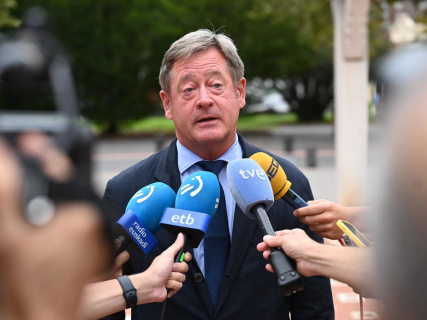

The Security Counselor of the Basque Government, Bingen Zupiria, considers that the massive arrival of migrants to Ceuta has highlighted the need to address key issues such as the management of migratory flows so that they are "manageable and socially accepted," given that migration is "necessary," as well as the humanitarian component, which in his opinion is "very significant and difficult to address." At the same time, he has avoided assessing whether the central Executive has reacted "late and poorly," as it is a "very complicated" situation.
In an interview on the SER Bilbao network, reported by Europa Press, Zupiria emphasized that what happened in Ceuta "has brought to the forefront issues that will be very present in the coming months, one being the debate on immigration." "No one is going to reject immigration, but in what way should that immigration occur? How do we face it? How do we organize it so that it is something manageable and socially accepted because we need it?" he pointed out.
As a second axis, he referred to the role of information services "that every State is supposed to have, or every Police has, or every Army has, whether they have acted properly or not, whether they have had that information or not."
Thirdly, he emphasized that there is "a very significant humanitarian aspect, which is difficult to address," and, fourthly, he recalled that there is "a political claim by the State of Morocco for a territory that is under Spanish sovereignty." "These are issues that have entered the political agenda this summer and that I believe will generate a lot of discussion in the coming months," he stated.
The counselor indicated that, according to the data they handle, there could be about 2,000 minors in Ceuta, "many of them boys and girls, very very young people, and there is no way to know how those people have arrived."
"The first thing, from a humanitarian point of view, is to seek the best situation and the best coverage for those people. Therefore, identifying them, knowing where they come from, knowing what family background they have, why they have decided to go to Ceuta at that moment," he defended, emphasizing that this prior work is essential.
In his opinion, this "is something fundamental and is the first thing," even in the case that it ultimately ends up "welcoming several hundred of those people." "If they are going to come to the State, if they are going to be welcomed in smaller centers, if they will need to be accompanied, given training, given education, it is also advisable to know what backgrounds and what family relationships they have to attend to their lives," he explained.
Questioned about whether he considers that in Ceuta it has been acted "badly and late," he admitted that "it is a very difficult situation." "I do not dare to question the reaction that has occurred, nor whether there was prior information, nor how others would have done it. It is very complicated," he emphasized.
Police competencies and arrests for incidents of the World Cup
Regarding the complaints he conveyed to the central Government after the arrests made by the National Police of several people who supposedly had assaulted citizens wearing the Spanish national team's jersey during the football World Cup, and which the Basque Government interpreted as an interference in the competencies of the regional Police, he pointed out that he has not received "any response," although he understands that "the agendas of those responsible for the Ministry of Interior are currently very busy."
"I believe that it is a matter that is legally and juridically clearly established in the Statute of Autonomy, in the agreements that have been made between the Basque Government and the Government of Spain: What corresponds to the Ertzaintza as the integral Police of this community and what functions are reserved for the National Police and the Civil Guard?" he noted.
After recalling that agreements were reached at the time on how to act in these types of scenarios, he has expressed confidence that, if each body assumes its functions and there is coordination, everyone will be "much more effective." "We are facing very delicate issues. One only has to look at Ceuta and everything that may come," he warned.
In response to the argument of the FSE that they can intervene in hate crimes, Zupiria replied that "everything fits within a hate crime." "And it is a situation that we previously experienced with environmental crimes, also when legislation was enacted regarding the guarantees that a minor must have, also in issues of violence against women. It is a recurring issue. That is why it is good that the principles are clear to everyone and we adhere to what we agreed upon at the time," he insisted.
In relation to the actions of the Ertzaintza in the disturbances linked to the World Cup, it has specified that more than twenty reports have been processed "that will have their corresponding judicial or sanctioning procedure."
Comprehensive Security Strategic Plan 2026-2030
Zupiria has also addressed the Comprehensive Security Strategic Plan 2026-2030 that he wants to implement, and has indicated that he will seek broad consensus. "It is important that we all have clear what the priorities are that we have as a society. Some are related to the loss of values that we are probably experiencing and with the lack of respect for authority, others are related to how we face the new risks that security has at this moment," he has indicated.
At the same time, he has emphasized that it will be necessary to prepare for "another type of events that this summer have been suffered such as, for example, heat waves or unexpected storms, etcetera."
"There are several areas that demand our attention and I believe that we are facing an opportunity so that, based on that strategic plan and the measures that all Basque institutions will have to adopt, we reach a situation that allows us to offer a horizon of security and certainty to Basque society," he has highlighted.
Likewise, he has valued that "the relationship between citizens, defense, local police, municipal guards, is of absolute normality and collaboration." "It is true that there are specific cases and that there are concrete groups that do not experience it that way and behave differently," he has added.
Antisystem Attitudes and the Work of the Ertzaintza
As he has explained, "there are strange behaviors" and "some respond to antisystem attitudes, rejection of democratic institutions and also of the Police, of the Ertzaintza and of the Local Police as democratic institutions."
"There are also political groups that still resist accepting, for example, the Ertzaintza as the democratic and legitimate Police that this society decided to have to guarantee the security of its citizens and their property," he has stated.
Likewise, he has pointed out that there are "some specific behaviors of people who, especially men, at night, consume alcohol and other substances, where respect for others and also for authority is lost."
Bingen Zupiria has highlighted that a ertzaina "dedicates almost 80% of their professional performance to attending to preventive actions or situations in which they have to assist or help a citizen." "From there, very specific events have occurred in the last two years that have required the use of force. Therefore, the training and preparation of the agents of the Ertzaintza to face those situations are important and are on the agenda of the Department and the Basque Police Academy in Arkaute," he has assured.