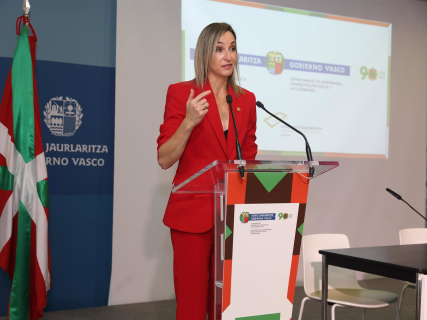

The spokesperson of the Basque Government and counselor of Governance, Digital Administration, and Self-Government, María Ubarretxena, has warned that a potential state Executive of PP and Vox would place Euskadi in a "very difficult" and "defensive" phase regarding the Statute of Autonomy, considering that the party led by Santiago Abascal "is totally against self-government."
In statements to Onda Vasca, collected by Europa Press, Ubarretxena has pointed out that "we only have to listen to the Vox parliamentarian in the Basque Parliament" to confirm that it is "a party that is totally against self-government."
"We already know what Vox thinks, that it is against self-government, and we would enter a very difficult phase and surely a phase of defense," she emphasized, stressing that Euskadi cannot "give up our great tool which is the Statute of Autonomy and we must cling to that," for which she reiterated that they will continue working to ensure its full compliance.
In line with the warning from the Lehendakari, Imanol Pradales, about the "dark times that may come," the spokesperson has avoided making "speculations," although she has emphasized that "we have to prepare for the specific scenarios that may arise." In this regard, she has assured that "we must consider different scenarios and, in the face of those scenarios, the Basque Government will be prepared."
Ubarretxena has explained that conversations about the pending transfers are ongoing, that communication channels "remain open" with the State, and that they are "trying to reach some agreement," despite her belief that, although there are "very few days left for the legislature to end and it would be difficult, if the State wants, it can do it."
After admitting that the time frame to convene the Joint Transfer Commission, following the bilateral commission in which agreements are finalized and transfers are formalized, is "short," the counselor considers it feasible to "at least initiate procedures," so that "if during these remaining days we achieve significant agreements, at least the procedure is already started."
"We are talking in those terms and we will see if it is possible," he indicated, insisting that the decision corresponds to the central Executive. However, he acknowledged that there are "reluctances" in some ministries, as "many high-ranking officials are already with one foot out because they see that the legislature is ending and everything is starting to slow down."
According to what he has stated, "there is less desire to push things forward," but even so, the Basque Executive maintains contact, given that "from Euskadi we have done the tasks, all the documentation has been sent and if agreements are not reached or if agreements are not achieved, it will not be because the Basque side has not done it," although "the other side needs to take the step."
Difficulties with the central Government
Ubarretxena has admitted the "difficulties" on the part of Pedro Sánchez's Government, but has reiterated that "at least, a start of the procedures could be achieved." "And as long as there are materials, the Basque side has to try until the end," he emphasized.
He detailed that negotiations are taking place "on various matters and we will see if we can reach agreements in some of those matters that could be an agreement of the Council of Ministers, because the State Government could do it calmly without any problem or start the procedures." In this sense, he stressed that "we are going to work with the tools that we currently have available on the table, because there are tools," appealing again to "the will of the State."
Claim of the Gernika Statute
Recalling that yesterday marked 47 years of the Gernika Statute and lamenting that "it has still not been fulfilled" and that we continue "in a fight that we should not be fighting," Ubarretxena has valued the decades of negotiations and the transfers of competencies that have been taking place, to emphasize that "we are always negotiating something that we should not be negotiating."
"Historically it has always been this way and, regardless of the color that has governed in Madrid, the dynamic has been the same, the PNV has always had to assert its votes in Congress to push forward issues, transfers, and competencies that are ours." Despite this, he stressed that the Basque Government is clear that "what is important is the Basque agenda, the interest of Euskadi, our competencies, and our self-government."
At this point, he has emphasized that the regional Executive "there makes a defense and will continue to do so." "Because it is what we have to do and because it is the best tool we have to continue advancing as a country and to expand our well-being," he has stated.
Finally, Ubarretxena has reiterated that conversations continue to try to close "some significant agreement, taking into account the circumstances, the discount time, and the tools" they have "right now." "It is about taking the opportunity to be pragmatic and from this context see if we can secure some more agreement," he has concluded.