The engineers reveal that the Government did not complete the replacement of the LZB by the ERTMS on the AVE Madrid-Seville despite having 780 million

El Engineering Newspaper documented this Wednesday that Adif tendered in 2020 the modernization of the security systems, but ERTMS level 2 remains pending implementation when the Urda accident occurred

EuropaPress 7874795 mapa localizacion accidente estacion urda toledo dos trenes colisionado

EuropaPress 7874795 mapa localizacion accidente estacion urda toledo dos trenes colisionado

Add DEMÓCRATA to Google

Ask FREN

Published

Last updated

7 minutes

Most read

Elecciones 29N · Encuestas

La media de las encuestas

Media a 27 de octubre de 2026 · 15 institutos

  • PP31,0 %
  • PSOE27,3 %
  • Vox18,9 %
  • Sumar6,3 %
  • Podemos2,9 %
  • ERC2,3 %
010203040ene 2024jul 2024ene 2025jul 2025ene 2026jul 2026

Media del último estudio de cada instituto en 30 días y su evolución semanal desde el 23J. Partidos con al menos un 2 %.

Todas las encuestas

Elecciones generales del 29 de noviembre · Demócrata

The renewal of the signaling systems of the Madrid-Seville high-speed line was still unfinished when the Urda (Toledo) railway accident occurred, despite the fact that the Government had a modernization program endowed with 780 million euros and Adif had begun to put out to tender the actions on the safety installations in 2020.

So records El Periódico de la Ingeniería, which has detailed the scope of the planned work on the first Spanish high-speed line and the state of execution of its main components. The specialized publication points out that the European ERTMS level 2 system had still not replaced the LZB, the technology used since the inauguration of the infrastructure in 1992.

The comprehensive renewal program comprises 89 public contracts to work on viaducts, tunnels, track, electrification, telecommunications and safety systems. However, the existence of this financial allocation and of awarded contracts does not mean that all the work has been carried out or that the new equipment has entered into operation.

The published information does not allow establishing how much of the 780 million euros has actually been disbursed. What it does document is that the modernization of the signaling had been contracted years earlier and that, at the beginning of 2026, ERTMS level 2 was still officially under execution.
Adif put the signaling out to tender in 2020 for 131 million

The technological modernization of the Madrid-Seville line included the implementation of ERTMS level 2, the European standard for management and protection of railway traffic used in a large part of the Spanish high-speed network.

The project contemplated progressively replacing the LZB, keeping it operational during the transition to guarantee the continuity of commercial services.

According to the documentation gathered by El Periódico de la Ingeniería, Adif put out to tender in 2020 the package of safety installations for 131.1 million euros, with an initial execution period of 52 months.

The main contract was awarded in 2021 for 93.8 million, within a set of awards related to signaling, track circuits and turnouts that exceeded 136 million.

The implementation of ERTMS was to be developed in two phases: a first one between Madrid and Córdoba and a second one between Córdoba and Sevilla.

The works included new electronic interlockings, digital ASFA, object-fall detectors, modifications to the interlocking systems and adaptation of the control centers and telecommunications.

The project also contemplated maintaining the functionality of the LZB while the works were being carried out.

However, the initial execution deadline did not translate into the full commissioning of the new system. In January 2026, the Ministry of Transport was still identifying the implementation of ERTMS level 2 as a measure "in execution", according to the official documentation cited by the specialized publication.
EuropaPress 7874791 agentes servicios emergencias trabajan lugar hechos 28 octubre 2026 urda
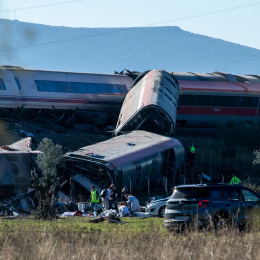
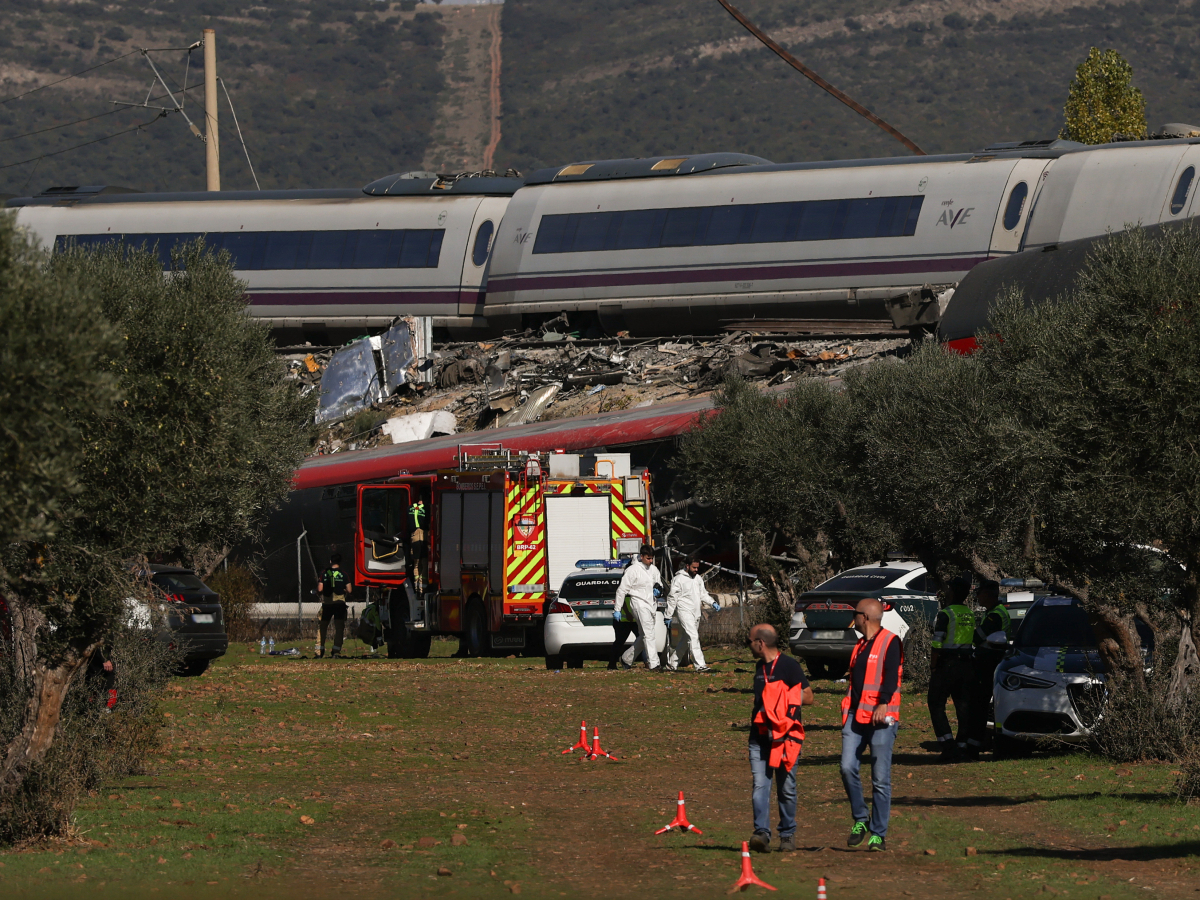
Emergency services agents working at the scene of the events. Photo: Europa Press.

ERTMS had not replaced the system installed in 1992

The Madrid-Sevilla line, 470.5 kilometers long, continued using the LZB, a railway protection system that transmits continuous information on operating conditions and supervises the train's speed.

This technology makes it possible to automatically order braking when certain safety parameters are not met.

ERTMS level 2, whose implementation was planned in the modernization program, also provides continuous supervision of speed and authorized movement, although through a more modern and interoperable technological architecture.

The renewal of the signaling had to be accompanied by the replacement of interlockings, the updating of detection systems and the adaptation of railway communications.

Nevertheless, ERTMS still did not constitute the main operating system of the Madrid-Sevilla when the Urda accident occurred.

The official information from the Atlantic Corridor, as detailed by El Periódico de la Ingeniería, differentiated a first phase of completed track renewal from a second still in progress, in addition to other pending infrastructure actions.

What actions the 780 million program comprised

The modernization program for the Madrid-Sevilla was not limited to signaling. The allocation of 780 million corresponded to a set of interventions on different elements of the infrastructure.

Civil works contemplated waterproofing works on decks, repair of structural defects, adaptation of tunnels, stabilization of slopes, improvement of drainage, correction of settlements in embankments and conditioning of access roads and fences.

Also the nine viaducts of Sierra Morena were modernized and work was carried out on the maintenance bases.

In the railway superstructure, the Government counted at the beginning of 2026 the replacement of 111 high-speed switches and 24 expansion joints installed on viaducts.

Between 2022 and 2025, 71,000 sleepers had been renewed and a second phase was underway to replace another 123,000.

The renewal of the rail, however, did not consist of completely replacing the two track rails along the 470.5 kilometers. The contracts established selective actions according to inspections, wear measurements and the detection of defects.

Modernization also extended to electrification, with actions on catenary, electrical substations, power equipment and tunnel lighting.

In telecommunications, new fiber optic networks and the reinforcement and duplication of GSM-R were planned, used for communications between the trains and the command posts.

Therefore, the expression "comprehensive renewal" refers to the set of subsystems included in the program, not to the complete replacement of all the components of the line.

What is the ertms?

ERTMS (European Rail Traffic Management System) is a technological standard developed to improve safety and facilitate the movement of trains between European railway networks. Its main feature is the automatic supervision of speed and operating conditions, with the ability to intervene on braking if the train exceeds the authorized limits.

At its level 2, ERTMS uses radio communications between the train and a control center called RBC (Radio Block Centre). Based on the information received, the system continuously calculates and monitors the maximum permitted speed and the distance the convoy can travel safely. If the driver does not respond to a warning, the system can automatically activate the brakes.

Unlike LZB, a continuous supervision technology installed on the Madrid-Sevilla line since 1992, ERTMS is an interoperable European standard that facilitates the movement of trains equipped to use it on different networks. Both systems incorporate automatic protection mechanisms, so the replacement of LZB by ERTMS does not imply, by itself, that the previous system was unsafe.

The European Commission states that ERTMS promotes interoperability between countries and can improve the capacity of railway lines. Its level 2 allows movement authorizations to be transmitted directly to the cab, without necessarily depending on light signals along the track.

The failure of the LZB and the Urda accident

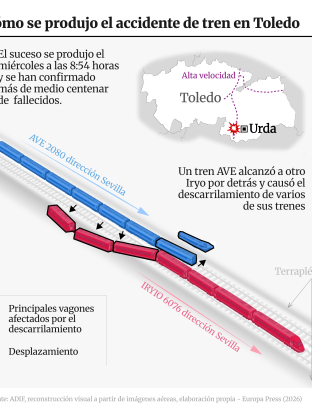
The situation of railway protection systems has acquired relevance after the collision between an AVE of Renfe and an Iryo train in Urda.

According to the information provided by Adif to RTVE and collected by El Periódico de la Ingeniería, the LZB was out of order and the trains were running using Lateral Signaling Block (BSL), with the ASFA as the onboard backup system.

This circumstance must be examined through the technical circulation records in order to establish the exact conditions under which both trains were operating.

The fact that ERTMS level 2 was not yet in service does not allow one to conclude that its implementation would necessarily have prevented the accident.

To determine this, it will be necessary to know the nature of the incident, the state of the interlockings and track circuits, the information available at the control center, and the orders transmitted to the drivers.

An announced investment does not equal an executed work

The information from El Periódico de la Ingeniería distinguishes three different phases: the awarding of the contracts, the material execution of the works, and the commissioning of the installations.

In railway safety systems, a finished work also requires tests, validations, and integration with the existing equipment before obtaining the necessary authorization for its operation.

For this reason, the 780 million associated with the modernization program do not, by themselves, allow the amount actually executed or the degree of commissioning of each action to be known.

To determine this, it would be necessary to examine the work certifications, the payments made, the reception files, and the corresponding authorizations.

The documentation analyzed by the specialized publication certifies that the program included important actions on the physical and technological infrastructure, but also that some remained pending.

In particular, the modernization of the signaling, tendered since 2020 and awarded in part in 2021, had not been completed with the full entry into service of ERTMS level 2.

At the time of the accident, renewed elements, previous equipment kept in operation, and next-generation systems still in the implementation phase coexisted. The investigation will have to determine the effective configuration of the installations and verify the functioning of the protections available during the circulation of both trains.


More key points, information and questions with FREN

AI-GENERATED CONTENT

What parliamentary or administrative procedures are pending to complete the implementation of ERTMS level 2 on the Madrid-Seville AVE line?

To complete the implementation of ERTMS level 2 on the Madrid-Seville line, the decisive steps are technical and administrative: finishing integration, certifying its safety, and obtaining the authorization for commissioning. There is no record of a pending parliamentary approval that is a condition for activation. As of October 28, 2026, the sources consulted do not confirm a definitive authorization for its full operation; nor do they allow identifying which specific documents Adif has already submitted and which remain pending.

Project status

The action is contracted, not pending an enabling law. According to Demócrata, the security installations package was tendered in 2020 for 131.1 million euros and the main contract was awarded in 2021 for 93.8 million, with an initial term of 52 months. The deployment contemplated two phases: Madrid-Córdoba and Córdoba-Seville, maintaining the LZB during the transition.

As an official precedent, Transport announced on June 11, 2024 that the second phase of ERTMS and the last renewal of track circuits were progressing. Later, it announced the goal of having the line renewed with ERTMS during 2026. That goal does not equate to an effective authorization.

What must be completed before full operation

It is advisable to distinguish the necessary requirements from the procedure, some of whose individual status is not published. The identified sequence is as follows:

  • Completion and integration of installations. Adif and contractors must complete signaling equipment, electronic interlockings —which prevent incompatible movements—, train detection, telecommunications, and control centers. Integration must cover both sections and the temporary coexistence with LZB.
  • Testing and validation. Joint operation tests, dynamic tests with trains, and verification of transitions, failures, and degraded situations must be completed. Mere physical installation does not prove the system is ready for commercial service.
  • Safety and interoperability dossier. It is necessary to gather evidence of tests, independent evaluations, compliance with applicable specifications, and documentation of the installations actually executed, as well as resolving identified risks.
  • Authorization for commissioning. The intervention of the State Railway Safety Agency constitutes the central administrative milestone before operating the modified control, command, and signaling subsystem. The sources consulted do not show the final resolution for the entire Madrid-Seville line, nor details of possible partial authorizations.
  • Train preparation and operation. Operators must certify the compatibility of their onboard equipment and have the corresponding authorizations. Adif and railway companies must complete circulation, maintenance, system transition procedures, and staff training.
The role of the Parliament and contracts

There is a written question in the Senate, submitted on April 16, 2026, by five senators from the Popular Group, about completed, ongoing, and pending ERTMS sections. It is a government oversight initiative, not a technical authorization: its response does not activate the system.

On the other hand, the Council of Ministers on October 27 authorized modifying the maintenance contract for traffic control of Madrid-Seville, Córdoba-Málaga, and La Sagra-Toledo, for an additional 11,508,626.53 euros. That agreement also does not by itself certify the commissioning of ERTMS.

In conclusion: the closure depends on Adif, contractors, operators, and safety authorization, not on a parliamentary vote. What remains to be publicly certified is the completion of tests and evaluations and the resolution that allows full operation.

What legal powers does the Ministry of Transport have in the modernization of the high-speed rail network?

The Ministry of Transport and Sustainable Mobility has powers to plan, regulate, promote financing, and supervise the modernization of the state high-speed rail network. However, it does not concentrate all decisions: construction and administration of infrastructures mainly correspond to Adif and Adif-High Speed, while safety supervision is the responsibility of the State Railway Safety Agency, with functional autonomy.

1. Legal framework and scope of action

The central regulations are Law 38/2015 on the railway sector, amended, among others, by Law 26/2022, and Royal Decree 253/2024, which distributes ministerial functions. High speed is framed within the General Interest Railway Network, whose regime does not depend exclusively on operating speed.

Article 4 of the law assigns the Ministry the inclusion and exclusion of infrastructures in that network and modification of its catalog. It must obtain the foreseen regional reports and, in certain cases of regional or disconnected infrastructures, obtain prior consent.

2. Planning and approval of actions

Article 5 entrusts the Ministry with publishing a development, maintenance, and renewal strategy with a minimum horizon of five years, priorities, and financial framework. It must consider economic and social efficiency, financial sustainability, and coordination between transport modes. The current text requires coherence with the strategic planning foreseen in Law 9/2025 on Sustainable Mobility.

It is also responsible for planning the establishment or modification of lines, sections, and stations, consulting administrators and affected communities. New actions or significant modifications require approval of an informative study: the document comparing territorial and functional alternatives, with required feasibility, profitability, and environmental assessments.

Not all modernization requires this study: the law exempts, among others, conservation works, electrification, or signaling that do not substantially alter the layout, without eliminating other applicable evaluations.

3. Financing, execution, and control

The Ministry promotes financing mechanisms and processes agreements with infrastructure administrators. The Directorate General of the Railway Sector evaluates their activity programs and assists in technical control and management evaluation, according to articles 25 and 30 of the law.

This public direction must be distinguished from material execution. Adif-High Speed has its own legal personality and assets and assumes construction and administration of assigned infrastructures, according to Royal Decree 1044/2013. Contracting and allocation of railway capacity are exercised by its competent bodies; this is reflected in the agreements published in 2025. Therefore, not every tender or operational decision corresponds to the minister.

4. Technology, safety, and limits

Article 5 of Royal Decree 253/2024 assigns the Directorate General of the Railway Sector to prepare regulatory and technical proposals, promote new technologies, prepare European interoperability plans —compatibility between networks and systems— and develop expropriation actions. These powers allow guiding the modernization of tracks, electrification, signaling, and communications.

Its powers are exercised without replacing the safety authority: the State Railway Safety Agency maintains its own competencies in operational safety and interoperability. The powers of the CNMC and administrators must also be respected. Consequently, a ministerial priority does not replace the necessary technical, environmental, budgetary, and safety procedures to execute it.

What technical and regulatory requirements does Spanish legislation demand for the approval and commissioning of systems like ERTMS on high-speed lines?

In Spain, commissioning ERTMS on a high-speed line requires demonstrating technical compliance, interoperability, and safe integration, and obtaining the corresponding authorization from the State Railway Safety Agency (AESF). It is not enough to approve equipment individually: it must be certified that the complete installation operates safely with trains and other subsystems of the line.

1. Regulatory framework and scope

The central Spanish regulation is Royal Decree 929/2020, on railway operational safety and interoperability. It incorporates European safety and interoperability directives and regulates components, subsystem verification, and commissioning authorizations. It is framed within Law 38/2015 on the railway sector.

Technical interoperability specifications (TIS) applicable to control-command and signaling must also be met, along with relevant national standards. The applicable version and transitional provisions must be identified for the project: it is not sufficient to generically declare that the equipment "complies with ERTMS." For operation, the Railway Traffic Regulation, approved by Royal Decree 664/2015, is also relevant.

2. Essential technical requirements

  • Train-track compatibility. The level, version, and ERTMS configuration implemented must be justified, as well as compatibility with the onboard equipment of the intended trains. Interoperability means allowing their safe circulation with the required performance.
  • Integration with the line. Interfaces with interlockings, train detection, telecommunications, control centers, and other affected installations must be verified. Certification of a component alone does not prove the safety of those interfaces.
  • Performance and protection. Functional, electrical, electromagnetic compatibility, reliability, availability, and safety requirements must be certified. Speed supervision and overrun protection must correspond to the planned operating conditions.
  • Risk management. Hazards must be identified, control measures established, and safe integration demonstrated through common safety methods, with independent evaluation when appropriate.
  • Testing and validation. The program must provide evidence of installation, integration, and operation: factory and track tests, dynamic trials, and checks of degraded situations, transitions, communication loss, and braking response, according to the evaluated configuration.

3. Certification and authorization

It is useful to distinguish three levels: declarations of conformity or suitability of interoperability components; the CE verification declaration of the subsystem, supported by corresponding evaluations; and the administrative authorization. Notified bodies evaluate according to TIS; national requirements require evaluation by designated bodies.

For ERTMS installations on the ground, the European Railway Agency also intervenes in approving the technical solution. The AESF guide identifies the positive European decision as a requirement to issue the corresponding authorization. That approval does not replace the Spanish authorization nor the demonstration of safe integration.

4. Dossier and subsequent operation

The dossier must gather the description of the solution and its configuration, declarations and certificates, evaluation reports, test results, compatibility evidence, usage restrictions, and operation and maintenance documentation. Personnel training and failure response procedures must be planned.

Subsystem commissioning must be coordinated with the commissioning authorization of the line or section when applicable. Afterwards, relevant changes in software, configuration, or interfaces require reevaluating their effects and determining if another authorization is needed. Operation must maintain the safety conditions that supported the initial authorization.

Play

Test your knowledge with FREN!

How much do you know about this topic? Answer the following 3 questions.

Which signaling system was still operational on the Madrid-Seville AVE line when the Urda accident occurred?

Question 1 of 3

What was the total budget for the comprehensive modernization program of the Madrid-Seville line?

Question 2 of 3

In which year did Adif tender the security installations package for the modernization of the Madrid-Seville line?

Question 3 of 3