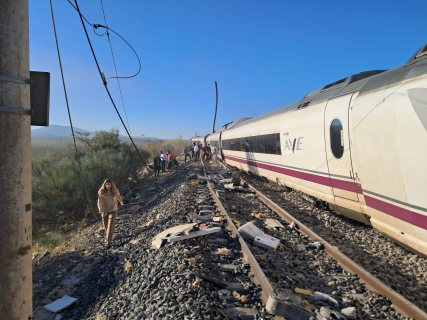

The first information about the circumstances of the Urda (Toledo) railway accident points to the trains involved, the AVE 2080 and the Iryo 6076, possibly having been traveling under the Lateral Signaling Blocking (BSL) system due to a fault in the LZB system. This circumstance has not yet been confirmed by Adif, although the possible incident in the signaling system and a subsequent human error appear as the main hypotheses about the origin of the accident, after Government sources indicated that the trains resumed circulation under human control following a failure of the automatic safety system.
According to the first information, the fault would initially have forced the convoys to stop, before the resumption of rail traffic was authorized through alternative circulation procedures. Always according to the Government, preliminary analyses point to an Adif operator possibly having made a mistake during this human control phase, a circumstance whose relation to the collision will have to be clarified by the official investigation.
A possible LZB fault before the accident
The LZB (Linienzugbeeinflussung) is a railway protection system that allows the circulation of trains to be continuously supervised and information to be transmitted directly to the equipment installed in the cabs, so that drivers receive indications about the authorized speed, braking distances and the conditions they must respect during the journey.
Its use on certain high-speed lines allows the convoys to circulate with constant supervision, especially important when the speeds reached make the distances needed to stop a train considerably greater than those usual in the conventional network.
The information known so far points to a fault in this system having forced the circulation conditions to be modified before the accident, although it has still not been specified when the failure was detected, how long it remained out of service or what measures those responsible for rail traffic adopted.
What the Lateral Signaling Blocking is and how it works
When the automatic protection system associated with the automatic block stops working properly, railway regulations provide for alternative procedures that allow traffic to continue under certain safety conditions, among them Lateral Signaling Block (BSL).
Unlike the usual regime of continuous supervision, this procedure uses the signals installed alongside the tracks to regulate the entry of trains into the different block sections, so that each new movement authorization depends on the safety conditions established for the corresponding section being met.
The Railway Traffic Regulation establishes that the sections must be free before authorizing certain movements and that the signals must prevent the entry of trains when incompatible movements may occur.
The use of this procedure is regulated and does not necessarily imply a loss of safety, although it requires applying the operational conditions provided for situations in which the usual automatic system is not functioning.
The Government points to a human error by Adif after the signaling failure
The first conclusions being handled by government sources point to the fact that an Adif operator could have made a mistake after a breakdown forced traffic to be managed under human control, a hypothesis that, if confirmed, would make it possible to explain why the safety mechanisms did not prevent the collision.
According to this version, the trains were initially stopped when the automatic signaling system failed and were later authorized to continue, although it is still not clear what specific instructions were transmitted or how the movement of both convoys was coordinated.
The possible failure would have occurred precisely during that phase of traffic resumption, when the decisions of the traffic controllers acquired special importance as the automatic supervision system was not available in its usual conditions.
High-speed service between Madrid and Andalusia interrupted
The accident between AVE 2080 and Iryo 6076 took place this Wednesday, October 28, in Urda (Toledo), on the Madrid-Andalusia high-speed line, where the collision caused several carriages to leave the track and part of the train to fall down an embankment.
The accident has left fatalities and numerous injured, while emergency services continue attending to those affected and the authorities work to clarify the circumstances of the collision.
Adif communicated the suspension of rail traffic between Madrid and Andalucía after reporting "an impact between two trains", with no official forecast at the moment to restore service.
The investigation will have to determine whether the possible failure of the LZB forced a change in the circulation regime and whether, during the subsequent management, the human error pointed to by the first government reports occurred.