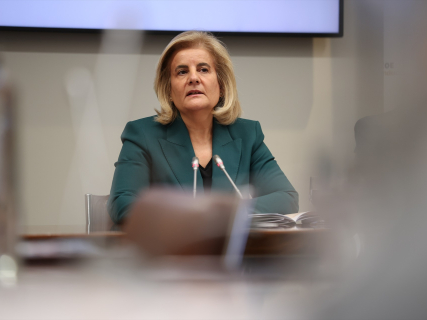
The former minister Fátima Báñez was traveling on one of the trains that were involved in the accident in Urda (Toledo) and has not been located

The president of the CEOE Foundation was traveling on the derailed Iryo train this Wednesday

EuropaPress 7158368 presidenta fundacion ceoe fatima banez presentacion edicion informe cash

EuropaPress 7158368 presidenta fundacion ceoe fatima banez presentacion edicion informe cash

Add DEMÓCRATA to Google

Ask FREN

Published

Last updated

1 minute

Most read

Elecciones 29N · Encuestas

La media de las encuestas

Media a 27 de octubre de 2026 · 15 institutos

  • PP31,0 %
  • PSOE27,3 %
  • Vox18,9 %
  • Sumar6,3 %
  • Podemos2,9 %
  • ERC2,3 %
010203040ene 2024jul 2024ene 2025jul 2025ene 2026jul 2026

Media del último estudio de cada instituto en 30 días y su evolución semanal desde el 23J. Partidos con al menos un 2 %.

Todas las encuestas

Elecciones generales del 29 de noviembre · Demócrata

The former minister Fátima Báñez was traveling on one of the trains involved in an accident this Tuesday in Urda (Toledo) and has still not been located.

According to what sources close to the former minister have confirmed to DEMÓCRATA, Báñez was traveling on the derailed Iryo train shortly before 9:00 a.m. this Wednesday.

Báñez was Minister of Employment and Social Security during the two governments of Mariano Rajoy, between December 2011 and June 2018. After the motion of no confidence that made Pedro Sánchez president, she left politics and began to develop her business activity.

In December 2019 she joined the Board of Directors of Laboratorios Rovi as an independent external director, and in April 2020 she joined the board of trustees of the Fundación CEOE, which she chairs.

More key points, information and questions with FREN

AI-GENERATED CONTENT

What are the next steps in the investigation of the Urda railway accident?

The next steps in the investigation of the Urda railway accident are to document the evidence at the scene, reconstruct the movement of both trains, and verify how the signaling, protection systems, and brakes acted. As of October 28, the causes remain undetermined: possible human error is a provisional hypothesis, not a conclusion. It is important to distinguish the announced proceedings from the technical checks that must clarify what happened.

1. Complete the judicial proceedings and the report

According to information published by Faro de Vigo, the judicial investigation is led by the Court of First Instance and Instruction number 1 of Orgaz. The Civil Guard will document the position of the trains and wagons, the signals, possible brake marks, and other indications of the scene.

This work includes technical images, aerial videos, and testimonies from survivors. At the same time, specialists in biological identification and DNA participate in identifying the deceased, supported by a mobile morgue from the UME. These are immediate actions accompanying the investigation while the emergency device continues.

2. Reconstruct what happened before the impact

The core of the analysis will be to establish a verified chronology. As explained by Demócrata about the LZB system, it must be clarified why the Iryo was at the point where it was hit and whether it was stopped or moving slower than the AVE.

Data from onboard equipment and traffic control systems will allow verification, among other aspects:

  • The speed of the AVE in the moments before the collision.
  • The movement authorization it had and the indications received in the cabin.
  • The moment the brakes were applied and the train's response.
  • Possible alarms, communication losses, or automatic interventions.

These are necessary checks to reconstruct the accident; they should not be presented as results already obtained or as proceedings with an announced completion date.

3. Examine train detection and automatic protection

Another decisive issue will be to verify whether the installations correctly detected track occupancy and what restrictions they transmitted to the train approaching from behind. The investigation must also determine which protection system was effectively active at that point.

The LZB continuously monitors speed and authorized circulation conditions. However, detecting the occupancy of a section and transmitting restrictions to the onboard equipment are different functions. Therefore, it will be necessary to distinguish between a possible anomaly in the infrastructure, communications, train equipment, braking, or railway operation. It is not confirmed that any of these elements failed.

4. Contrast hypotheses and communicate progress

Initial information points to Adif reviewing its systems and reconstructing the sequence of circulation and signaling. The actions of the drivers and traffic regulation personnel must also be examined, but a rear-end collision does not automatically attribute the cause to a person.

The Cadena SER information presents human error as a hypothesis pending verification. Meanwhile, Demócrata covers the Transport Ministry's appearance to report on the accident.

There is no specific timeline for the conclusions of Urda in the sources consulted. The next substantive advance will be to have a reconstruction supported by evidence, not just a preliminary explanation.

What are the competencies of the president of the CEOE Foundation according to its statutes?

According to the Statutes of January 2023, the president of the CEOE Foundation has functions of representation, convening and directing the meetings of the Board of Trustees, and executing its agreements. Additionally, they may exercise the powers that this body validly delegates to them. The essential distinction is that the president does not replace the Board: the governance and administration of the Foundation correspond to the collegiate body.

President's own competencies

The powers of the Presidency are specified in the following areas:

  • Represent the Foundation. They hold its representation before individuals and legal entities, authorities, and public or private entities. This function allows acting on behalf of the institution but must be distinguished from the power to decide on matters that the statutes reserve for the Board.
  • Convene the Board. They are responsible for calling its meetings. This is a competence linked to the functioning of the governing body, not an authorization to individually assume decisions that must be made by its members.
  • Preside over meetings. They exercise the Presidency of the Board when it meets and lead the sessions.
  • Direct and moderate debates. They organize the deliberation of the collegiate body. This power refers to conducting debates without transforming the Board's decisions into personal decisions of the president.
  • Execute agreements. They may carry out the agreements adopted by the Board and perform the acts necessary for their execution, within the legal and statutory framework.
Powers that may be received by delegation

These competencies are supplemented by those the Board decides to delegate. Therefore, to determine the scope of a specific action by the president, it is necessary to distinguish between their own statutory powers and the additional powers received through a delegation agreement.

Delegation does not eliminate the responsibility of the Board as the highest governing body. Nor can it include powers that legislation considers non-delegable. Consequently, the institutional representation of the president does not alone equate to having all governance and administration powers.

What corresponds to the Board

The statutes assign the representation, governance, and administration of the Foundation to the Board, with legal and statutory limitations. The institutional information from CEOE places the presidential functions within this governance framework.

Among the collegiate body's competencies are defining and supervising strategy and general lines of action; approving action plans, budgets, annual accounts, and activity reports; deciding on the organization and administration of resources; and making appointments as appropriate. Decisions on statute modifications, mergers, or dissolution, according to applicable legislation, also fall under its competence.

Therefore, the president should not automatically be attributed with individual approval of these matters. Their role in executing agreements presupposes that the decision has been made by the competent body.

How the Presidency is appointed

The initial statutory rule links the Foundation's Presidency to whoever holds the CEOE Presidency. However, that person may propose another to preside over the Foundation, provided the Board approves the proposal by a simple majority.

In short, the president represents, convenes, presides, moderates, and executes; the Board adopts the governance decisions that correspond to it. Any additional power of the president must be supported by a valid delegation, not solely by the title of the position.

What has been Fátima Báñez's political and professional trajectory before and after her time as minister?

The trajectory of Fátima Báñez García combines an initial business experience, nearly two decades in Congress, and a subsequent stage of advising and participating in business entities. Before becoming a minister, she specialized in economics and budgets within the Popular Party; after leaving the Government, she returned to the private sector and assumed the presidency of the CEOE Foundation.

Before the ministry: business and Andalusian politics

Born in San Juan del Puerto, Huelva, in 1967, she worked between 1993 and 1997 as Head of Strategy and Corporate Development of a family business group. Between November 1997 and June 2000, she belonged to the Board of Directors of Radio Televisión de Andalucía. Both experiences appear in her profile published by Rovi.

In parallel, she developed her career in the Andalusian PP. According to her institutional curriculum, she belonged to the Regional Executive Committee since 1996, was coordinator of the Presidency between 1997 and 2004, deputy secretary of Economy between 2004 and 2008, and deputy secretary of Economy and Employment between 2008 and 2011.

Congress: economic specialization

She was elected deputy for Huelva in 2000 and held the seat until 2019, during six consecutive legislatures. Her parliamentary trajectory before the ministry focused on economic matters:

  • 2000-2004: deputy spokesperson of the Economy and Finance Commission and spokesperson of the subcommittee on the statute of microenterprises and self-employed workers.
  • 2004-2008: Budget spokesperson for the Popular Parliamentary Group.
  • 2008-2011: deputy spokesperson of the group and coordinator of its economic area.

These responsibilities, recorded in the cited institutional curriculum, preceded her incorporation into Mariano Rajoy's Government.

The ministerial stage, 2011-2018

Báñez led the Ministry of Employment and Social Security between December 2011 and June 2018, during Rajoy's two governments. Her responsibilities covered employment, labor relations, Social Security, and pensions. Her mandate was especially associated with the 2012 labor reform and the management of the labor market during the crisis and subsequent recovery.

Additionally, between August and November 2016, she provisionally assumed the functions of Health, Social Services, and Equality, combining them with Employment. The Junta de Andalucía's review confirms both ministerial periods.

After the Government: transition and business activity

After Rajoy left the Executive in June 2018, she continued in Congress and chaired the Foreign Affairs Commission between 2018 and 2019. At the end of her parliamentary stage in 2019, she began working as a consultant and business advisor.

  • CEOE and its foundation: in July 2019, she joined as an advisor to Antonio Garamendi. She entered the CEOE Foundation's board in April 2020 and assumed its presidency in July. Her activity is linked to employment, training, inclusion, and corporate social commitment.
  • Rovi: she joined in December 2019 as an independent external director; shareholders approved her reelection in June 2024.
  • Energy sector and advising: she was an independent director of Iberdrola Mexico from September 2020 until approximately mid-2022; in July 2022, she was proposed for Avangrid. She has also advised the board of Incarlopsa.

Her subsequent activity includes the presidency of the EY-Sagardoy Talent and Innovation Institute, cited by the Madrid City Council in 2024. Although she left elected positions, she maintained ties with the PP environment as a member of the advisory council of Reformismo21, according to Demócrata.

Play

Test your knowledge with FREN!

How much do you know about this topic? Answer the following 3 questions.

What position does Fátima Báñez currently hold?

Question 1 of 3

In which years was Fátima Báñez Minister of Employment and Social Security?

Question 2 of 3

Which train suffered the accident in which Fátima Báñez was traveling?

Question 3 of 3