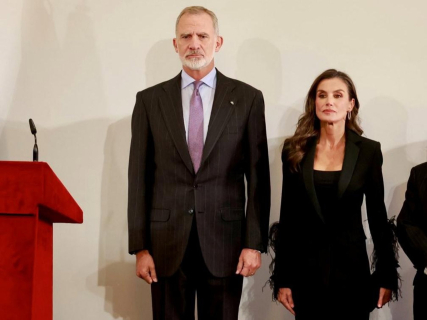
The King and Queen visit at Toledo Hospital the injured from the Urda railway accident

The King and Queen will go to the Hospital de Toledo to visit the injured from the collision between an AVE and an Iryo in Urda, with 53 people still hospitalized.

fotonoticia 20261009143934 1920

fotonoticia 20261009143934 1920

Add DEMÓCRATA to Google

Ask FREN

Published

Last updated

1 minute

Most read

Elecciones 29N · Encuestas

La media de las encuestas

Media a 27 de octubre de 2026 · 15 institutos

  • PP31,0 %
  • PSOE27,3 %
  • Vox18,9 %
  • Sumar6,3 %
  • Podemos2,9 %
  • ERC2,3 %
010203040ene 2024jul 2024ene 2025jul 2025ene 2026jul 2026

Media del último estudio de cada instituto en 30 días y su evolución semanal desde el 23J. Partidos con al menos un 2 %.

Todas las encuestas

Elecciones generales del 29 de noviembre · Demócrata

The Kings are scheduled to travel this Thursday to the University Hospital of Toledo to visit those injured in the Urda railway accident, according to Zarzuela.

The spokesperson for the Government of Castilla-La Mancha, Esther Padilla, has confirmed that the number of people hospitalized in different centers in the region remains at 53, of whom 15 remain in Intensive Care Units (ICU), as a result of the railway disaster recorded this Wednesday after the collision of an AVE train with an Iryo.

In her statement, she detailed that 15 people continue to be admitted to the hospital in Ciudad Real, 36 in the Mancha Centro of Alcázar de San Juan, 41 in the University Hospital of Toledo, 13 in Manzanares, 4 in Valdepeñas and one more in Albacete.

The Royal House has likewise indicated that the Kings have decided to cancel their presence at the presentation of the 24th edition of the Dictionary of the Spanish Language, which was scheduled for this Friday in Madrid.

The King’s message after the disaster

King Felipe VI conveyed "the condolences, support and affection" of the Royal House at a moment "so hard and so difficult" from Bétera (Valencia), where he was to attend the "GRIFO 2026" exercise of the Valencia NBQ Defense Regiment no 1. Maneuver field of the Jaime I Military Base.

In Bétera, the monarch was informed of "the news of the terrible accident of the AVE near Toledo". "The first thing is to lament the terrible accident with apparently the high number of fatalities and many injured. I know that they are in the full process of handling the emergency and are recovering and analyzing all the circumstances," he declared before the media.

Felipe VI indicated that he was able to hold a conversation with the president of Cartilla-La Mancha, Emiliano García Page. After the accident, Zarzuela decided to reduce the schedule planned at the Bétera barracks to facilitate the King’s return as soon as possible.

More key points, information and questions with FREN

AI-GENERATED CONTENT

What are the powers of the King of Spain in emergency situations according to the Constitution?

In the Spanish Constitution, the King has a primarily symbolic and moderating role, also in emergency situations. He does not politically direct the response, but he does intervene at key moments in institutional functioning. His powers derive from various provisions, especially articles 56 to 65 and the rules on states of crisis (art. 116 CE).

1. Head of State and moderating function

Article 56 of the Constitution establishes that the King is the Head of State, symbol of its unity and permanence, and that he “arbitrates and moderates the regular functioning of the institutions.” In an emergency situation (disaster, health crisis, serious public order disruption, etc.), this mainly implies:

  • Being the institutional reference of State continuity, even when the Government or the Cortes face serious tensions.
  • Publicly supporting the institutions managing the crisis (Government, Autonomous Communities, armed and security forces), reinforcing citizen confidence.
  • Carrying out intense representative activity (messages to the nation, visits to affected areas, audiences with authorities and experts), always without directing political action or replacing the Government.

2. Sanction and promulgation of emergency regulations

Although the King does not decide the specific emergency measures, he does formally intervene in key regulations:

  • Royal decree-laws (art. 86 CE): in situations of extraordinary and urgent need, the Government may issue decree-laws. Once approved by the Council of Ministers, the King sanctions and promulgates them, allowing their immediate publication and entry into force.
  • Organic and ordinary laws: if the response to the emergency involves legal reforms (for example, in matters of citizen security, public health, or civil protection), the King also sanctions and promulgates those laws once approved by the Cortes Generales.
  • In all cases, the political decision corresponds to the Government and Parliament; the King's intervention is a due act, subject to governmental countersignature.

3. States of alarm, exception, and siege (art. 116 CE)

The specific constitutional regulation of emergencies is in article 116, which provides for three types of exceptional states: alarm, exception, and siege. The King's role here is essentially formal but legally necessary:

  • State of alarm: declared by the Government by royal decree, reporting to the Congress of Deputies. The decree establishing or extending it is a Government act, but formally it is the King who signs it (countersigned by the Prime Minister), just like other royal decrees.
  • State of exception: must be previously authorized by the Congress. Once the Government decides and the Congress authorizes it, it is also formalized by royal decree signed by the King and countersigned by the Government.
  • State of siege: declared by the Congress, at the exclusive proposal of the Government. Again, formalization is through a royal decree with the King's signature, but the decision power is parliamentary-governmental.

In none of these three states does the King take the initiative or set the content of the measures. His function is to give the final legal form to the decisions of the executive and legislative powers.

4. Supreme command of the Armed Forces

Article 62.h) CE assigns the King the supreme command of the Armed Forces. In situations of serious security crisis, this element mainly has a symbolic and representative meaning:

  • Operational command and strategic direction correspond to the Government and, within it, to the Prime Minister and the military chain of command.
  • The King acts as an institutional reference for the Armed Forces, especially relevant in emergencies where they are deployed for civil protection, border control, surveillance, or maintenance of order.

5. Countersignature and absence of political responsibility

An essential note: article 64 CE establishes that all acts of the King must be countersigned by the Prime Minister or the competent ministers, who assume political and legal responsibility. The King is inviolable and not responsible (art. 56.3 CE), also in emergency situations.

This means that, even in the most critical moments, his formal decisions always depend on the Government's countersignature; he cannot act autonomously nor impose his own political direction in crisis management.

6. Summary

In short, in emergency situations the Constitution grants the King of Spain powers mainly of a formal and symbolic nature:

  • Represent the unity and continuity of the State.
  • Arbitrate and moderate the regular functioning of institutions.
  • Sanction and promulgate regulations (including decree-laws and exceptional measures) approved by Government and Cortes.
  • Sign royal decrees that formalize states of alarm, exception, and siege.
  • Exercise the symbolic supreme command of the Armed Forces.

The effective direction of the emergency response always corresponds to the Government and Parliament, which are the politically responsible bodies.

Could you explain with real examples how the King has intervened in states of alarm or recent crisis situations? What constitutional differences exist between the state of alarm, exception, and siege and what rights can be limited in each? How does the King's role in emergencies differ from that of other heads of state in European parliamentary monarchies?

What education and political background does Esther Padilla, spokesperson of the Government of Castilla-La Mancha, have?

Esther Padilla Ruiz holds a degree in Legal and Social Sciences from the University of Castilla-La Mancha and has a political career combining municipal, regional, and national responsibilities. Since July 2023, she has been the spokesperson counselor of the Government of Castilla-La Mancha, presided over by Emiliano García-Page. Her career also includes leadership and communication roles within the PSOE.

Academic background

According to her official curriculum, she obtained her degree in Legal and Social Sciences in 1999. She was born in 1975 and her public activity has been especially linked to Toledo and the Castilla-La Mancha Administration.

The sources consulted do not detail other official qualifications or a prior private professional career. Therefore, it is advisable to distinguish her university education from her subsequent experience: this has mainly developed in public management, political representation, and institutional communication.

From municipal politics to regional management

Her first institutional stage was as a councilor of the Toledo City Council between 1999 and 2003. During that period, she also began her path in the regional Government, where she successively assumed three general directorates:

  • Youth, between 2001 and 2007. This was her first leadership responsibility in the regional Administration and partially coincided with her time as councilor.
  • Social Action and International Cooperation, between 2007 and 2011. Her career thus moved from the youth field to areas of social intervention and cooperation.
  • Institutional Promotion, between 2015 and 2019. This responsibility preceded her incorporation into the Congress and is part of her experience in the institutional field of the regional Executive.

These positions appear in her curriculum published by the Transparency Portal. The sequence shows that her arrival at the spokesperson role was not her first experience in the regional Government: she had held leadership responsibilities during different previous stages.

Member of Congress

Between April 2019 and July 2023 she was a PSOE deputy in the Congress, during the XIII and XIV legislatures. Her national parliamentary experience thus developed in the Lower House.

In the final part of that stage, she took on an additional responsibility: she was deputy spokesperson of the Socialist Parliamentary Group between September 2022 and July 2023. This role added parliamentary coordination and communication experience to her previous path in the regional Administration. Her term as deputy ended with her incorporation into the Castilla-La Mancha Government, according to the institutional curriculum.

Responsibilities within the PSOE

Alongside her public offices, Padilla has held organic functions — that is, internal party responsibilities — both in Toledo and Castilla-La Mancha:

  • Her trajectory includes the Regional Executive Commission of the PSOE since 2000, with responsibilities related to social movements.
  • She was Communication Secretary and regional spokesperson between 2008 and 2012.
  • She served as Communication Secretary and spokesperson of the PSOE provincial branch in Toledo between 2012 and 2016.
  • Since 2016, she has been deputy secretary general and provincial spokesperson, according to her official biography.
Her current responsibility

Since July 2023, she leads the Spokesperson Ministry. Her central function is to communicate the agreements and positions of the Council of Government and maintain the Executive's relationship with the media.

Overall, her profile combines legal and social education, regional management, parliamentary experience, and sustained spokesperson responsibilities. Political communication is a recurring thread in her career, both within the PSOE and in institutions.

What legal requirements exist for the Royal Household to cancel scheduled official acts?

No specific legal procedure has been identified in the sources consulted that the Royal Household must follow to cancel any scheduled official act. This does not mean that all cancellations lack requirements: it is necessary to distinguish between modifying an institutional agenda and failing to carry out a legally binding act.

The fundamental distinction: agenda and legal obligation

The expression "official act" can cover different situations. A reception, a visit, or an announced attendance do not necessarily raise the same issue as an act linked to the exercise of a constitutional function. Therefore, the official nature of the event alone is not enough to determine what requirements its cancellation demands.

It is also advisable to separate three decisions: canceling the entire event, postponing it, or only withdrawing the participation of a Royal Family member. In an event organized by another institution, modifying that participation does not necessarily mean canceling the event. Identifying who organizes and what has been decided is essential to analyze its consequences.

What requirements must be verified?

To legally assess a specific cancellation, the relevant questions would be the following. These are analysis criteria, not a list of procedures whose general requirement has been established:

  • Nature of the act. It must be determined whether it is a representative activity or if there is a legal obligation to perform a specific act. Changing the schedule does not by itself eliminate an obligation established by a rule.
  • Competence to decide. It must be distinguished between managing the Royal Household's participation and making decisions that correspond to the organizer, another institution, or a public authority.
  • Existence of deadlines. If the act is subject to a legal deadline, the issue is not only how to announce its cancellation but how to fulfill the obligation within the deadline or through the corresponding mechanism.
  • Commitments with third parties. Suspension may have consequences on contracts, reservations, services, or organizational commitments. These consequences must be examined separately from the institutional decision to attend or not.
  • Particular conditions of the event. Organizational agreements, access conditions, and security measures may introduce specific obligations not deduced solely from its inclusion in an agenda.
Is justification, notice, or publication of a resolution necessary?

No general rule has been found that imposes, for any cancellation, a fixed cause, minimum prior notice, or mandatory publication in the Official State Gazette (BOE). Nor has a universal requirement for Government authorization been identified. These absences should be understood as limited to the sources consulted, not as a statement that such requirements could never exist.

It is important to differentiate institutional communication from legal obligation. Informing the organizer, guests, or the public may be necessary to manage the change; but it should not automatically be presented as a legal procedure with specific form and deadline without identifying the rule or commitment that requires it.

Practical conclusion

The legally prudent answer is that not all official acts can be attributed a single cancellation regime. To resolve a specific case, the announced act, its organizer, the planned participation, and any applicable normative or contractual obligation are needed. What matters is not only that it was scheduled but what legal effects its celebration had and what its suspension produces.

Play

Test your knowledge with FREN!

How much do you know about this topic? Answer the following 3 questions.

To which hospital are the Kings scheduled to go to visit the injured from the Urda train accident?

Question 1 of 3

Which official event did the Royal House cancel after the train accident?

Question 2 of 3

How many people remain hospitalized in Intensive Care Units (ICU) after the accident?

Question 3 of 3