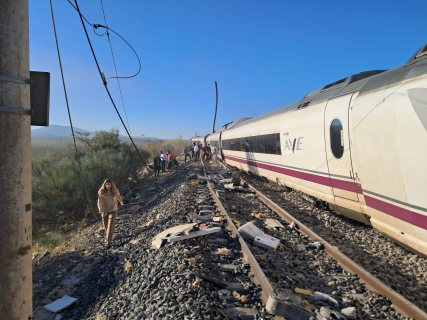
The Railway Union sees the Toledo accident as "very strange" because of the safety of the line

The spokesperson of the Railway Union, Rafael Escudero, expresses his surprise at the collision of two high-speed trains in Urda (Toledo) and points out that the safety systems should prevent an accident of this kind. The causes of the accident remain under investigation

HVtIvNmXkAEBVhG

HVtIvNmXkAEBVhG

Add DEMÓCRATA to Google

Ask FREN

Published

Last updated

2 minutes

Most read

Elecciones 29N · Encuestas

La media de las encuestas

Media a 27 de octubre de 2026 · 15 institutos

  • PP31,0 %
  • PSOE27,3 %
  • Vox18,9 %
  • Sumar6,3 %
  • Podemos2,9 %
  • ERC2,3 %
010203040ene 2024jul 2024ene 2025jul 2025ene 2026jul 2026

Media del último estudio de cada instituto en 30 días y su evolución semanal desde el 23J. Partidos con al menos un 2 %.

Todas las encuestas

Elecciones generales del 29 de noviembre · Demócrata

Rafael Escudero, spokesperson for the union, said this Wednesday that in the Urda area there is no commercial stop and that the control systems should prevent one train from catching another. The collision between a Renfe AVE and an Iryo has caused fatalities and has forced the suspension of high-speed traffic between Madrid and Andalucía.

The spokesperson for the Railway Union, Rafael Escudero, has expressed his surprise at the circumstances of the railway accident registered in Urda (Toledo), where two high-speed trains, one from Renfe and another from Iryo, have collided early in the morning. In statements to the program Espejo Público, on Antena 3, Escudero has described the crash as "very strange" because of the characteristics of the section in which it occurred and because of the safety systems that supervise railway traffic.

The union representative has explained that there is no commercial stop at that point and that traffic is supervised in real time. According to him, the trains have information about the condition of the track and the protection systems should intervene when they detect a risk situation, such as the presence of another convoy.

Escudero has indicated that, if it is confirmed that one of the trains was stopped and the other hit it from behind, it will be necessary to determine why the safety mechanisms did not prevent the collision. This is a preliminary assessment by the union, since the causes of the accident have not yet been established.
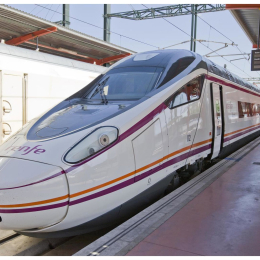
An AVE would have hit an Iryo train from behind

According to the first indications communicated by the Ministry of Transport and Sustainable Mobility, a Renfe AVE would have hit an Iryo train from behind, causing the derailment of two carriages of this last convoy.

The accident occurred at 8.54 a.m., according to the notice received by the 112 Emergency Service of Castilla-La Mancha. Adif has located the incident at kilometer point 118 of the high-speed line, between Mora and Orgaz and Urda, in the province of Toledo.

The collision has caused the fall of two carriages down an embankment and has forced the interruption of railway traffic between Madrid, Ciudad Real and Andalucía.

The emergency services have mobilized firefighters, medical teams, three medical helicopters and mobile intensive care units to attend to the victims and participate in the rescue efforts.

The causes of the accident, pending investigation

The statements of the spokesman for the Railway Union refer to the functioning of the systems of supervision and protection of traffic, whose performance must be examined during the investigation.

For the moment, it has not been determined why the collision between the two trains occurred or whether there was any technical, operational, or signaling incident.

The investigation must clarify the circumstances of the movement of both convoys, the position they occupied before the crash, and the functioning of the safety mechanisms.

While emergency work continues, the authorities have begun to communicate provisional casualty figures. Emergencias de Castilla-La Mancha has reported at least 39 dead, according to the latest update released by Antena 3 at 10.16 hours. The figure may vary as rescue work progresses.

More key points, information and questions with FREN

AI-GENERATED CONTENT

What is the status of the parliamentary or judicial investigation into the Urda railway accident, and what are the next planned steps?

As of October 28, 2026, the clarification of the Urda railway accident is in an initial phase: Adif is analyzing its systems and the sequence of events, but no cause has been confirmed. The consulted sources do not yet show the public identification of an investigating court, formally investigated persons, or a specific parliamentary commission with an approved schedule. It is important to distinguish announced actions from steps that are only considered foreseeable.

Status of the judicial investigation

No official communication has been found identifying the judicial body that has taken over the proceedings, the case number, or the crimes that might be investigated. There are also no scheduled judicial statements, precautionary measures, arrests, or confirmed charges. This describes the publicly available information; it does not allow us to state that no actions are being carried out.

Initial reports point to a possible collision of a Renfe AVE with an Iryo train, following an incident in signaling and the application of an alternative circulation procedure. The possible erroneous authorization from the control center and possible human error are preliminary journalistic hypotheses, not judicial or expert conclusions. This is how the explanations collected by El Confidencial should be read.

According to information from EFE about the causes, Adif is reviewing the operation of its systems and reconstructing what happened. That operational analysis does not, by itself, equate to a judicial resolution nor does it establish individual responsibilities.

Status of the parliamentary investigation

The consulted sources do not show the establishment of a specific commission on Urda in the Congress, the Senate, or the Cortes of Castilla-La Mancha. Nor has an opening agreement accompanied by a work plan, a list of witnesses, or dates to hear public and railway officials been found.

It is advisable to avoid confusion: the hearings held months earlier in the Senate's Railway Network Status Investigation Commission dealt, among other matters, with the accidents of Adamuz and Gelida. The official Senate information from April 27 confirms those actions, but not an investigation of the Urda accident that occurred today. The court, complaints, or proceedings corresponding to Adamuz should not be transferred to Urda either.

Next steps: what has been announced

The specific known step is to continue Adif's analysis. No date has been published for its results, for a definitive technical report, or for a specific parliamentary hearing. The investigation must clarify the position and circulation of both trains, the orders transmitted, and the response of the protection mechanisms.

As foreseeable actions, but without confirmed schedule or judicial order, the consulted information points to:

  • Collecting and cross-checking communications between the drivers and the control center, movement authorizations, and signaling data.
  • Examining the train recorders, their speed, braking, and the operation of the LZB protection system.
  • Conducting inspections and expert assessments of vehicles and infrastructure, differentiating technical, operational failures, and contingency protocols.
  • If a criminal cause is publicly confirmed, specifying the proceedings and possible statements agreed upon by the judicial body.

In short, there is not yet a publicly closed parliamentary or judicial itinerary. The next verifiable milestone will be a communication identifying judicial actions, publishing technical results, or formally announcing a parliamentary control mechanism. Until then, attributing blame or anticipating conclusion dates would go beyond what is known.

What are the competencies and functions of the spokesperson of the Railway Union according to Spanish labor regulations, and what has been their professional background?

Spanish labor legislation does not assign specific competencies to the position of spokesperson of a union: their powers depend on the statutes and the mandate received from the organization. In the Railway Union (SF-Intersindical), the consulted statutes place legal and public representation in the Federal Secretariat. Regarding the person who exercises that spokesperson role, Demócrata identifies Rafael Escudero on October 28, 2026, but the consulted sources do not allow reconstructing his complete professional background.

Legal framework and scope of the position

The general framework includes Article 28.1 of the Constitution, which recognizes union freedom; the Organic Law 11/1985, on Union Freedom; the Workers' Statute; and, for participation in prevention, Law 31/1995 on Occupational Risk Prevention. Applicable collective agreements specify rights and participation mechanisms in each railway company.

These regulations govern the action of unions and workers' representatives but do not automatically make the person speaking to the media a union delegate, member of the works council, or authorized negotiator. The union's own documentation refers to the Law on Union Freedom as the basis of its organization.

Functions within the Railway Union

According to the consulted federal statutes, approved at the fifth Federal Congress in May 2017, legal and public representation corresponds to the Federal Secretariat, which acts collegially according to the agreements of the Plenary of Representatives. That text does not configure a state spokesperson as an independent position with its own powers.

The distinction matters because management functions belong to the collective body, not necessarily to the person who appears publicly. Among the powers assigned to the Secretariat are executing federal decisions, coordinating union action, and exercising the representation powers provided in the statutes.

Within that framework, a person designated as spokesperson may carry out these tasks:

  • Public communication: conveying the union's official positions and explaining its demands, agreements, or mobilizations.
  • Interlocution: appearing before media and maintaining contacts with companies, administrations, or other organizations when authorized.
  • Explanation of labor issues: communicating positions on employment, working conditions, and railway safety, according to the union's stance.

However, being a spokesperson alone is not enough to sign collective agreements, assume legal obligations on behalf of the union, or replace its governing bodies. Such actions require the corresponding representation or authorization. The rights to information, consultation, and participation of union delegates or elected employee representatives cannot be automatically attributed to the spokesperson either.

Identity and professional background

The most recent information found identifies Rafael Escudero as spokesperson of the Railway Union. This is reported by a Demócrata news article dated October 28, 2026, which covers his appearance on the program Espejo Público on Antena 3 about a railway accident in Toledo.

That appearance confirms he performs a public representation and union communication role. However, the news does not detail his railway position, companies he has worked for, professional seniority, training, previous union responsibilities, or date of appointment as spokesperson.

Therefore, a sufficiently documented professional biography is not available in the consulted sources. What is verifiable is his public identification as spokesperson; it would not be rigorous to deduce from this a specific professional category or technical experience. Furthermore, the journalistic reference does not replace an appointment nor does it allow specifying what powers the union has delegated to him.

What legal and technical requirements must protection and control systems meet on Spanish high-speed lines?

Protection and control systems on Spanish high-speed lines must demonstrate safety, interoperability, and compatibility between train and infrastructure, in addition to obtaining the corresponding authorizations. Installing ERTMS alone is not enough: the safe integration of signaling, interlockings, communications, onboard equipment, operation, and maintenance must be demonstrated.

1. Applicable legal framework

The Spanish reference is Royal Decree 929/2020, on railway operational safety and interoperability, which incorporates Directives (EU) 2016/797 and 2016/798. Its requirements cover design, construction, commissioning, renewal, operation, and maintenance.

For control-command and signaling, the central European reference is Implementing Regulation 2023/1695, with its amendments and transitional provisions: it contains the technical specification for interoperability, or TSI, applicable to trackside and onboard equipment. It is complemented by relevant national rules, the Railway Traffic Regulation approved by Royal Decree 664/2015, and Adif's applicable project specifications.

2. Automatic protection and compatibility

The ETCS component of ERTMS protects against overspeed and exceeding authorized limits. Depending on the installed configuration, it must receive movement authorizations, determine the train's position, supervise speed and distance, and order braking when appropriate.

  • Compatibility: versions and performance of trackside and onboard equipment, their interfaces, and system transitions must be justified.
  • Communications: in ETCS level 2, radio communication connects the train with the radio block center, which manages movement authorizations.
  • National systems: coexistence with ASFA requires defining transitions, priorities, and operating conditions in case of failures. ASFA is not equivalent to ETCS nor guarantees the same performance.

Spanish documentation requires expressly identifying the versions of ETCS and ASFA specifications, blockings, interlockings, train detection, and planned communications.

3. Functional safety of the installation

Interlockings must prevent incompatible routes, verify the position and locking of switches, and avoid authorizations without safe conditions. Track circuits or axle counters must provide reliable occupancy information. Interfaces with centralized control must also be verified.

The design must justify safe behavior in case of failures, data integrity, and diagnostic, access protection, and maintenance measures. CENELEC standards on reliability, availability, maintainability, and safety, software, electronics, and communications are common technical references; they do not replace legislation nor automatically assign the same safety integrity level to all equipment.

4. Evaluation and authorization

The commissioning dossier must include CE verification declarations, technical compatibility justification, and an evaluator's report accrediting safe integration. Significant changes require risk assessment according to the common method of Regulation (EU) 402/2013.

For ERTMS projects on track with ETCS or GSM-R, Article 113 of Royal Decree 929/2020 requires requesting approval of technical solutions from the European Union Railway Agency before tendering. This decision does not replace the commissioning authorization from AESF, which may establish conditions and usage limits.

5. Compliance during operation

Safety must be maintained through integration tests, preventive and corrective maintenance, competent personnel, and procedures for communication loss or failures. The administrator and railway company must manage their respective risks and coordinate interfaces. Authorized configuration and speed depend on the demonstrated performance of the whole, not only on the name of the installed system.

Play

Test your knowledge with FREN!

How much do you know about this topic? Answer the following 3 questions.

Where did the collision between Renfe's AVE and the Iryo train occur?

Question 1 of 3

What did the spokesperson of the Railway Union say about the safety systems in the accident area?

Question 2 of 3

What is the provisional number of fatalities reported after the Urda railway accident?

Question 3 of 3