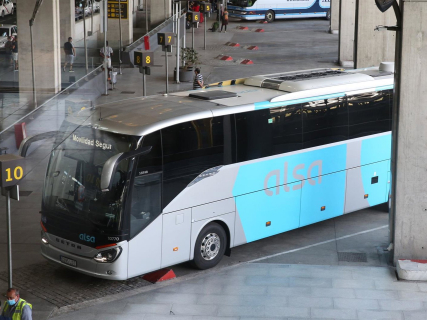

The Ministry of Social Rights, Consumption and the 2030 Agenda has opened a sanctioning file against a bus company for possible misleading practices in the information about the prices of its tickets and for applying alleged abusive clauses in refunds. The company, whose identity has not been disclosed, could be adding management fees in the final phase of the purchase and avoiding reimbursing them when a trip is canceled.
The investigation, initiated by the General Directorate for Consumption, focuses on two practices that directly affect travelers’ pockets. On the one hand, the known as drip pricing, or drip pricing, which consists of advertising an initial fare and adding mandatory costs once the customer has already advanced in the contracting process. On the other hand, the possible retention of management fees when a trip is canceled.
The Ministry recalls that the opening of the file does not constitute a firm penalty nor prejudge the outcome of the procedure.
The advertised price must be the final price
Consumer regulations establish that the amount announced at the start of an offer must include all mandatory costs the customer will have to assume. This includes the taxes and management, administration, distribution or processing expenses that apply.
The so-called Customer Service Services Law (Customer Service Law, Ley SAC) modified article 20.1.c of the General Law for the Defense of Consumers and Users to expressly establish that these expenses must be part of the final price from the start of the commercial communication.
Therefore, if a company advertises a ticket for 15 euros, but adds another three euros in mandatory management fees when reaching the payment screen, the initial price would not be reflecting the full cost of the service.
This does not mean that all add-ons are prohibited. Additional services that the consumer chooses voluntarily, such as certain extras, may have an independent cost. The difference is that mandatory expenses cannot appear unexpectedly at the end of contracting.
What happens if they cancel the trip and do not refund the fees?
The second aspect that Consumption is investigating is the possible lack of full refund of the amount paid by travelers when a trip is canceled.
According to the Ministry, the company would not be reimbursing the management costs associated with canceled tickets. The contractual clauses used to justify that retention could be abusive, in accordance with Articles 83 and 87 of the General Law for the Defense of Consumers and Users.
In these cases, it is advisable to keep the ticket, the payment receipt, and any communication from the company about the cancellation or the refund. If the amount received does not match what was charged, the consumer may request in writing a breakdown of the amount retained and claim the difference.
What documents to keep and how to file a claim
In the event of an unexpected additional charge or an incomplete refund, the first step is to gather evidence of the contracting. It is recommended to keep:
-
The initial offer: a screenshot showing the advertised price before entering personal data.
-
The final purchase summary: it should show the total amount, the added expenses, and the breakdown of concepts.
-
The payment receipt: the confirmation email, the ticket, and the bank charge.
-
The contracting terms: especially those relating to management fees, cancellations, and refunds.
-
Communications with the company: emails, customer service forms, and responses received.
With this documentation, the traveler can submit a claim to the company’s customer service and request the return of the amounts that they consider to have been charged improperly. It is advisable to do so in writing and keep a copy of the request.
If the company does not respond or the solution is not satisfactory, the consumer may go to the Municipal Office of Consumer Information (OMIC) in their locality or to the consumer services of their autonomous community. They may also request information about the possibility of appealing through the Consumer Arbitration System, provided that the company is affiliated with it or agrees to submit to it.
Up to one million euros in fines for possible infringements
The economic consequences provided for by regulations vary depending on the conduct being investigated. The practice of advertising prices without including mandatory expenses could result in fines of up to 100,000 euros or between four and six times the illicit profit obtained.
In the case of any possible abusive clauses related to refunds, the penalties could reach one million euros or fall between six and eight times the illicit benefit.
This is the second case file that Consumo opens this year for possible deceptive practices in the presentation of prices in the transport sector. The previous one, initiated during the summer, affected a company that marketed train and plane tickets. In both cases, the objective of the investigation is to determine whether consumers were provided with transparent information about the total cost before contracting.