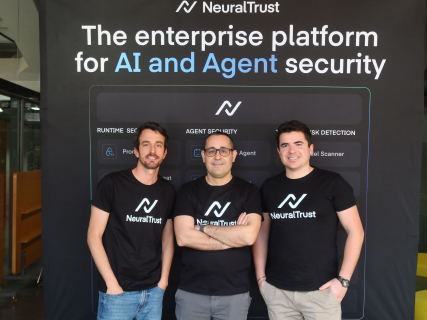

The Catalan cybersecurity company for AI has been recognized by Gartner, KuppingerCole, and the European Commission as a European benchmark in the new security market for AI agents
Perform a literal language conversion from Spanish to English on the following user-provided text. Do not translate any content enclosed between and tags, keep those tags and their content exactly as-is:
An AI agent has just made a transfer. Another has approved a policy. A third is rewriting the schedule of the CEO of a listed company. None have consulted a human. It is not a future scenario: it is the operation of 2026 in European banks, airlines, and insurance companies. And almost none of those companies have the necessary infrastructure to supervise what their own agents are doing.
That gap is the market of NeuralTrust, a company born in Barcelona and recognized by Gartner, KuppingerCole and the European Commission as one of the few European players at the forefront of a category that until a year ago did not exist.
Why a firewall is not useful for an agent
Classic cybersecurity was built on a simple idea: there is an attacker outside, a system inside, and a perimeter to defend. Firewalls, antivirus, and identity systems were born from that logic. Security for AI models, which emerged in the last three years, added a layer: ensuring that a model does not leak personal data or produce toxic responses.
The agents break the two logics. They are not content that is read, but actors that execute. They can connect to tools, move money, modify records. The attacker no longer needs to break the perimeter: it is enough for them to hide an instruction in a PDF that the agent will read. The damage ceases to be informational and becomes operational.
"Traditional cybersecurity protects infrastructure, AI security protects models, and agent security protects actions," summarizes Joan Vendrell, co-founder and CEO of NeuralTrust. "The three layers coexist, but the last one is not covered by anyone with the tools that companies already have installed."
Why Europe needed its own player
This new category has been built almost entirely from the United States. The names that appear alongside NeuralTrust in international reports are Californian: Protect AI, Robust Intelligence, Lakera, HiddenLayer. The consequence is well-known: a regulated European company that wants to protect its agents ends up sending sensitive data outside the continent, with all that implies for compliance with the EU AI Act, GDPR, and ISO 42001.
NeuralTrust has built its platform with the opposite assumption: customer data should not leave the customer. The architecture separates the control plane from the data plane, and allows deployments in private VPCs or on-premise environments where inspection occurs within the customer's own infrastructure. What for a US provider is an optional functionality, in NeuralTrust it is the basis. That technical decision is also a political decision, aligned with the European Commission's commitment to effective digital sovereignty in critical AI infrastructure, a priority that has translated into direct backing from the European Innovation Council.
What is already stopping
The platform's operational data describe the size of the problem better than any projection. NeuralTrust has blocked more than 15 million attacks against AI systems, monitors more than 6,000 applications in production, and has prevented estimated losses of $107 million for its clients. It detects threats with latencies below 10 milliseconds and covers more than 100 prompt injection techniques. Among its clients is already a good part of the Ibex 35 companies, with a prominent presence in banking, airlines, energy, insurance, and retail.
The company is not limited to detecting what is already known. Its research team has published the Echo Chamber Attack, an effective jailbreak technique against models like GPT-4, along with its detection system. Anticipating attackers, not reacting to them, is part of the model.
NeuralTrust in the spotlight
Leading analyst firms, such as Gartner, have included NeuralTrust in numerous reports, including their Market Guide for AI Gateways and the Market Guide for Guardian Agents. Other firms such as KuppingerCole, OWASP, Forrester, HFS, Omdia or Info-Tech also mention the Spanish company in their analyses of the AI security market. The European Commission supports it through the European Innovation Council. Added to this is the double award at South Summit Madrid 2025 and the Digital Horizons award at 4YFN of the Mobile World Congress 2026.
The question that every CISO will have to answer
Gartner anticipates that by the end of 2026 every CISO will have to account for their security strategy for AI agents. Today, 76% of enterprise AI initiatives lack specific measures and 29% of companies that have deployed generative AI have suffered a breach. The difference between a prepared organization and one that is not will cease to be a matter of efficiency and will become a matter of governance.
"We are at the moment when agent security stops being a technical conversation and becomes a key conversation in the boardrooms," concludes Vendrell. "That this conversation has a European answer matters."
About NeuralTrust
NeuralTrust is the leading platform in Europe for the security and governance of AI agents and applications based on language models. Founded in 2022 in Barcelona, with offices in London, New York, and soon, Germany, it already works with a good part of the Ibex 35 companies in sectors such as banking, airlines, energy, insurance, and retail. Recognized by Gartner, KuppingerCole, and the European Commission.
More information at https://neuraltrust.ai.