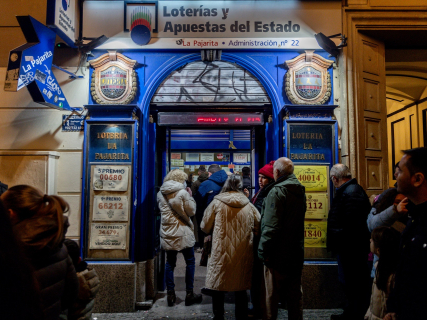
Draws of today Thursday, October 22: schedules of National Lottery, Bonoloto, Primitiva, EuroDreams and Daily Coupon

La Primitiva puts 40 million euros at stake and the National Lottery holds its weekly draw, with a first prize of 300,000 euros per series.

EuropaPress 7190192 gente comprando loteria sorteo extraordinario nino 29 diciembre 2029 madrid

EuropaPress 7190192 gente comprando loteria sorteo extraordinario nino 29 diciembre 2029 madrid

Add DEMÓCRATA to Google

Ask FREN

Published

Last updated

1 minute

Most read

Elecciones 29N · Encuestas

La media de las encuestas

Media a 21 de octubre de 2026 · 15 institutos

  • PP31,6 %
  • PSOE26,9 %
  • Vox18,7 %
  • Sumar6,3 %
  • Podemos3,1 %
  • ERC2,2 %
010203040ene 2024jul 2024ene 2025jul 2025ene 2026jul 2026

Media del último estudio de cada instituto en 30 días y su evolución semanal desde el 23J. Partidos con al menos un 2 %.

Todas las encuestas

Elecciones generales del 29 de noviembre · Demócrata

The draws of today Thursday, October 22 bring together five main events: National Lottery, Bonoloto, La Primitiva, EuroDreams, and the Daily Coupon of ONCE.

The largest jackpot corresponds to La Primitiva, with 40 million euros. The National Lottery holds its weekly draw on Thursdays, whose first prize is endowed with 300,000 euros per series.

The day is completed with Bonoloto, EuroDreams, and the Daily Coupon. Their results will be published after the respective draws are held.

Schedules and prizes of today's draws

  • National Lottery: 20:30 hours; first prize of 300,000 euros per series.
  • Bonoloto: 21:30 hours; jackpot pending confirmation.
  • La Primitiva: 21:15 hours according to the draw sheet published by SELAE; jackpot of 40 million euros.
  • EuroDreams: draw of this Thursday; first category prize of 20,000 euros per month for 30 years.
  • Daily Coupon of ONCE: 21:25 hours; main prize of 500,000 euros.

When the results will be known

The official results will allow checking the winning numbers, the complementary and the refund of Bonoloto and La Primitiva, the Dream number of EuroDreams, and the winning number and series of the Daily Coupon.

More key points, information and questions with FREN

AI-GENERATED CONTENT

What legal requirements must lottery and betting draws in Spain meet to be authorized?

In Spain, there is no single authorization for all draws and bets: the requirements depend on the type of activity, its territorial scope, and whether it is habitual or occasional. The main distinction is that state lotteries are reserved for certain operators, while bets can be operated with the corresponding licenses. The basic state framework is the Law 13/2011 on gambling regulation.

1. Determine the activity and the competent Administration

The proposal must first be legally classified: lottery, bet, raffle, or other modality. It must also be determined whether it corresponds to the state or regional scope. State activities are subject to the regime explained here; regional ones require reviewing the legislation of the corresponding community. Additionally, opening premises or installing participation equipment may require regional authorization, even if the operator has a state license.

2. Obtain the appropriate title before starting
  • State lotteries: their operation is reserved for the State Society of Lotteries and Bets (SELAE) and ONCE. A private company cannot organize a state lottery simply by requesting an ordinary betting license.
  • Habitual bets: require a general license and a specific license for each type of game. The modality must have prior regulation. Specific licenses last between one and five years and can be extended.
  • Occasional or sporadic games: require prior authorization and payment of the corresponding fees. If a month passes without notification of granting, the application is considered denied.

A foreign license does not authorize operation in Spain. The procedure is developed in Royal Decree 1614/2011.

3. Prove capacity, solvency, and guarantees

To access general licenses, the applicant must be a public limited company with the exclusive corporate purpose of organizing, marketing, and operating games. They must prove technical, economic, and financial solvency and comply with applicable establishment and representation conditions.

They cannot incur legal prohibitions, such as certain criminal records, sanctions, or insolvency situations. They must be up to date with their tax and Social Security obligations. Additionally, general licenses require economic guarantees, especially to cover prizes, sanctions, and fees; additional guarantees may be required for specific games.

4. Ensure transparency and security

The rules must be clear and truthful: the participant must know how to play, the conditions to win, and how and when they will collect. They must also be able to identify the operator, know the amounts bet, and file complaints.

Equipment and systems must meet applicable homologation requirements. In electronic gaming, identity, integrity of bets, confidentiality, traceability, and operation control must be guaranteed. Royal Decree 1613/2011 develops these technical requirements, with specific treatment for lotteries.

5. Protect participants and comply with tax obligations

Identification controls and prohibitions on participation by minors and excluded persons must be applied, along with responsible gaming measures, data protection, and prevention of fraud and money laundering. Operators cannot lend money to players. Advertising must respect legal restrictions and not present gambling as a way to social superiority or an alternative to effort.

Applicable fees and taxes must also be paid: there is no single rate for all modalities. State lotteries are not subject to the gambling activities tax, without this meaning a general exemption from any tax obligation.

Operating without the required title is a very serious offense. The initial authorization is also not enough: guarantees must be maintained and the conditions of the game and the granted title must be permanently fulfilled.

What are the functions and competencies of the State Society of Lotteries and Bets (SELAE)?

The State Society of Lotteries and Bets (SELAE) is the public company responsible for managing, operating, and marketing the state lotteries and bets assigned to it. Its function is to act as a game operator, not as the regulatory authority of the entire sector. To understand its competencies, it is useful to distinguish its business activity, its control responsibilities, and the limits of its powers.

Legal nature and scope of action

SELAE is a state commercial company whose capital fully belongs to the General State Administration and is attached to the Ministry of Finance. Its basic framework comes from Royal Decree-Law 13/2010, of December 3. Although it develops a business activity mainly governed by private law, it is subject to the public obligations corresponding to it in budgetary, accounting, patrimonial, contractual, and financial control matters.

The company itself explains this configuration on its pages about the company and its applicable regulations.

Operational and commercial functions

Its legal regime and functions mainly include the following activities:

  • Organize and operate state games. It manages products such as the National Lottery, including the Christmas and Niño draws, La Primitiva, Bonoloto, Euromillions, and El Gordo de la Primitiva. This function includes organizing draws and the necessary operations for their development.
  • Manage sports and horse racing bets. Its activity covers bets and prediction contests on sports results and other events, within its corporate purpose and the titles that enable its operation.
  • Market the games. It distributes its products through administrations and points of sale, as well as through electronic, computer, telematic, interactive, and audiovisual channels. Its corporate purpose also contemplates marketing outside Spain when appropriate and authorized.
  • Manage the commercial network. It establishes the operating conditions of its official network and maintains commercial relations with lottery administrations. This business dimension is reflected, for example, in the debate about commissions and digital sales covered by Demócrata.
  • Support the technical infrastructure. It develops and maintains the IT and operational means necessary to validate bets, distribute products, and settle games.
  • Manage results and prizes. It publishes official results and organizes the determination and payment of prizes according to the rules of each game, with the corresponding controls over operations and their documentation.
Security and compliance responsibilities

SELAE must balance marketing with security measures, transparency, data protection, and responsible gaming. Additionally, it is a subject obliged in matters of prevention of money laundering and terrorist financing: these responsibilities do not equate to supervisory powers over other operators.

Prize control is a particularly relevant responsibility. The parliamentary resolution published in 2025, regarding the audit of the 2022 fiscal year, urged improving fraud detection, payment documentation, participation rules, and suspicious operation communications. These are control improvement requirements, not new regulatory competencies.

What does not correspond to SELAE

SELAE does not regulate all gambling in Spain nor does it grant general market authorizations by itself. Regulation, authorization, inspection, and sanction correspond to the competent public authorities, especially the Directorate General for Gambling Regulation at the state level. The reservation of certain lotteries should not be confused with a monopoly over any gambling modality: SELAE operates within reserved games and the licenses or authorizations applicable to it.

What regulations govern the distribution of prizes and the taxation of lotteries in Spain?

In Spain, the distribution of prizes and the taxation of lotteries are regulated in two distinct regulatory blocks: gambling legislation and the rules of each modality determine how prizes are awarded and paid; tax legislation establishes how they are taxed. There is no single rule that sets the same distribution for all lotteries.

1. General framework of lotteries

The reference norm is Law 13/2011 on gambling regulation. Its first additional provision designates the State Society of Lotteries and Bets (SELAE) and ONCE as operators of reserved state lotteries. It also contemplates exceptional authorizations for charitable, sporadic lotteries organized by non-profit entities.

The second additional provision maintains ONCE's singular regime, which includes Royal Decree 358/1991 on the reorganization of the organization, Royal Decree 1336/2005, and its specific provisions. Autonomous communities retain their competencies over games within their territorial scope.

2. Awarding and payment of prizes

The categories, percentages, and distribution conditions depend on the specific game. For example, Royal Decree 1360/1985 authorizes the operation of La Primitiva Lottery; its contests and modalities have specific rules, such as the Resolution of October 16, 2000. To resolve a case, the applicable version for the draw must be consulted, including subsequent modifications.

The Resolution of November 27, 2001 regulates payment aspects: it contemplates the payment of minor prizes through the commercial network and major prizes through financial entities managing central accounts. This payment operation should not be confused with the rules determining how much corresponds to each prize category.

3. Taxation of individuals

The central piece is the thirty-third additional provision of Law 35/2006 on Personal Income Tax (IRPF). Law 16/2012 introduced, from January 1, 2013, the special tax on certain prizes.

  • It covers prizes from SELAE, regional entities, Spanish Red Cross, and authorized ONCE modalities, as well as certain equivalent bodies of the European Union and the European Economic Area.
  • The rate is 20% on the amount exceeding the exempt amount, not on the entire prize.
  • It is required separately for each winning ticket, fraction, coupon, or bet and is accrued upon payment.
  • The prize is not incorporated into the ordinary taxable base of the IRPF. If withholding is correctly applied, no additional self-assessment of the tax is required.

The initial exemption of 2013 was later modified by Law 6/2018; therefore, the original threshold of 2,500 euros should not be used as the current reference.

4. Shared prizes and non-residents

When there are several co-owners, the exemption and taxable base are proportionally divided according to their shares: the exemption is not multiplied by the number of persons.

For non-residents without a permanent establishment, the fifth additional provision of the consolidated text of the Non-Resident Income Tax (IRNR), approved by Royal Legislative Decree 5/2004, establishes an equivalent regime and allows refunds when a double taxation agreement applies.

Finally, Order HAP/70/2013 regulates forms 230 and 136; Order HAP/2368/2013 regulates the annual withholding summary through form 270.

Play

Test your knowledge with FREN!

How much do you know about this topic? Answer the following 3 questions.

What is the largest jackpot offered in the draws on Thursday, October 22?

Question 1 of 3

At what time is the National Lottery draw held this Thursday?

Question 2 of 3

What is the main prize of the ONCE Daily Coupon in today's draw?

Question 3 of 3