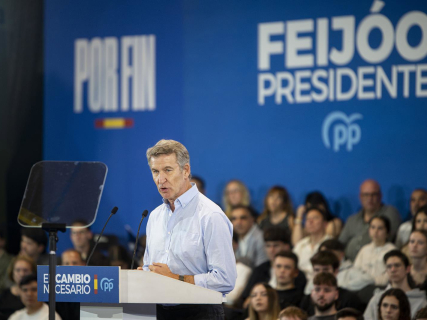

The President of the PP and candidate for La Moncloa, Alberto Núñez Feijóo, has advanced that, if he manages to form a Government after the general elections of November 29, he will not maintain an independent Ministry of Housing, despite considering it “the main problem” in the country. Instead, this matter will be integrated into a strategic vice presidency.
During his appearance on the podcast The Wild Project, Feijóo has explained that his future Executive will have a smaller number of senior positions than the current one and that areas such as Equality or Housing will no longer have a specific ministry.
These statements come just one day after the Permanent Deputation gave the go-ahead to the so-called “decreto Maricarmen,” a package of measures in housing matters that the PP has committed to repeal as soon as it comes to power.
The Galician leader had already advanced in an interview with Vozpópuli that, in the event of governing, he would concentrate housing policies within a strategic vice presidency, along with other competencies.
In its electoral program, the PP details that it will overturn the current Housing Law if it gains access to Government. With this, the areas of tense residential market and the rental price index will disappear, understanding that these tools have generated “more intervention, more uncertainty and less supply” in the rental market. In return, it proposes a package of tax incentives and guarantees to facilitate young people’s purchase of their first home.
The program document of the popular party proposes cutting the VAT on the purchase of the first home for those under 40 years old from 10% to 4%, also allowing this tax to be paid in installments, synchronized with mortgage payments.
For the acquisition of an existing home, the PP suggests reaching an agreement with the autonomous communities to reduce the transfer tax on documented legal acts (ITP), also with the option of deferred payment. Likewise, it is proposed to extend from two to four years the period for reinvesting the amount obtained from the sale of the usual home and to keep the exemption in the IRPF.
More public guarantees and the “hucha hogar joven”
The program also includes the expansion of the public guarantee that covers up to 20% of the value of the property for buyers under 40 years old, with the possibility of raising the age threshold up to 50. The objective is for the mortgage to be able to finance also the down payment of the home.
To this measure is added the creation of the "young home nest egg," a specific account in which minors under 40 will be able to deposit up to 2,000 euros per year for the purchase of their first home, with a 20% tax deduction on the amounts contributed and a cumulative cap of 40,000 euros. The returns generated will be exempt from taxation as long as the savings are used for that purpose, and account holders will be able to access a guarantee equivalent to the accumulated balance, up to a maximum of 40,000 euros, in order to obtain financing with a subsidized interest rate.
Objective: a million new homes
On the supply front, the PP maintains its goal of building a million homes. To do so, it proposes mobilizing public and private land, passing a new Land Law, and setting a maximum period of three months to process permits for new construction and rehabilitation, with positive administrative silence. It also proposes authorizing social housing on designated land and facilitating the change of use of offices and commercial premises so that they can be used as affordable housing.
The program includes the creation of a new urban planning figure that will make it possible to speed up major residential developments, promote industrialized housing, and increase flexibility in urban regeneration processes, through adjustments to the building density and the height of buildings, including the possibility of adding new floors.
Ultra-reduced VAT for rehabilitation and more financing
Lastly, the conservatives want to encourage the rehabilitation of vacant or deteriorated homes with an ultra-reduced VAT of 4% for work on the habitual home, in addition to direct aid, public financing, and preferred guarantees.
The plan also includes mobilizing resources from the Instituto de Crédito Oficial (ICO), the European Investment Bank, and European funds to develop land and build affordable housing, improve the financing of town councils by linking it to specific objectives in this area, and launch a training and employment program that will make it possible to cover the demand for labor in the construction sector.