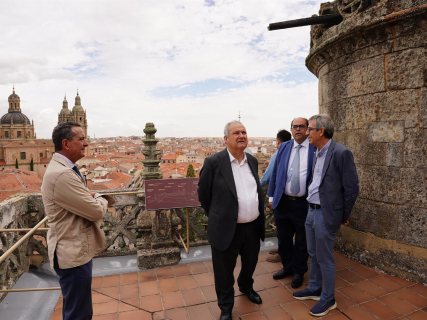

The Minister of Industry and Tourism, Jordi Hereu, emphasized this Wednesday the "strategic role" that Salamanca plays "in the Spain of sustainable tourism," a framework in which the interventions carried out in the Cathedral are situated.
Hereu has toured these works, executed within the framework of the Tourism Sustainability Plan funded by his department, and expressed his "pleasure" at being in the city and for the welcome extended by the City Council and the Government Subdelegation.
In relation to these actions, the Tourism official pointed out that his Ministry focuses its efforts on "two major economic engines," industry and tourism, and that both register "enormous economic growth in a difficult international context."
Within this context, he highlighted the modernization improvements of the cathedral complex, with the incorporation of new visitable spaces, exhibition resources, and immersive audiovisual experiences, in addition to the main novelty: the rehabilitation and opening to the public of the under-roof space, which offers visitors the opportunity to learn about one of the least known areas of the Cathedral.
"In this case, we come to visit a project in which we have invested 3.5 million euros and here you can see the result: the improvement and preparation for the citizens of Salamanca and for those who visit us, updating a beauty such as the Cathedral of Salamanca," he stated.
Likewise, Hereu defended that, in the tourism sector, Spain should focus on "quality rather than quantity," betting on de-seasonalized, diversified, and digitalized destinations. In this model, Salamanca, he affirmed, "is a treasure for its history and its heritage."
"We have to make this wonder known to the world. Investing in quality is investing in triple sustainability: environmental, social, and economic," he added.
The minister also focused on state investment in the province of Salamanca and mentioned the case of the company Dulca, to which the Government has allocated more than nine million euros for its modernization.
Subsequently, Hereu moved to the Fonda Veracruz to learn on-site about another intervention included in the same PSTD, a remodeling that has allowed for the recovery and adaptation of this 19th-century building as a reception, information, and cultural dynamization center.
In total, the Government has allocated to Castilla y León more than 232 million euros to materialize 125 projects for sustainable tourism, in addition to other lines of action in tourism linked to digitalization, diversification, and the enhancement of historical heritage for tourist use.
For his part, the deputy mayor and councilor of Finance, Fernando Rodríguez, who accompanied the visit, emphasized that "tourism is a very important source of economic activity generation" in the city and recalled that Salamanca recorded "a record of overnight stays and travelers in 2025," in addition to highlighting that the figures for 2026 "are on a very good path."
Rodríguez has indicated that the City Council maintains "a constant effort for the promotion of the city as a destination for excellence and quality tourism," valuing heritage as one of its main attractions.
Regarding the visited interventions, he specified that the work on the Cathedral has made it possible to expand spaces, with special relevance to the attic.