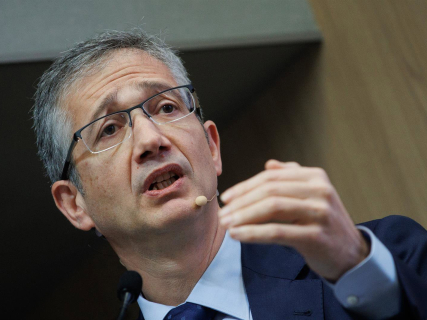

The Eurogroup has confirmed this Friday that Spanish Pablo Hernández de Cos, former governor of the Bank of Spain, and the Dutch Klaas Knot, the former top official of the central bank of the Netherlands, are the only two candidates to succeed Christine Lagarde at the head of the European Central Bank (ECB), once the deadline for euro-area countries to present their proposals had concluded.
The announcement was made by the president of the economic forum, Kyriakos Pierrakakis, through a statement in which he advanced that the euro-area ministers of Economy and Finance will assess both candidacies at their meeting next Monday, 9 November, although that meeting will not yet involve the designation of the next head of the institution.
The meeting will serve to open negotiations among governments in order to determine which of the two candidates obtains the necessary support, before the EU Council formally raises its recommendation to the European Council, which will be the body that makes the final decision after gathering the opinion of the European Parliament and the ECB’s Governing Council.
Specifically, the designation must obtain the backing of at least 16 of the 21 euro-area member states, which also represent a minimum of 65% of the population of the single-currency area, as the Eurogroup recalled when detailing the conditions required to approve the appointment.
Pierrakakis launched this process after Lagarde informed the president of the European Council on 29 October of her intention to leave the position before 7 February 2027, that is, nine months before the date set for the expiry of her term.
Hernández de Cos, the current managing director of the Bank for International Settlements (BIS), led the Bank of Spain between 2018 and 2024, a period in which he also served on the ECB’s Governing Council, while Knot was in charge of the Dutch central bank and likewise took part in the euro-area monetary policy decisions.
The election of the person who will replace Lagarde coincides with a broader renewal at the top of the ECB, marked by the early departure of Isabel Schnabel at the beginning of 2027 and by the end of the term of the institution’s chief economist, Philip Lane, in May, so that governments could negotiate jointly the allocation of these positions.