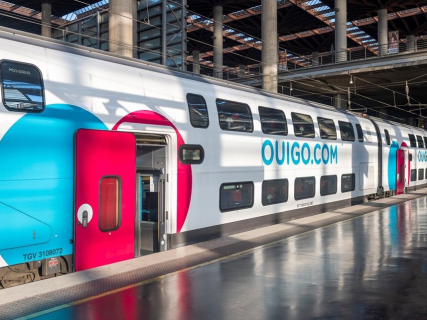
Ouigo cancels all its trains between Madrid and Andalusia until, at least, November 2

Ouigo cancels all its Madrid-Andalusia trains until November 2 due to an accident in Urda and guarantees full reimbursement to travelers.

fotonoticia 20261028173126 1920

fotonoticia 20261028173126 1920

Add DEMÓCRATA to Google

Ask FREN

Published

Last updated

1 minute

Most read

Elecciones 29N · Encuestas

La media de las encuestas

Media a 27 de octubre de 2026 · 15 institutos

  • PP31,0 %
  • PSOE27,3 %
  • Vox18,9 %
  • Sumar6,3 %
  • Podemos2,9 %
  • ERC2,3 %
010203040ene 2024jul 2024ene 2025jul 2025ene 2026jul 2026

Media del último estudio de cada instituto en 30 días y su evolución semanal desde el 23J. Partidos con al menos un 2 %.

Todas las encuestas

Elecciones generales del 29 de noviembre · Demócrata

Ouigo has decided to cancel all of its high-speed trains connecting Madrid with Andalusia, a measure that will remain in place, at a minimum, until Monday, November 2 inclusive, as the company itself has communicated.

The operator is adopting this measure as a result of the damage caused to the railway infrastructure by the accident recorded this Wednesday in Urda (Toledo), which has forced the suspension of traffic on this corridor.

According to the company, all affected passengers have been notified via the email associated with their reservation and have been offered the "full refund of their tickets" to compensate for the cancellation of the services.

In parallel, the train drivers' union Semaf maintains a strike called at Ouigo for this Friday and next Monday, although in this case "it will only affect the rest of the lines", since the connections between Madrid and Andalusia are already suspended due to the incident on the tracks.

More key points, information and questions with FREN

AI-GENERATED CONTENT

What procedures must Adif follow to restore railway traffic after an accident of this type?

Adif must verify that the section once again meets safety conditions before restoring traffic. Physical repair is not enough: emergency coordination, respecting investigation actions, and verifying affected installations are required. Since the specific accident is not identified here, the following outline explains general actions without attributing specific authorizations or procedures to the case that have not been proven.

1. Protect traffic and attend to the emergency

The first action is to prevent other trains from accessing the dangerous area and coordinate the response with emergency services and affected railway companies. Depending on the damage, it may be necessary to keep traffic interrupted, isolate electrical installations, and establish safe conditions for rescue and repair teams to access.

Traffic recovery is subordinate to the protection of people. Therefore, the completion of rescue, the possibility of accessing to work, and the subsequent availability of the section for trains must be distinguished: they are not necessarily simultaneous.

2. Coordinate work with the investigation

Before removing vehicles or modifying elements that may serve as evidence, the intervention must be coordinated with the authorities responsible for the investigation. If there are judicial actions, Adif must respect the restrictions established on the area, material, or evidence.

The technical investigation should not be confused with a reopening authorization. Nor can it be stated, without knowing the decisions made in the accident, that it is always necessary to wait for the final investigation report or that there is a general judicial authorization applicable in all cases. What matters are the restrictions effectively imposed and the safety conditions.

3. Remove material and repair damages

Once these works can be carried out, the removal of the damaged material should be organized and the infrastructure inspected. The review must be adjusted to the affected elements: track, platform, structures, electrification, signaling, and communications, as appropriate.

The extent of repairs depends on the actual damage, not just what is visible. It is also necessary to consider whether the means used to remove the vehicles have affected other installations and if there are risks that require keeping part of the section closed.

4. Verify safety conditions

Before resuming traffic, the work performed and the operation of the systems necessary for circulation must be checked. Specific inspections, measurements, and tests will depend on the damage and repaired installations; there is no basis to present a single list of mandatory tests applicable to any accident.

Adif's competence is supported by the fact that infrastructure administration includes its maintenance, operation, and management of the control, traffic, and safety system, as stated in Judgment 124/2016 citing the Railway Sector Law. This does not imply that every reopening requires a new ministerial authorization.

5. Restore traffic and communicate conditions

If safety permits, recovery can be partial or progressive, with restrictions adapted to the situation, such as speed limits or use of a single track. These measures must be communicated to operators and traffic personnel.

Reopening the infrastructure does not mean immediately restoring all services. Railway companies must reorganize trains, equipment, and personnel. In summary, Adif manages the safe availability of the section; investigative authorities determine restrictions within their scope, and operators organize commercial recovery.

What are Adif's competencies in the management and repair of railway infrastructures in Spain?

Adif has competencies to manage, maintain, repair, and renew the railway infrastructures it owns and those whose administration is entrusted to it. Its role is not limited to fixing tracks: it also includes infrastructure operation and management of control, traffic, and safety systems. These functions are mainly supported by Law 38/2015, of the Railway Sector, and its Statute, approved by Royal Decree 2395/2004.

1. Which infrastructures it administers

Its scope includes the infrastructures of the General Interest Railway Network assigned to it. Therefore, Adif should not be automatically identified as the manager of any existing railway in Spain: when an infrastructure is not owned by it, the corresponding legal instrument assigning its administration is required.

It is also important to distinguish Adif and Adif-High Speed, separate entities. The latter was created by separating the construction and administration activities of high-speed infrastructures and others assigned. To determine who should intervene on a specific section, ownership and division of functions matter, not only the type of train running on it. Adif explains its regulatory framework on its legal information page.

2. Maintenance, repair, and renewal

The Adif Statute defines maintenance as the set of conservation, repair, replacement, and technological updating operations necessary to keep the infrastructure in adequate operational and safety conditions. This includes:

  • Preventive and periodic maintenance: inspections, checks, and scheduled works to anticipate deterioration and failures.
  • Corrective maintenance: repair of faults and incidents affecting the operation of installations.
  • Replacement and renewal: substitution of deteriorated elements and actions to preserve infrastructure functionality.
  • Technological updating: adaptation of equipment and systems when necessary for their operation and safety.

Actions may involve tracks, signaling systems, communications, electrification, and protection devices. Therefore, it is not exclusively about repairing rails or sleepers.

3. Projects, execution, and contracting

Adif can carry out studies and approve and lay out projects, as well as their modifications, necessary for maintenance. Technical drafting can be done directly or commissioned to third parties.

Likewise, it can execute works with its own means or through contracting companies. Contracting a repair does not eliminate its responsibility as administrator: it retains administration, control, and safety functions, without prejudice to the contractor's obligations. Resolutions published on June 17, 2025 specify the internal distribution of powers regarding contracting and technical approval and other management competencies.

4. Operation, traffic, and control

Besides material maintenance, its functions include managing control and traffic systems, allocating infrastructure capacity to railway companies, and establishing operating conditions. It is also responsible for controlling and inspecting the administered infrastructure, its protection zones, and the traffic carried out on it.

Management also includes operating own or assigned assets and service installations attributed to it, with the corresponding maintenance and replacement.

5. Limits of its competencies

Adif acts within state planning and applicable agreements, instructions, and resources. Construction and major actions are not unlimited powers detached from the competent ministry.

In short, in case of a failure, it must be identified which element has failed and who administers it. If it belongs to infrastructure assigned to Adif, its maintenance and repair fall within its competencies; this does not automatically make any railway incident its responsibility.

What legal requirements exist for operators to resume traffic after a suspension due to an accident?

If you refer to railway operators in Spain, resumption requires restoring safety conditions, complying with imposed restrictions, and having the necessary authorizations. Reopening the line should not be confused with authorization to use a train or for involved personnel to resume driving. It is not generally necessary to wait for the final investigation report, but evidence must be preserved and judicial decisions respected.

1. Restore safe circulation conditions

The main framework is the Railway Sector Law, Royal Decree 929/2020, and the Railway Traffic Regulation. The company and infrastructure manager are responsible for safe operation, each regarding their part of the system.

  • Infrastructure: risks preventing use of the section must be resolved, applying corresponding checks and operational conditions.
  • Rolling stock: the train must meet technical and maintenance conditions; removing accident debris alone does not prove its fitness.
  • Corrective measures: detected risks must be addressed and communicated to other affected agents.

Royal Decree 929/2020 provides that non-compliance with conditions that may generate risks will be cause for train stoppage by the administrator, on its own initiative or at the request of the State Railway Safety Agency (AESF).

2. Respect who decides and current restrictions

The operator cannot unilaterally decide that a line is available again. Traffic management corresponds to the administrator, according to the regulation, applicable instructions, and its safety management system, i.e., its procedures to control risks.

The administrator may take urgent provisional decisions in safety incidents and must communicate them to the AESF within 24 hours. This is a communication deadline: it does not constitute a mandatory waiting period nor an automatic authorization to resume.

3. Maintain authorizations and fit personnel

The company must retain the license necessary to provide the service and the required safety certificate. An accident alone does not imply loss of the license; if there is an administrative suspension or restriction, it cannot be ignored when restarting activity.

Availability of authorized and fit personnel must also be verified. Royal Decree 929/2020 requires alcohol and drug tests after accidents or incidents involving personnel. A confirmed positive result implies suspension of the authorization for at least three months; recovery requires a new psychophysical fitness certificate. This affects the worker, not necessarily the entire operator.

4. Notify, preserve evidence, and cooperate

The event and measures taken must be communicated to competent authorities, recordings preserved unaltered, and investigation facilitated. Information on accident analysis and preventive measures must be kept for at least ten years.

Royal Decree 623/2014 provides for rapid information gathering to allow traffic restoration. It should be read together with Law 2/2024 and the Investigator Authority Statute, which reform its organization. Investigating and reopening are distinct actions.

Finally, resumption does not extinguish victim and family assistance required by Royal Decree 627/2014. This outline refers to the state railway network; for road, metro, or regional networks, their specific regime applies.

Play

Test your knowledge with FREN!

How much do you know about this topic? Answer the following 3 questions.

As a result of what incident has railway traffic between Madrid and Andalusia been interrupted?

Question 1 of 3

Which company has suspended ticket sales until December?

Question 2 of 3

What is Ouigo's situation regarding the resumption of its services between Madrid and Andalusia?

Question 3 of 3