

The president of the National Federation of Real Estate Associations (FAI), José María Alfaro, explains to DEMÓCRATA that the sector is entering a phase of moderation in transactions, after a prolonged period of strong activity and rising property prices. The evolution of prices has ended up introducing two different behaviors among potential buyers: those who cannot access a home due to a lack of sufficient resources and those who, even having financial capacity, consider that current prices do not justify closing a deal immediately.
This second group represents one of the developments detected by real estate professionals. These are solvent buyers who can purchase a home, but prefer to wait in view of the possibility of finding better conditions. Their decision introduces an element of caution in a market where, over the last few years, the shortage of supply has reduced the margin for negotiation.
Resistance is beginning to shift to transactions. According to Alfaro, buyers are more frequently questioning the prices initially requested by owners and seeking discounts before formalizing the purchase.
This does not mean that prices are declining in a generalized way, but rather that negotiation is taking on a greater role in determining the final sale price.

From selling a home in two weeks to needing up to nine
One of the indicators that FAI uses to describe this change is the time needed to sell a property. According to the data handled by the federation based on the activity of its members, the average marketing period has gone from two or three weeks to between six and nine weeks in recent months.
The increase means that certain transactions now take approximately three times longer to close than during the most dynamic period. Owners find buyers less willing to immediately accept the listed price, while interested parties spend more time comparing homes and studying financing conditions.
The change especially affects the relationship between the asking price and the final price. During periods of intense demand, competition among buyers can limit the possibilities for negotiation. In the scenario described by FAI, on the contrary, the buyer regains the ability to discuss the requested amount, although that greater capacity depends on the location, the characteristics of the property, and the available supply.
Alfaro qualifies, however, that the moderation of transactions coexists with a structural problem that remains unresolved: housing demand continues to exceed the available supply in the main Spanish cities. The slower pace of sales therefore does not mean that pressure on the residential market has disappeared.

Two profiles of buyers: those who cannot and those who prefer to wait
The federation distinguishes two factors that are conditioning purchase decisions.
The first is the lack of economic affordability. The accumulated increase in housing costs has raised the effort required to acquire a property to levels that are difficult for many households to bear. The average buyer finds it difficult to gather the required initial savings and face the corresponding mortgage payments at current prices.
The second factor is the emergence of a more skeptical demand. These are people who have sufficient income or assets to buy, but who do not have an immediate need to do so. This profile believes that it can wait and observe the evolution of the market before committing a significant amount of money.
The difference is substantial. Some buyers are left out of the market because they cannot pay the prices; others temporarily withdraw because they do not want to accept them. Both behaviors contribute to moderating transactions, although they respond to different economic situations.
To these factors is added, according to Alfaro, the increase in the cost of mortgage financing conditions. The evolution of interest rates and bank offers especially conditions those who need to resort to credit to buy a home.
In this segment, the announced price is not the only variable. The available savings, the percentage of financing granted by the institution, the resulting monthly payment, and the stability of family income also matter.
Housing out of necessity continues to support home sales
Despite greater caution, the market has not come to a standstill. FAI identifies two groups that continue to account for a large part of the transactions: replacement buyers and those who are accessing a home for the first time with sufficient savings or family support.
The first are owners who need to change homes due to personal or family circumstances. This may involve couples who require a larger home, families who change their residence, or people who must reorganize their asset situation after a separation.
In the second group are first-time home buyers who manage to meet the bank requirements thanks to their savings and, in certain cases, to the financial help of their relatives.
The common characteristic is that their decisions respond to needs that cannot always be postponed. Emancipation, the birth of children, a separation or the difficulty of continuing to pay high rent can precipitate a purchase even when market conditions are not favorable.
This circumstance explains, according to the federation, why transactions remain active despite the tightening of access conditions. Demand out of necessity remains present, while part of the demand with greater room for choice opts to wait.
Fewer transactions does not necessarily mean cheaper homes
The change of pace that FAI describes must be distinguished from a generalized fall in prices. The federation observes greater negotiation and longer sales periods, but does not maintain that the Spanish real estate market is on the verge of a collapse.
Alfaro rules out that the current situation can be interpreted as an imminent downturn in activity. His diagnosis is one of moderation after years of intense growth, in a market that continues to be constrained by the shortage of available housing.
The difference between both phenomena is important. A reduction in sales indicates that fewer transactions are being formalized, but it does not by itself prove that the price of properties has fallen. To know that evolution, it is also necessary to observe the amounts actually notarized and distinguish them from the prices that sellers initially advertise.
The statistics of the General Council of Notaries, which records transactions formalized before a notary, make it possible to analyze the volume of transactions and their evolution. The reading that FAI makes of these indicators, together with the experience of its members, points to a loss of speed in the market during 2026.
The federation predicts that the year will end with a number of sales below that of the previous year, although it considers that activity will continue at positive levels. This is a sectoral forecast, not a definitive year-end figure.
More than 600 professionals analyze the market change in Zaragoza
This diagnosis has been one of the issues addressed in the eighth edition of FAI Conecta 2026, held in Zaragoza on October 26 and organized by the National Federation of Real Estate Associations in collaboration with the Zaragoza Real Estate Association, Aportalia.
The meeting brought together more than 600 real estate agents and professionals to analyze the evolution of prices, the difficulties of access to housing, the shortage of supply, and changes in the behavior of buyers and sellers.
Alfaro highlighted during the congress that real estate agents intervene, according to the federation’s estimates, in 80% of transactions carried out in Spain. From that position, the sector perceives a greater gap between the economic expectations of owners and the willingness of buyers to accept the requested prices.
The technological transformation also occupied part of the program, especially the use of artificial intelligence to automate tasks, improve the management of agencies and modify the relationship with clients. The meeting has also examined the impact of regulatory changes on real estate activity.
But the main novelty identified by FAI lies in the behavior of demand. The buyer who can wait begins to do so and the one who needs to buy negotiates more intensely. The result is a market that maintains its problem of supply scarcity, but in which selling a home now requires more time and, in an increasing number of transactions, reviewing the initially proposed conditions.
The data that confirms the change: eight months of declines in home sales
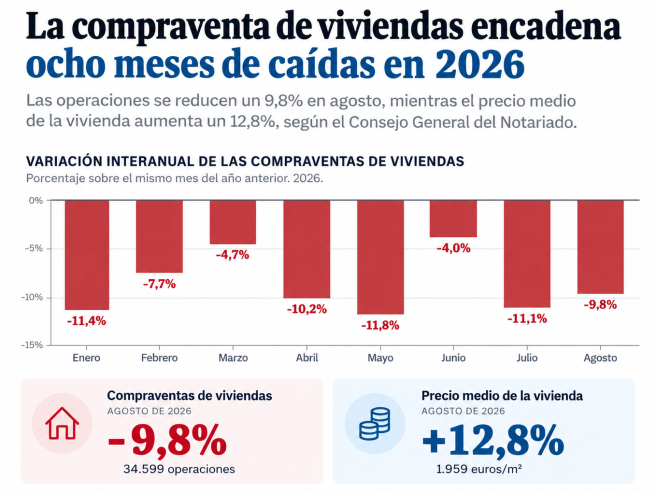
The latest data from the General Council of Notaries make it possible to specify the evolution described by FAI. In August 2026, 34,599 home sales were formalized, 9.8% less than a year earlier, bringing the market to eight consecutive months of year-on-year declines. In July, transactions had fallen by 11.1% and in June by 4%.
The fall in activity, however, is still not translated into a generalized decline in deeded prices. In August, the average price increased by 12.8% year-on-year, to 1,959 euros per square meter. Home sales decreased in 16 autonomous communities and only Cantabria recorded a slight increase. The largest declines corresponded to Navarra (-18.8%), Baleares (-17.8%) and Aragón (-16%). Madrid recorded a fall of 11% and Catalonia of 6.2%.
Financing is also affected by the moderation of transactions. Mortgages intended for the purchase of housing decreased by 5.6% year-on-year in August, to 19,875 transactions. The average amount of these loans, however, increased by 1.3%, to 164,978 euros.
These data place the analysis provided by José María Alfaro to DEMÓCRATA in a scenario of fewer homes sold, prices still rising and buyers who, according to FAI, are beginning to negotiate more firmly. The change detected by the agencies affects, for now, mainly the pace of sales and the negotiation conditions, while the notarial statistics continue to show price increases.