
The phone rings in a house in the provinces. On the other end of the line, a leader of a newly legalized party makes a proposal: to be part of his candidacy for Congress. He has never been a member, he has his job, his family, and no parliamentary experience. Doubts bloom, the conversation ends without an answer, but with the promise to speak again the next day. When the BOE proclaims the candidacies for the first democratic elections, there is his name. He has decided to take the plunge.
Scenes like this occurred during the spring of 1977. With the Law for Political Reform already in force and the Register of Political Parties of the Ministry of the Interior operating at full capacity, the leaderships had ahead of them the great challenge of presenting lists up to the circumstances.
A candidate wanted
During the dictatorship, there were thousands of people who defended their ideas in clandestinity, also those who "coquetted" with the world of associations (which preceded the legalization of the parties). All of them found a place on the electoral lists. Their political vocation was clear, however, they were not enough and the leaderships set out in search of talent in civil society. They knocked on the door of men linked to the military, business, judicial, or academic sphere. Also that of some women, such as Teresa Revilla (UCD).
Decades later, Podemos and Ciudadanos also turned on the radar and resorted to outside figures to differentiate themselves from the traditional formations and convey an image of renewal in the midst of the post-15M period with political disaffection rates at their peak.
However, the lists for the general elections next November 29 show a different trend, with a much greater prominence of organic leaders, institutional officeholders, and representatives who have already developed a good part of their careers within the parties. There is no longer room for galactic signings.

Podemos and Ciudadanos
The new politics, in addition to the end of bipartisanship, brought with it a greater concern for aesthetics, public image, and the appearance of renewal of the parties.
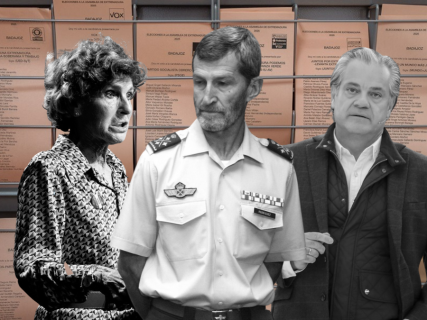
One of the most notable signings was that of General Julio Rodríguez, former Chief of the Defense Staff (JEMAD) during the Government of José Luis Rodríguez Zapatero, who joined Podemos for the general elections of December 2015.
The former JEMAD did not win the seat in those elections, but his signing became one of the most notable moves of the campaign. The purple party also brought in magistrate Victoria Rosell, candidate for Las Palmas, and former anti-corruption prosecutor Carlos Jiménez Villarejo, who had been part of its candidacy for the 2014 European elections.
The strategy of turning to professionals of recognized prestige was not exclusive to Podemos either. Ciudadanos turned the incorporation of figures from the business world and other professional fields into one of its main attractions.
The most representative example was that of Marcos de Quinto, former global vice president of Coca-Cola, who in March 2019 ran as Ciudadanos number two for Madrid for the April general elections. Albert Rivera presented him as an example of his party's ability to attract professionals with management experience outside politics.
The parties sought to strengthen their credibility and expand their electoral base through the arrival of personalities whose careers had developed mainly outside their structures, at a time when "being a politician" was very badly viewed.
Surprise, surprise
This trend found in the "beautiful Government" of Pedro Sánchez, which included "independent" profiles such as judge Fernando Grande-Marlaska or astronaut Pedro Duque, its fullest expression. It was the institutionalization of the phenomenon that would also have repercussions in the following elections.
In the 2019 elections, the PP also wanted to join this wave and Pablo Casado entered the transfer market. Political scientist Edurne Uriarte and economist Daniel Lacalle occupied prominent positions for Madrid, a list that also included bullfighter Miguel Abellán, while journalist Pablo Montesinos headed the candidacy for Málaga and Juan José Cortés, father of Mari Luz Cortés, did the same for Huelva.
Sounds familiar
However, that time has already passed and the candidacies presented for the general elections of next November 29 offer a different image. The main parties have fundamentally turned to well-known faces and internal cadres. The seat is very expensive and they have preferred to sweep home. The program above the people. The bet is on the proposals more than on who may end up carrying them out.
In this sense, the PSOE once again trusts members of the Government and leaders of its territorial structure to head the main constituencies. Top names such as Grande-Marlaska, who have gone from being a star signing to being a regular on the socialist list (although he still has a card).
The PP has also resorted in most constituencies to figures with an established track record in the organization. Among the confirmed list heads are Miguel Tellado for A Coruña, Ester Muñoz for León, María José Catalá for Valencia and Carmen Fúnez for Ciudad Real, all of them with prior experience in political or institutional responsibilities.
In Vox, Santiago Abascal heads the candidacy for Madrid, accompanied by Montserrat Lluís, Juan Sergio Redondo and Pepa Millán, profiles all of them linked to the organic structure or to the institutional representation of the formation. The party has also opted for the continuity of a good part of its territorial representatives as DEMÓCRATA already analyzed.
On the other hand, in Frente Amplio the trend that characterized its first years of incorporating external figures has been broken and its lists are packed with old acquaintances, starting with Ada Colau. The symbolic exception here is the painter Antonio López, who will close the candidacy for Madrid. In Podemos, Irene Montero will be the number one, who returns from Brussels to fight the battle in the Carrera de San Jerónimo.
don't miss it
On the occasion of the general elections next November 29, DEMÓCRATA has launched an interactive search engine to find out all the candidates, province by province.
Consult the general search engine, or look up by party:
- PP
- PSOE
- Vox
- Podemos