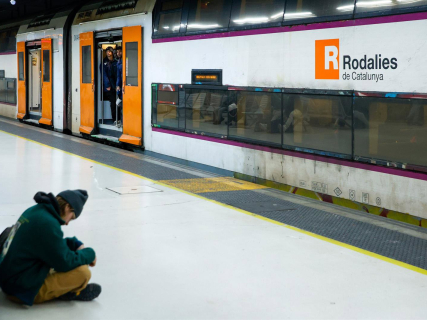
Rodalies estimates at 2% the minimum service levels not met by the strike until 8:30 a.m.

Rodalies places at 2% the minimum services violated by the strike of train drivers and expects to eliminate the majority of speed restrictions in December.

fotonoticia 20261029093730 1920

fotonoticia 20261029093730 1920

Add DEMÓCRATA to Google

Ask FREN

Published

Last updated

1 minute

Most read

Elecciones 29N · Encuestas

La media de las encuestas

Media a 27 de octubre de 2026 · 15 institutos

  • PP31,0 %
  • PSOE27,3 %
  • Vox18,9 %
  • Sumar6,3 %
  • Podemos2,9 %
  • ERC2,3 %
010203040ene 2024jul 2024ene 2025jul 2025ene 2026jul 2026

Media del último estudio de cada instituto en 30 días y su evolución semanal desde el 23J. Partidos con al menos un 2 %.

Todas las encuestas

Elecciones generales del 29 de noviembre · Demócrata

The head of Rodalies de Catalunya, Òscar Playà, has calculated at 2% the minimum services that have not been respected by the train drivers' strike promoted by the Semaf union until 8:30 a.m. this Thursday.

He detailed that this percentage corresponds to "practically normality" in terms of compliance with the minimum services, whose monitoring he described as very rigorous, according to what he said in an interview on TV3 reported by Europa Press.

In relation to the railway accident recorded this Wednesday in Urda (Toledo), Playà has conveyed his condolences to the relatives of the 68 deceased and has indicated that the works committee has organized 5 minutes of silence in memory of the victims.

When addressing the pending actions regarding infrastructure, he defended that a management model close to the territory favors better service operation and underlined that "important" work is being carried out in the area of investments.

Regarding the speed restrictions in force on some sections of Rodalies due to the state of the network, he stated that, by December, the "important bulk" of these limitations will have been lifted, in line with Adif's planning.

More key points, information and questions with FREN

AI-GENERATED CONTENT

What is the current status of the processing of infrastructure investments in the Rodalies network and what are the next steps planned by the competent administrations?

Investments in Rodalies are in simultaneous execution, contracting, and planning: they do not depend on a single pending approval. As of October 29, 2026, the updated plan through 2030 includes 8.037 billion euros; the latest detailed official report, corresponding to the first half of 2026, places the executed investment at 2.962 billion. The next steps are to complete the contracted works, put finished infrastructures into service, and develop projects for the second period.

Execution status and main actions

According to the September Transport report, since the start of the plan, 3.160 billion have been tendered and 4.294 billion awarded. These are different magnitudes: awarding means contracting an action, not having finished it. During the first half of 2026, 339.8 million were executed, actions worth 104 million were tendered, and contracts worth 95.3 million were awarded.

  • Works in execution: duplication of the R3 between Parets and La Garriga; railway integration of Sant Feliu de Llobregat; urban integration of Montcada i Reixac and Vallbona variant; remodelings of Castelldefels and Montcada Bifurcació; and implementation of GSM-R communication systems and ERTMS signaling.
  • Completed works, pending service: new railway access to the airport and extension of track 2 at the southern head of Vic. Their construction completion does not yet equate to commercial opening.
  • Stations: progress is being made at Sants, La Sagrera, Reus-Bellissens, Sant Feliu, and Montcada Bifurcació. Improvements have been tendered in Gelida, El Papiol, and Viladecans, as well as lifting systems in eight stations. Accessibility improvements at Celrà, Colera, Sant Jordi Desvalls, and Vilajuïga have already been completed.
  • Infrastructure renewal: work has been done on tunnels, trenches, and embankments. The Figueres-Portbou catenary renewal is practically finished, with pending work at Figueres station.
What must be processed next

The update presented in January strengthens maintenance, capacity, and stations. It foresees 287 asset renewal actions for 1.340 billion in 2026-2030, nearly 740 million for stations, and 637 million for parking tracks and workshops.

  • Transport and ADIF: must continue contracting and executing the program. The informative study of the Cerdanyola del Vallès flyover is already definitively approved; for the quadrupling of Castelldefels-El Prat, the drafting of the study has been awarded, so it is not yet in the construction phase.
  • Facilities for new trains: projects for track remodeling in Manresa, Sant Vicenç de Calders, Sant Celoni, and Maçanet-Massanes have been tendered. Work is also underway at the Ripoll workshops and the expansion of Vilanova i la Geltrú.
  • Generalitat, State, and ADIF: have a agreement published in December 2025 for two interchanges between the R8 and FGC. Therefore, the mere authorization phase to sign it has already been surpassed. Agreements on Vila-seca adaptation and the Flaçà crossing addendum are also published.
Financing and distribution of responsibilities

ADIF maintains responsibility for the state infrastructure; Renfe, for operation and fleet renewal, while the Generalitat participates in planning, monitoring, and management agreements. The transfer of service does not automatically imply transferring all infrastructure.

The state agreement of October 13 enables multi-year commitments for new agreements with ADIF and ADIF-AV 2026-2030, still in processing. It is a general framework, not an exclusive allocation to Rodalies. The immediate priority is to convert contracts and projects into completed works and operational services; there is no known single and closed schedule for opening all actions.

What are the competencies and functions of the person responsible for Rodalies de Catalunya according to current regulations and to which political party is Òscar Playà affiliated?

Òscar Playà performs railway management and direction functions but does not concentrate all public competencies over Rodalies. His operational responsibility in the current service, his position as CEO of the new mixed company, and the powers that regulations assign to administrations must be distinguished. Regarding his political affiliation, no publicly accredited affiliation to any party is recorded: political support for his appointment does not prove membership.

What competencies does the regulation establish

The main reference is Royal Decree 2034/2009, which transferred to the Generalitat the state functions related to the commuter service. Its annex assigns to the Generalitat "the regulation, planning, management, coordination, and inspection of said service, as well as tariff powers." These are competencies of the autonomous administration, not automatic personal attributions of the Rodalies director.

Section B of the annex specifies the following functions:

  • Ordering and planning: determining the management form, the railway offer, and compensations for public service obligations.
  • Quality and contracting: establishing quality levels, formalizing contracts with operators, supervising compliance, and adopting corrective measures.
  • User protection: determining rights and duties, approving contracting and usage conditions, and regulating claims.
  • Inspection and sanction: inspecting the service and means linked to its provision, applying the sanctioning regime, and combating fraud.
  • Tariffs and coordination: setting prices and discounts, articulating tariff integration, coordinating Rodalies with other transport, and establishing minimum services in collective conflicts.

The same decree reserves to the State functions over infrastructure of general interest, railway licenses, personnel training and habilitation, and traffic safety. Article 140.6 of the Statute of Autonomy likewise distinguishes between Generalitat-owned infrastructures and its participation in planning and management of state ones.

What functions does Playà perform

As general director of Rodalies since February 2026, his responsibility lies in operational management: daily functioning, team coordination, incident response, and traveler information. The appointment aimed to strengthen coordination between Generalitat, Renfe, and Adif, as explained by Transport and reported by Demócrata. This does not make him holder of the regulatory or sanctioning powers previously listed.

As CEO of Rodalies de Catalunya SME, SA, he leads the preparation of the new operator: internal organization, strategic and business plan, management processes, and obtaining necessary authorizations to progressively assume services. The official presentation of the company identifies three areas: railway operation, facilities, and user service. A complete statutory text enumerating its specific delegated powers has not been located.

He should also not be confused with the Commissioner for the Integral Transfer of Rodalies: Decree 206/2023 assigns that figure advisory, transfer promotion, operational continuity, and recommendations on resources and quality.

Political affiliation

Playà comes from the management of the Barcelona Metro and has a technical and managerial career. The Generalitat proposed his incorporation to the board through Agreement GOV/6/2026. ERC pushed for him to also assume operational direction, but there is no basis to identify him as an affiliate or organic representative of ERC, PSC, or any other party. It is advisable to separate support for the appointment, institutional dependence, and party membership.

What legal requirements must be met to remove speed restrictions on the railway network managed by Adif?

To remove a speed restriction on the network managed by Adif, two conditions must concur: that circulation at the recovered speed is safe and that the removal is processed and communicated according to the Railway Traffic Regulations. It is essential to distinguish between lifting a temporary limitation and increasing the permanent maximum speed: these are not equivalent actions nor necessarily have the same requirements.

1. Safety justification

Law 38/2015, of the railway sector assigns to infrastructure managers and railway companies the responsibility for the safety of the part of the system that corresponds to them. It requires them to apply safety standards and have management systems that include risk evaluation, control, and monitoring.

Therefore, lifting a limitation requires justifying that the conditions of the section allow recovering the planned speed. When due to a defect or works, it is not enough to announce their completion: the decision must be supported by the pertinent technical checks and the procedures of Adif's safety management system. The specific verifications will depend on the cause and affected elements; there is no universal list of tests for any removal in the examined provisions.

2. Mandatory procedure for temporary limitations

Section 2.1.5.7 of the Railway Traffic Regulations, approved by Royal Decree 664/2015, expressly establishes the procedure for establishment or removal:

  • Infrastructure personnel must arrange the removal of fixed signals as soon as possible and send a telephone call, a formal regulatory communication, to the circulation manager of a collateral station or the centralized traffic control center.
  • The communication must identify that it is a removal, the limited speed, affected tracks, start and end kilometer points, and the route.
  • The receiving manager must transmit the information to the corresponding circulation managers and the regulation band of the command post, according to the regulatory circuit.
  • The command post must update the information used by railway companies to prepare the Driver's Route Book.

Thus, removal does not consist solely of removing signals: it requires a formal operational communication and coordinated updating of circulation information.

3. Signaling and limits that remain

Removing a temporary limitation does not authorize exceeding other applicable speeds. The maximum infrastructure speed, operating conditions, and limits associated with train protection systems and their operability must be respected.

Section 2.1.4.1 requires signaling maximum speed increases with the corresponding signal, with the particularities provided for continuous cab supervision. Additionally, section 1.2.1.3 obliges the administrator to prepare, disseminate, and ensure the availability of pertinent operational documentation. Signaling, information provided to the driver, and protection conditions must be coherent.

4. AESF intervention

The cited temporary removal procedure does not establish a prior individual authorization from the State Railway Safety Agency for each lifting. It is different if installations or subsystems are modified, or if a permanent speed increase is intended: the safety regime and commissioning authorization corresponding to that action must also be complied with. Ordinary removal of a limitation should not be confused with authorization of a modified infrastructure.

Play

Test your knowledge with FREN!

How much do you know about this topic? Answer the following 3 questions.

What percentage of minimum services has not been respected in Rodalies de Catalunya until 8:30 AM during the strike?

Question 1 of 3

What measure did the works council organize after the Urda (Toledo) railway accident?

Question 2 of 3

When is it expected that most of the speed restrictions on some sections of Rodalies will have been lifted?

Question 3 of 3