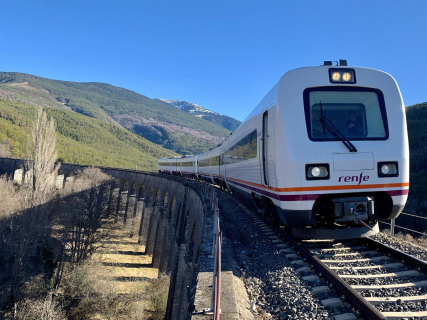

The Ministry of Transport and Sustainable Mobility has determined the minimum services that must be provided during the 24-hour strike called by the Spanish Union of Railway Machinists (Semaf) for the staff of the Renfe group this Thursday, October 29.
In Commuter services, the minimum services have been set according to different time slots: during peak hours (from 06:00 to 09:00; from 13:30 to 15:30 and from 18:30 to 20:30) 75% of the usual circulations will be guaranteed, while the rest of the day will operate at 50% of the normal service.
For Medium Distance trains, an average of 65% of the usual services has been marked; in High Speed and Long Distance trains, 73% of the planned circulations are ensured; and in freight trains, 26% of the scheduled service will be provided.
In a statement, Renfe maintains that the demands raised by Semaf to justify this protest "exceed the company's competence," so the operator considers it "incoherent" to call a strike against its service for reasons outside its responsibility, such as regulations on driving times or certain actions by the Labor Inspection, which also fall outside its decision-making capacity.
The railway company emphasizes that the issues raised by Semaf to call for the strike are not included in the collective agreement that the union itself signed last July.
Renfe defends its management against the claims that Semaf has been making in recent months and emphasizes that the union acknowledges the existence of agreements with the company, "which do not exist with other operators." According to the company, many of the union's demands are based on measures that are already applied at Renfe and that Semaf intends to extend to the entire railway sector.
In this regard, the operator assures that, in the face of adverse weather phenomena or risk situations, Renfe is the only operator that adopts additional safety measures, while other competitors maintain circulation, "a fact that the union also acknowledges."
Regarding the agreement signed in February to reinforce the railway system after the Adamuz accident, also signed by Semaf, Renfe states that all obligations assumed have been fulfilled "in full," as has been conveyed in the follow-up meetings held in April, May, and October.
The public company adds that it has reinforced the railway operations and security with the incorporation of more than 1,200 new workers, the reinforcement of maintenance teams, and various actions aimed at improving the reliability of rolling stock and the quality of service.
Renfe concludes by lamenting the inconveniences that the strike may cause to users.
Semaf denounces a "blockage" in the agreements
For its part, Semaf justifies this 24-hour strike due to the lack of progress in negotiations with Renfe and the existence of an "administrative blockage" of the agreements reached previously.
The union explains that the call responds to the paralysis of the commitments agreed upon regarding railway safety, protocols for meteorological emergencies, hiring of new train drivers, attention in cases of accidents, and improvement of the reliability of rolling stock.
From Semaf, they assure that they have presented proposals at each of the negotiation tables, but they maintain that both the Administration —the Ministry of Transport— and the companies and public bodies involved —Renfe, Adif, and the State Agency for Railway Safety (AESF)— are relying on the bureaucratic slowness resulting from coordination among various bodies.
The organization demands the implementation of effective and mandatory protocols in the face of meteorological alerts, as well as regulations that articulate communications in risk situations.
In addition, it aims to implement the so-called 'just culture' in the driving cabins and enable a direct channel between the unions, the AESF, and the Labor Inspection to supervise safety and working conditions.
The collective also demands technical solutions to the incidents of rolling stock, the application of interruptions in driving times, and the unlocking of the reduction coefficients for the retirement age. Likewise, it demands the full application of the agreement of May 7 for new promotions and the complete fulfillment of the 1990 protocol on attention after an accident.