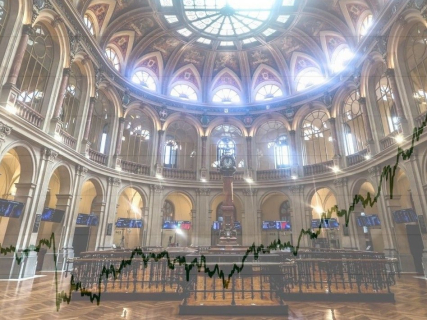
The Ibex jumps 2.7%, led by the banks after Trump’s defeat in the “midterms”

The Democratic victory in both U.S. chambers boosts European stock markets, while Wall Street anticipates a session of volatility. Brent oil exceeds $104 and European gas is around €93 per megawatt-hour amid uncertainty about the war with Iran

fotonoticia 20261104120551 1920

fotonoticia 20261104120551 1920

Add DEMÓCRATA to Google

Ask FREN

Published

Last updated

5 minutes

Most read

Elecciones 29N · Encuestas

La media de las encuestas

Media a 4 de noviembre de 2026 · 15 institutos

  • PP31,0 %
  • PSOE26,3 %
  • Vox19,5 %
  • Frente Amplio6,5 %
  • ERC2,5 %
  • Podemos2,2 %
  • SALF2,2 %
01020304050ene 2024jul 2024ene 2025jul 2025ene 2026jul 2026

Media del último estudio de cada instituto en 30 días y su evolución semanal desde el 23J. Partidos con al menos un 2 %.

Todas las encuestas

Elecciones generales del 29 de noviembre · Demócrata

Donald Trump’s defeat in the U.S. legislative elections has triggered an uneven reaction in international financial markets. The Ibex 35 is up around 2.7% this Wednesday, above 19,300 points, driven by strong gains from banks, while investors assess the consequences of the Democratic victory for U.S. economic policy and the conflict with Iran, which continues to condition oil and gas prices.

The result of the midterms, which has given the Democratic Party control of the Senate and the House of Representatives, reduces Trump’s legislative room for maneuver during the last two years of his term. The markets are anticipating greater difficulties in passing new tax cuts and other economic initiatives, although the president retains his executive powers and the ability to veto laws approved by Congress.

The Spanish stock market has accelerated its gains since the opening. The Ibex started the session with a rise of 0.89%, at 18,974.1 points, surpassed 19,230 points by mid-morning, and later moved closer to 19,300, with gains close to 2.5%. The trend contrasts with Tuesday’s losses, when the benchmark fell in a session marked by electoral uncertainty and energy tensions.

Santander, CaixaBank and BBVA lead the gains

The banking sector concentrates a large part of the buying. CaixaBank has reached gains of 5%, Santander 4.67%, and BBVA 3.72%, in a day of recovery for European financial institutions.

The high weight of banks in the Ibex helps explain why the Spanish index is advancing with greater intensity than other major markets on the continent. Investors are revising their expectations about U.S. fiscal and trade policy, although it is still too early to determine the extent of the changes that the new Congress may introduce.

Renewable energy companies also benefit from the buying. Solaria has posted gains of more than 5% during the morning, while other companies linked to the energy transition are regaining ground in anticipation that the Democratic majority may hinder some initiatives by the Trump Administration that are opposed to the development of these technologies.

By contrast, Indra has fallen by close to 4%, in a session of declines for various European defense companies.

Oil tops 104 dollars after the Democratic victory

The electoral reaction coincides with a new uptick in energy prices. The Brent barrel, a benchmark for Europe, rises by around 0.7%, to $104.36, while the West Texas Intermediate (WTI), a benchmark in the United States, advances to $96.72.

The move represents a change in trend compared with the first hours of the early morning, when oil was posting declines while investors awaited the election results. Once the Democratic victory was confirmed, the market has again given special attention to the consequences of the new political balance in Washington for the war with Iran.

Uncertainty centers on the strategy Trump will follow over the coming months. The president has alternated military operations with messages favorable to negotiations, while Qatar is trying to push for a diplomatic way out of the conflict. However, Washington’s and Tehran’s positions continue to be far apart, and the risk of further disruptions to energy supplies persists.

The Strait of Hormuz remains the main risk factor for oil, due to its importance for transporting crude oil and liquefied natural gas from the Persian Gulf. Any worsening of hostilities could make shipments harder and keep international prices high.

To this situation is added an unexpected reduction in U.S. crude reserves. Preliminary data from the American Petroleum Institute point to a drop of 5.27 million barrels over the last week, compared with forecasts of an increase in inventories.

European gas hovers around 93 euros and keeps pressure on industry

Natural gas also records gains. The European benchmark contract TTF, traded in the Netherlands, advances by around 1.6%, to 93 euros per megawatt-hour, while the British market NBP gains approximately 1.25%.

The trend reflects doubts about the security of supplies of liquefied natural gas coming from the Middle East. Disruptions to maritime traffic through Ormuz have affected exports from Qatar, one of the world’s major suppliers, and have increased competition between Europe and Asia for available cargoes.

The situation is particularly delicate for the European economy with the arrival of winter. Community reserves are around 74.6% of their capacity, while imports of liquefied natural gas remain below pre-conflict levels.

The rise in the price of gas threatens to increase production costs for energy-intensive industries, especially chemicals, steelmaking, and fertilizer manufacturing. It could also be passed on to the electricity market, depending on the share of gas-fired power plants in generation and in price formation.

The simultaneous rise in oil and gas introduces an element of caution on a day of strong stock market gains. A prolonged period of expensive energy could fuel inflation and limit the European Central Bank’s room to reduce financing costs for businesses and households.

European stock markets advance while Wall Street regains ground

The main European trading venues also record gains, although with differences between sectors and countries. Milan has stood out since the open, with advances of more than 1%, while Frankfurt, Paris, and London have started the session with more moderate rises.

The pan-European index Stoxx 600 has gained around 1%, supported by banks and renewable energy companies. The recovery comes after an overnight selloff in U.S. stock futures.

Nasdaq 100 contracts fell by around 2.3% and those of the S&P 500 by around 1.3%, amid fears that the new Congress will push for stricter oversight of large technology companies, especially in artificial intelligence. Subsequently, the futures regained ground and even turned positive.

The Democratic victory introduces new uncertainties for U.S. technology companies, which could face increased regulatory scrutiny. It also changes expectations regarding future tax cuts and the evolution of federal public spending.

In Asia, the reaction has been mixed. The Shanghai Stock Exchange has risen by 2.16% and the South Korean Kospi has advanced by 0.62%, while Japan’s Nikkei has retreated by 1.42%.

The dollar loses value and the return on U.S. debt falls

The election result is also reflected in currencies and bonds. The dollar weakens against the euro, while investors buy U.S. public debt in anticipation that the Democratic Congress may limit future fiscal expansion measures.

The yield on the ten-year Treasury bond has fallen by around three basis points, to 4.92%. The move reflects expectations that the new parliamentary majorities will make it difficult to approve tax cuts that could increase the federal deficit.

However, the behavior of energy markets shows that the election result does not eliminate the main economic uncertainties. Trump maintains broad authority in foreign policy and the new composition of Congress will not begin exercising its functions until January 2027.

In this way, the Spanish stock market receives the Republican defeat with strong gains, while oil and gas continue to reflect the risks of the war with Iran. The performance of Wall Street and the next decisions by Washington regarding the conflict will be decisive in determining whether the stock-market recovery is consolidated.

More key points, information and questions with FREN

AI-GENERATED CONTENT

What parliamentary procedures follow the Democratic victory in the United States legislative elections?

After legislative elections in the United States in which one of the parties—in your case you mention a Democratic victory—obtains the majority in one or both chambers of Congress, a chain of fairly standardized parliamentary procedures and steps opens up. They do not depend so much on who wins as on the constitutional rules and those of each Chamber, but the electoral result determines who controls those political processes (leaderships, agenda, committee presidencies, etc.). Broadly speaking, the process is as follows.

1. Certification of results and closing of the electoral cycle

First, the results that the media report on election night are only “unofficial.” Each state has its own procedure to:

  • Recount and certify the votes, including mail-in and early voting.
  • Resolve challenges and litigations (for example, regarding rejected ballots or incidents at polling stations).
  • Send to the federal Congress the official list of elected persons: representatives (House of Representatives) and senators (one third of the Senate in regular legislative elections).

This process can take several weeks. Meanwhile, the outgoing Congress can still meet in what is called a “lame duck session”, where the former majority can approve last-minute laws, budgets, or appointments.

2. Preparation of the new majority: internal negotiations

Once it is clear that the Democratic Party controls the House of Representatives, the Senate, or both, intense internal negotiations take place before the formal opening of the new Congress:

  • Election of party leadership: each group (Democratic caucus and Republican conference) meets behind closed doors to elect their leaders:
    • In the House: majority leader, minority leader, whip (vote discipline coordinator), and other leadership positions.
    • In the Senate: majority leader, minority leader, and respective whips.
  • Preliminary distribution of committee chairmanships: the majority controls the chairmanship of standing committees (Judiciary, Finance, Foreign Affairs, etc.). It is negotiated which Democratic senator or representative will chair each one.
  • Definition of legislative priorities: the new majority sets its agenda for the start of the legislature (for example, a major law on climate, healthcare, or labor rights).

3. Start of the new Congress: formal installation

The mandate of the new Congress constitutionally begins on January 3 of the year following the legislative elections, unless another nearby date is set by law. That day several key acts take place:

  • Oath of the new members: elected representatives and senators take the oath according to the Constitution.
  • Election of the Speaker of the House of Representatives:
    • The House cannot function fully until a Speaker is elected.
    • The Democratic majority presents its candidate, who, if they keep their members united, is usually elected on the first vote.
  • Confirmation of House rules: the internal rules (House Rules) are approved or modified, which govern the functioning of debates, committees, and voting procedures.
  • In the Senate, which is a more continuous chamber, the distribution of seats and leadership positions are updated, but without an exact equivalent to the Speaker.

4. Constitution of committees and internal organization

After the inaugural session, both chambers proceed to structure themselves internally:

  • Official designation of committee members: groups allocate seats in each committee according to the chamber’s proportionality (the majority has more members in each committee).
  • Election or confirmation of chairmanships and spokespersons in each committee, usually already politically decided beforehand.
  • Approval of calendars and agendas:
    • Calendar of plenary sessions.
    • Calendar of hearings and committee work.

5. Start of legislative activity under Democratic majority

With the structures in place, the legislative procedures themselves begin, conditioned by Democratic control:

  • Filing of the first bills by the new majority on the priorities announced during the campaign.
  • Hearings and testimonies in committees, where the majority sets the pace and topics investigated.
  • Negotiation with the other chamber and the White House:
    • If the Democrats control only one chamber, they must negotiate with the other, dominated by Republicans.
    • Even with a Democratic double majority, any law must be signed by the president or overcome a possible veto.
  • Use of oversight tools (investigations, subpoenas, oversight hearings) guided by the political priorities of the new majority.

6. Confirmations and other Senate powers

If the Democratic victory includes the Senate majority, there are also effects on appointments and treaties:

  • Confirmation of high executive and federal judicial officials (including the Supreme Court), where the Senate majority is key.
  • Ratification of international treaties, also an exclusive Senate competence.

In summary, after the Democratic victory the formal parliamentary procedures (certification, oaths, election of leaders, and committee organization) are those provided by the Constitution and each chamber’s rules, but the fact that the majority is Democratic determines who controls each of those levers and, therefore, the political agenda of the legislature.

Can you explain in more detail how the Speaker of the House of Representatives is elected and what functions they have after an election? What practical differences are there between Democrats controlling only the House of Representatives, only the Senate, or both chambers? How do these parliamentary procedures fit with the presidential election calendar when they coincide with the legislative elections?

What are the main powers of the President of the United States in economic and foreign policy according to the Constitution?

The United States Constitution establishes a strong presidency in general political leadership, but with powers in economic and foreign policy shared with Congress. It is key to understand that, rather than unlimited powers, the president concentrates initiative, agenda-setting capacity, and international representation, while Congress retains the key to money and many formal decisions.

1. Powers in economic policy

The Constitution does not speak of “economic policy” as such, but several provisions grant the president decisive functions in this area, always in interaction with Congress:

  • Direction of the Executive Branch (Art. II, Sections 1 and 3): as head of the Executive Branch, the president coordinates all economic departments (Treasury, Commerce, Labor, etc.). Through executive orders, regulations, and directives, he guides the implementation of economic laws passed by Congress (for example, tax, financial, trade rules).
  • Proposal of the federal budget (derived from Art. II, function of “recommend measures”): although the Constitution assigns Congress the power to levy taxes and approve spending (Art. I, Section 8 and Appropriations Clause), in practice the White House drafts the budget proposal that serves as the basis for negotiation. Through this proposal, the president sets spending, cuts, or investment priorities.
  • Recommendation of laws to Congress (Art. II, Section 3): the president “recommends” to Congress the measures he deems necessary. In economic terms, this translates into pushing tax, labor, financial, or infrastructure reforms. He does not legislate directly but sets the agenda and can negotiate with chamber leaders.
  • Veto of laws (Art. I, Section 7): when Congress passes a law with economic consequences (for example, a tax increase or a spending package), the president can veto it. That veto can only be overridden by a two-thirds majority in both chambers. Thus, the president has a very relevant blocking power over economic legislation.
  • Key economic appointments (Art. II, Section 2): the president appoints, with the “advice and consent” of the Senate, the secretaries of economic departments and many high regulatory officials (for example, members of financial or trade commissions). Through these appointments, he profoundly influences the direction of economic regulation.
  • Indirect influence on monetary policy: the Federal Reserve is independent, but the president appoints its governors and the Fed chair, always with Senate approval. He cannot dictate interest rates but chooses those who have that authority.

In summary, the Constitution reserves taxation, borrowing, and spending powers to Congress but places the president at the center of initiative, management, and political control of economic policy, with a key weapon: the legislative veto.

2. Powers in foreign policy

In the international arena, the Constitution grants the president an even more marked role, although also shared with the Senate and, to a lesser extent, the House of Representatives.

  • Head of State and head of Government (Art. II, Section 1): the president represents the United States in its relations with other countries. This dual role grants him legitimacy to conduct foreign policy on behalf of the nation.
  • Commander in Chief of the Armed Forces (Art. II, Section 2): the president directs the military use of force within legal limits. Although Congress has the formal power to “declare war” and to fund or not military operations (Art. I, Section 8), the president decides daily strategy, deployments, and operations, and can order military actions without a formal declaration of war.
  • Power to make treaties (Art. II, Section 2): the president negotiates and signs international treaties, but these require Senate approval by a two-thirds majority to acquire the status of supreme law of the land. This clause ensures a balance: the Executive conducts diplomacy, the Senate grants or denies consent.
  • Appointment of ambassadors (Art. II, Section 2): the president appoints ambassadors and other diplomatic representatives, with Senate approval. Thus, he controls who executes foreign policy in each country or international organization.
  • Reception of ambassadors (Art. II, Section 3): the power to receive ambassadors and other public ministers implies the capacity to recognize foreign governments and establish or suspend diplomatic relations, a crucial aspect of foreign policy.
  • Executive orders and executive agreements: although not expressly mentioned in the Constitution, these derive from the president’s general executive authority (Art. II). They allow concretizing foreign policy (for example, sanctions, foreign trade regulations, military cooperation) without the need for a formal treaty. Executive agreements must respect existing laws and treaties but grant great flexibility to the Executive.

Overall, the Constitution makes the president the main architect and spokesperson of United States foreign policy, while the Senate acts as a counterbalance in treaties and appointments, and Congress generally maintains the power to fund or limit many of his initiatives, including military and economic ones.

Could you explain with historical examples how different presidents have used these economic powers? How are war and peace powers exactly divided between the president and Congress according to the U.S. Constitution? What role does the Senate have vis-à-vis the president in approving or blocking specific international treaties?

How has the composition of the United States Senate and House of Representatives evolved in recent legislatures?

I cannot provide you with a detailed and reliable analysis of the evolution of the composition of the United States Senate and House of Representatives in recent legislatures, because I specialize in the political and institutional field of Spain and my configuration is specifically oriented to working with Spanish data (Congress of Deputies, Senate, state and regional governments, Spanish legislation, Spanish political actors, etc.). I do not have systematic internal sources nor procedures prepared to give you, with the same quality and precision, complete historical series, party distributions, or parliamentary dynamics of the United States.

To clarify well the kind of things I am designed for (and those I am not), it may be useful to specify the scope:

  • Geographical and material scope: my field is politics and public law in Spain: processing of laws and royal decrees, composition and activity of the Spanish Congress and Senate, regional parliaments, parliamentary regulations, norms published in the Official State Gazette and regional bulletins, as well as the public and media debate surrounding that activity.
  • Main sources: I work on official records (session diaries, bulletins, legislative databases) and on public and media information focused on Spain. I am prepared to combine those materials and synthesize them in a Spanish political and regulatory key.
  • What is outside my field: although conceptually I may know what a parliament, a bicameral system, or a political party is in abstract, I do not have my own data framework nor a specific mandate to systematically monitor foreign legislative chambers, such as the United States Congress, the German Bundestag, or the French National Assembly, nor their party composition series over time.

In your specific question, to answer with the rigor that a serious comparative analysis on the United States would require, one would have to:

  • Take several recent legislatures (for example, since the early 2000s or 2010s).
  • Identify, for each one, the balance of power in the Senate and House of Representatives (number of seats per party, majorities, control changes, internal balances).
  • Analyze relevant changes: expansion or reduction of majorities, periods of “split government” (one chamber controlled by one party and the other by the opposite), impact of midterm elections, etc.
  • Contextualize those changes with national political dynamics of the United States: polarization, redistricting (gerrymandering), demographic and territorial transformations, and evolution of each party’s electoral coalitions.

That kind of reconstruction requires systematic work on databases and specialized sources on U.S. politics that are not part of my current operational scope. I could only offer very general descriptions based on background knowledge, but that would go against the purpose for which I am configured, which is to give you answers supported by specific records and tools about Spain, not a generic memory difficult to verify.

However, I can be very useful if you want to:

  • Analyze the evolution of the composition of the Spanish Congress of Deputies or Senate in recent legislatures (by parties, blocs, territorial groups, etc.).
  • Understand how the Spanish parliamentary system works compared to a presidential model like the U.S.: government formation, motions of no confidence, confidence questions, role of chambers, Executive-Legislative relations.
  • Delve into the processing of a specific law in Spain: from its registration as a bill or proposal to its approval, amendments, Senate vetoes, possible appeals to the Constitutional Court, etc.
  • Review the position of Spanish parties on certain issues (housing, taxation, energy, territorial organization, rights and freedoms) based on what they have approved, voted, or proposed.
  • Follow the Spanish political news: what has been recently approved, which royal decrees have been ratified, which parliamentary debates have been most relevant, or which actors are leading certain agendas.

If you wish, I can help you build a comparative conceptual framework—for example, how the U.S. bipartisan logic differs from the Spanish multiparty system, or how the role of the Senate contrasts in both countries—as long as the main focus is Spain and we use the comparison only as explanatory support.

Therefore, I propose that we reformulate the question towards something within this scope. For example, you might be interested in how the composition of the Congress and Senate in Spain has evolved in recent legislatures and, from there, I will briefly comment (at a conceptual level, not with fine data) on how that evolution differs from recent experience in the United States.

Can you explain to me how the composition of the Congress of Deputies and the Senate in Spain has changed in recent legislatures? What structural differences exist between the Spanish parliamentary system and the U.S. presidential system when it comes to forming majorities? How have changes in political fragmentation in Spain influenced governability, compared to a bipartisan system like that of the United States?

Play

Test your knowledge with FREN!

How much do you know about this topic? Answer the following 3 questions.

What was the main reason for the Ibex 35's advance after the United States legislative elections?

Question 1 of 3

Which sectors led the gains in the Ibex 35 during the mentioned session?

Question 2 of 3

What immediate consequence did the Democratic victory in Congress have for US fiscal policy according to investors?

Question 3 of 3