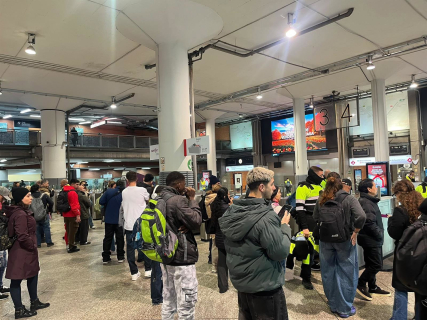

The mandatory minimum services set by the Ministry of Transport and Sustainable Mobility for the day of a general strike that began at 0.00 hours this Wednesday ensure the average circulation of 73% of Renfe’s High Speed and Long Distance trains, 72.7% of those of Iryo, and 69.23% of those of Ouigo.
In the Madrid Suburban rail networks managed by the General State Administration, the resolution establishes coverage of 75% of the usual service during the hours of highest demand—for Renfe, between 6.00 and 9.00 hours; from 13.30 to 15.30 hours and from 18.30 to 20.30 hours—and 50% during the rest of the day.
For Renfe’s conventional Medium Distance and high-speed services, an average protection of 65% has been set, while in Rail Freight traffic the essential services are limited to 26% of the scheduled runs.
111 High Speed and Long Distance trains cancelled
Across the High Speed and Long Distance transport operated by the three commercial companies in Spain (Renfe, Iryo and Ouigo), of a total of 403 trains affected or scheduled for today, 292 protected services will run as essential minimums, which represents 72.46% of the total and the cancellation of 111 runs (27.54%).
In the case of Renfe, for High Speed and Long Distance trains, of the 333 commercial runs of a normal day, the Government resolution guarantees 73%, which implies that 242 trains will operate and 91 will be cancelled.
In Iryo, of the 44 runs scheduled for this Wednesday with a potential demand of 20,284 travelers, the departure of 32 trains is assured (72.7%) and 12 are cancelled, with a forecast of 5,532 affected users (27.3%).
In Ouigo, of the 26 runs planned with a potential supply of 12,433 seats, coverage of 69.23% has been established through the mandatory operation of 18 trains. In this way, eight services are annulled, which will directly impact 3,457 passengers (27.8%).
Suburban rail, Medium Distance, and freight traffic
In Suburban rail, the minimum services have been designed to prioritize travel during the time slots with the highest concentration of passengers.
Thus, in Madrid and in the centers of Asturias, Cantabria, Galicia, Castile and León, Seville, Cádiz, Málaga, Valencia, Murcia and Zaragoza, 75% of minimum services are set during peak hours—between 6.00 and 9.00 hours, from 13.30/14.00 to 15.30/16.00 hours, and from 18.30 to 20.30 hours—and 50% in off-peak hours.
On the C2 line of Asturias, coverage during off-peak hours is reduced to 30%. In addition, the resolution reminds that the regulation of strikes on Rodalies de Cataluña and on the Cercanías of the Basque Country corresponds to their respective regional governments.
On Renfe Medium Distance trains, of the 641 affected convoys on the day, 417 (65%) will run as minimum services, while 224 services will be canceled.
As for Renfe Mercancías, 56 trains will operate out of a total of 217 affected, which represents 26% of the services, with the aim of ensuring the critical supply of steel products, automotive, dangerous goods, fuels, agrofood raw materials and the removal of urban solid waste in Galicia (Sogama).
More than 6,800 workers assigned to minimum services
To ensure the operability and safety of the railway network during this 24-hour strike, the State Secretariat for Transport and Sustainable Mobility has ordered the allocation of specific staff in each of the entities and companies in the sector.
At Adif, 2,589 working people have been designated for minimum services for the night shifts of 10 November and the three shifts of this Wednesday 11, out of a workforce of 12,771 employees called to strike. These personnel are responsible for command and traffic positions, corrective maintenance of track and facilities, electrical remote controls, and safety in stations.
At the Renfe Group, 4,123 workers must attend, which represents 30.47% of the workforce called to strike.
At Ouigo, 114 professionals are mobilized (53.52% of the staff with the scheduled shift), of whom 19 are drivers, 54 crew on board, 13 from the operations center and 28 from central services.
Finally, at Iryo, 33 essential operations and on-board workers are assigned, which represents 67.35% of the operational standard.