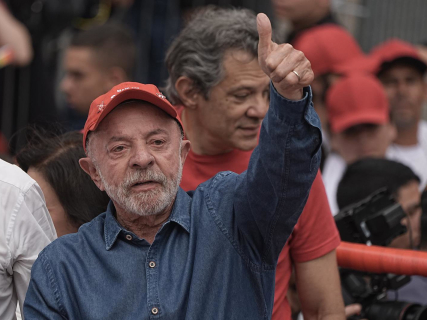

Brazil is already voting in the second round facing Luiz Inácio Lula da Silva and Flávio Bolsonaro. The two candidates have gone to the polls during the morning of this Sunday, October 25: the president, in São Bernardo do Campo, in the state of São Paulo; his opponent, in Rio de Janeiro. Attention now turns to participation and the development of a day whose national result will begin to be known tonight in Spain.
More than 158.7 million voters are called to vote. Brazilian polling places operate on a unified schedule, from 08:00 to 17:00 Brasília time, equivalent to 12:00 and 21:00 in the Peninsula and Balearic Islands after the time change. Those waiting in line at closing will retain the right to cast their vote.
Lula votes in São Bernardo and Flávio Bolsonaro calls to participate despite the rain
Lula has voted in São Bernardo do Campo, accompanied by his wife, Janja, and political allies. The locality in the industrial belt of São Paulo is once again the chosen setting for the electoral image of the president, who seeks to remain at the forefront of the country.
Flávio Bolsonaro arrived around 08:20 at the municipal school Barão Homem de Mello, in Vila Isabel, in the northern zone of Rio de Janeiro. He did so alongside his wife, Fernanda. According to Metrópoles, the candidate plans to follow the counting in Brasília.
The candidate of the Liberal Party has taken advantage of the day to insist on mobilization. In a message captured by Band, he has called to go to the polling places whether it rains or shines. The weather has thus entered the last-minute calls, although that message does not itself warrant interruptions of the voting.
Are there incidents in the elections in Brazil?
The first local reports describe scenes of normality, although they still do not allow for a nationwide balance.
In Ananindeua, in the state of Pará, O Liberal describes a calm morning at the Luiz Nunes Direito school, considered the largest voting center in the state. The establishment allowed the entry of elderly people before the start of voting.
In Natal, Tribuna do Norte also collects testimonies from voters describing tranquility at the municipal school Emmanoel Bezerra, despite the presence of lines in several sections.
The president of the Superior Electoral Court, Kassio Nunes Marques, voted early in Brasilia. He previously witnessed the opening checks of the polling station, including the issuance of the document that certifies that the electronic ballot box starts without registered votes. His message has been one of confidence in a calm election, an expectation that must be distinguished from the final balance of the day. [
The rain, the lines, and participation: what to look for before the results
During the voting hours, the most useful information will be that which allows knowing if voters can access their polling places and exercise their right normally. The existence of a line or an episode of rain does not allow deducing, by itself, who is better mobilizing their supporters.
Weather monitoring is part of the electoral device. According to UOL, the TSE has a national room that coordinates the monitoring of climate risks and possible contingency measures.
Participation takes on special interest in a second round because the supports must be expressed again. The votes from the first election do not carry over to the counting of this Sunday: the candidates compete again for the majority.
Flávio Bolsonaro led in the first round, but the count starts from zero
Flávio Bolsonaro finished the first round with 47.03% of valid votes, compared to Lula's 45.16%. The distance was 1.87 points. That is the previous electoral reference, not the result of the voting taking place today.
To follow the presidential race, it will be necessary to wait for the official totalization and jointly observe the progress of the count, the difference between candidates, and the territories that still have pending votes.
What time will we know who wins the elections in Brazil
The TSE will begin to disseminate the results starting at 17:00 in Brasilia: 21:00 in mainland Spain and 20:00 in the Canary Islands. The data can be consulted on the official results portal of the Electoral Justice.
This time marks the beginning of the publication, not the announcement of the winner. The pace will depend on the reception and processing of the ballot reports. The system allows tracking the national progress and consulting the details by states, municipalities, and electoral zones.
The first advantage that appears on the screen should be interpreted with caution. A partial count is not a survey designed to represent the entire country: it shows the votes that have arrived up to that moment. The Presidency will be decided with the national sum, and there is no guaranteed fixed hour to know the winner.