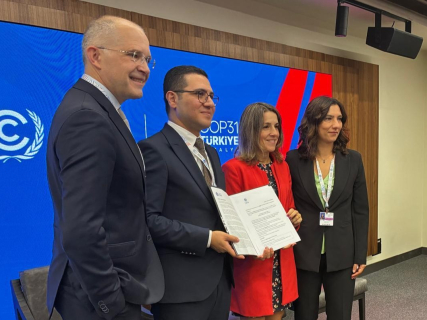

The biogas and the biomethane gain ground on the international climate agenda. The COP31, held in Antalya (Türkiye), has hosted the presentation of the so-called Biogas Declaration, a document that urges countries to redouble their efforts to expand the production and the sustainable use of these renewable gases and their byproducts. The initiative places the focus not only on the capacity to produce them, but also on the need to develop markets that absorb that energy, infrastructures that make it possible to integrate it, and regulatory frameworks that facilitate its use.
The declaration was presented during a session held in the Pavilion of Türkiye, in the Blue Zone of the conference, in which the United Nations Economic Commission for Europe (UNECE), the European Biogas Association (EBA) and the Spanish Gas Association (Sedigas) took part. The Deputy Minister of Energy and Natural Resources of Türkiye, Nevzat Şatıroğlu, was in charge of presenting and signing the document.
The COP31 urges countries to redouble their efforts to expand the production and the sustainable use of these renewable gases and their byproducts
From Sedigas they consider that biomethane can connect decarbonization goals with energy security and the development of rural areas. Its Secretary General, Naiara Ortiz de Mendíbil, states that Spain has organic resources and a gas infrastructure that would allow it to move forward in the production and consumption of renewable energy of local origin.
"The Biogas Declaration recognizes the value of an available solution that connects climate action with energy security and rural development. For Spain, it is an especially relevant opportunity: we have organic resources and a gas infrastructure that allow us to move forward in the production and consumption of renewable energy of local origin," says Ortiz de Mendíbil.
It also points out that "the challenge is to turn that potential into projects that bring benefits to the territory. We need to facilitate investment and speed up procedures, with all environmental guarantees and a close dialogue with local communities. We encourage the Government of Spain to back this Declaration and to accompany that commitment with measures that make it possible to accelerate the sustainable development of biomethane".
The association calls on the Government to support the declaration and to back that commitment with concrete measures. Among its priorities it lists streamlining administrative procedures, creating conditions that facilitate investment, and maintaining environmental guarantees and dialogue with local communities.
The sector calls on the Government to support the declaration and to back that commitment with concrete measures
Spain could cover half of its gas demand with biomethane
The Spanish potential is one of the central arguments of Sedigas’ claim. The Study of the capacity for biomethane production in Spain, prepared by the association and published in January 2023, estimates that the country could produce up to 163 terawatt-hours (TWh) annually of this renewable gas. That amount would be equivalent to approximately half of the national natural gas demand.
This is an estimate of technical capacity, not of currently available production. The study calculates that making use of all that potential would require setting up 2,326 specialized plants and mobilizing an investment close to 40,500 million euros, equivalent to 3.6% of GDP. The construction and operation of these facilities would make it possible to generate around 62,000 direct and indirect jobs.
The report also attributes to biomethane development environmental and energy benefits. Its production would make it possible to use organic waste that, otherwise, could end up releasing methane into the atmosphere during decomposition. According to Sedigas’ calculations, this would avoid the emission of 8.3 million tonnes of this gas. In addition, the association estimated that developing the entire national potential could have meant savings of up to 4,000 million euros on consumers’ energy bills in 2022, by reducing gas purchases from third countries.
Intermediate crops and forest waste, among the main resources
The study identifies different sources of raw material to produce biomethane. The main one is intermediate crops, which would provide 58.8 TWh annually, 36.1% of the total potential. Next are residual forest biomass, with 27.66 TWh (17%); livestock waste, with 25.48 TWh (15.6%), and agricultural waste, with 24.77 TWh (15.2%).
The remaining potential comes from landfills, with 8.81 TWh (5.4%); organic municipal solid waste, with 7.92 TWh (4.9%); waste from the agri-food industry, with 6.42 TWh (3.9%), and wastewater treatment plants, with 2.99 TWh (1.8%). This diversity of resources makes it possible to link the sector’s development with the management of agricultural, livestock, forestry and urban waste.
The territorial distribution is also not homogeneous. Castilla y León leads the production potential, with 37.78 TWh per year, 23.2% of the national total. Andalucía ranks second, with 23.62 TWh (14.5%), followed by Castilla-La Mancha, with 20.37 TWh (12.5%). These three communities together account for 50.2% of the estimated capacity. Aragón, with 17.62 TWh, and Cataluña, with 14.46 TWh, complete the top five positions.
Biomethane in Spain, awaiting the quotas that will guide its demand until 2035
The draft Royal Decree to boost biomethane seeks to provide producers and buyers with a reference point for planning their investments. As part of the development of article 26 of Royal Decree-Law 7/2026, of 20 March, the Ministry for Ecological Transition and the Demographic Challenge (MITECO) proposes that the marketing companies and the consumers that buy gas directly on the market must meet a minimum biomethane quota for uses other than transport.
According to the text submitted for public consultation, the quota would rise from 0.5% in 2028 to 6% in 2035, on the volumes of gas subject to the obligation. The period for submitting comments concluded in June and the National Commission on Markets and Competition issued its report in July, but the final approval of the regulatory text remains pending.
For the sector, having predictable demand in the medium and long term is decisive for the development of new plants. While the quotas and their schedule remain open, buyers will have less certainty about the volumes they will have to contract, which can delay the signing of the supply agreements that the project promoters need in order to finance their projects. Approval of the decree would allow that stimulus to be aligned with the measures that the draft itself provides to facilitate the connection of the plants to the gas network. In part, it is from that coordination that it will depend whether Spain can meet future demand with biomethane produced from its own organic waste and gradually facilitate the replacement of its imports.