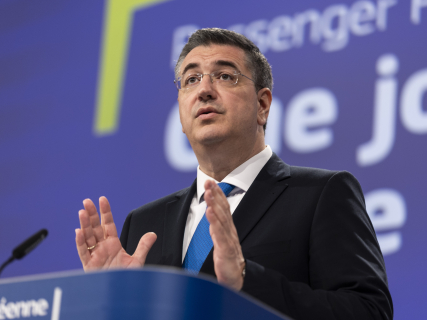
Brussels calls for accelerating the ERTMS across the entire European network: “Two serious accidents in a year is not something we want to see”

The Transport Commissioner, Apostolos Tzitzikostas, confirms that the European Railway Agency will provide technical assistance to the Spanish investigation, although he emphasizes that it will be directed entirely by national authorities

P 069750 00 10 01 ORIGINAL 432467

P 069750 00 10 01 ORIGINAL 432467

Add DEMÓCRATA to Google

Ask FREN

Published

Last updated

3 minutes

Most read

Elecciones 29N · Encuestas

La media de las encuestas

Media a 3 de noviembre de 2026 · 17 institutos

  • PP30,4 %
  • PSOE27,4 %
  • Vox19,2 %
  • Frente Amplio6,5 %
  • ERC2,4 %
  • Podemos2,4 %
010203040ene 2024jul 2024ene 2025jul 2025ene 2026jul 2026

Media del último estudio de cada instituto en 30 días y su evolución semanal desde el 23J. Partidos con al menos un 2 %.

Todas las encuestas

Elecciones generales del 29 de noviembre · Demócrata

The European Commission has avoided on Wednesday anticipating conclusions about the causes of the Urda train accident, in Toledo, and has defended the need to speed up the deployment of the European signaling system ERTMS to strengthen the safety of the Community rail network. The Commissioner for Sustainable Transport and Tourism, Apostolos Tzitzikostas, has confirmed that the European Union Agency for Railways (ERA, for its English-language acronym) will provide technical assistance to the investigation opened by Spanish authorities, at the request of the latter.

"It is too early to draw conclusions about the causes of this accident. The independent investigation will establish the facts," Tzitzikostas said during the presentation of the European strategy for sustainable transport. The commissioner has insisted that the investigation will remain "under the authority and direction of the Spanish investigators," despite the technical support that the Community agency will offer.

The European official has conveyed his condolences to the victims, their families, and all the people affected by the incident. "My thoughts are with the victims, their families, and their friends," he said, before stressing that safety is a non-negotiable priority for the Community Executive. "For all modes of transport, safety will always be my number one priority. For us, in the Commission, safety is non-negotiable."

The European Railway Agency will assist Spain

Tzitzikostas’s intervention comes after the Spanish authority in charge of the investigation requested this same Wednesday the collaboration of the European Railway Agency. The Community body will make available to the Spanish investigators the technical assistance that proves necessary, although it will not assume direction of the inquiries nor replace the national authorities.

The commissioner has explained that Brussels maintains contact with Spain and is prepared to provide support during the process. However, he has avoided commenting on the possible causes of the accident or establishing any link between the incident and the condition of the infrastructures, signaling systems, or rail operations. The Commission’s caution comes after the Urda accident has again placed rail safety at the center of the European debate. Asked about the succession of serious accidents recorded in Spain and about the impact these episodes may have on citizens’ trust in rail, Tzitzikostas acknowledged his concern.

"Two serious accidents in a year is not something we want to see, especially when these accidents cause tragedies and loss of human lives," he pointed out. The commissioner, however, has avoided establishing a link between the two incidents and has reiterated that it is up to the investigations to determine what happened in each case.

ERTMS, one of Brussels’ priorities

Beyond the Urda investigation, Tzitzikostas took advantage of the presentation of the sustainable transport strategy to call for accelerating the deployment of the European Rail Traffic Management System (ERTMS). This is one of the main Community tools for moving toward an interoperable rail network, with common signaling and traffic control standards. The commissioner argued that its rollout across the entire European network is a necessary condition to raise safety levels and facilitate the development of high-speed rail transport. "If we want to increase the safety of the European rail network, we have to deploy the ERTMS system as soon as possible on all our lines," he said.

The system makes it possible to progressively replace the different national signaling and control mechanisms with a common technology, with the aim of improving interoperability between the networks of the member states. Its deployment is also one of the central elements of European policy to promote rail as an alternative to road transport and reduce emissions from the sector. Tzitzikostas has argued that the Commission will continue to monitor the application of European rail safety rules in the member states. The Community Executive wants to strengthen the role of the European Union Agency for Railways in this area and expand its capacity to intervene in matters related to safety.

The strategy presented this Wednesday is part of Brussels’ effort to make rail a central infrastructure for European mobility. However, the Urda accident once again brings to the table the gap between the Community objectives of modernization and interoperability and the need to guarantee effective safety in rail operations.

More key points, information and questions with FREN

AI-GENERATED CONTENT

What is the status of the ERTMS system implementation on the Spanish and European railway network?

The implementation of ERTMS is progressing but remains uneven: Spain stands out for its deployment on high-speed lines, while pending actions remain on conventional and commuter lines. In the European Union, coverage continues to be limited and the pace is insufficient to meet the 2030 targets. This assessment, as of November 4, 2026, combines recent Spanish information with European statistics whose latest comparable closure corresponds to 2024.

What it means to have ERTMS implemented

The European Rail Traffic Management System combines automatic train protection —ETCS, which monitors speed and authorized movement— and railway communications. At level 2, information is continuously transmitted by radio to the cab. Its purpose is to facilitate cross-border traffic and improve capacity management and safety.

The decisive distinction is between contracted, installed, in testing, and authorized to operate. An equipped line cannot be automatically operated with ERTMS: it also requires technical validation and compatible trains.

Spain: advanced deployment but incomplete

The Ministry of Transport announced on October 2, 2026, that Adif had more than 3,100 operational kilometers, mainly on high-performance lines. This figure does not equate to coverage of the entire Spanish network nor should it be directly compared with double-track kilometers counted by other countries.

  • Barcelona Commuter Rail (Rodalies): 280 million euros have been mobilized. L’Hospitalet–Mataró had completed works and internal technical validation but was preparing documentation to request authorization from the State Railway Safety Agency. Manresa–Barcelona Sants and Barcelona–Sant Vicenç de Calders were still renewing installations; L’Hospitalet–Vilafranca–Port Aventura was progressing linked to the Mediterranean Corridor. Can Tunis–Mollet was reviewing pre-installations; La Sagrera–Granollers was in contracting and Granollers–Maçanet in project drafting. This is detailed by Transportes.
  • Madrid–Sevilla: according to Demócrata, October 29, ERTMS was still in testing and its full commissioning was expected in the first quarter of 2027, with LZB maintained during the transition. The signaling contract, awarded in 2021 for 93.83 million euros, should not be confused with the 780 million of the complete modernization program.
  • Regional networks: Mallorca is deploying ERTMS with a total investment exceeding 51 million, including infrastructure, trains, and control center, according to the Balearic Government. In Euskadi, information from March placed night tests between Irun and Hendaye, with planned extension towards Oiartzun, according to the Basque Government.
European Union: far from widespread coverage

The third European work plan places, at the end of 2024, approximately 12,400 operational kilometers: 10% of the TEN-T trans-European network. In its core network, it was about 10,600 kilometers, 17%. Additionally, around 8,730 vehicles —19% of the European fleet— had ETCS.

The European Commission warns that planned actions on another 28,000 kilometers until 2030 are insufficient to equip the 62,960 kilometers of the core network by that horizon. Significant national differences exist: Belgium completed the equipment of its main network in December 2025, after Luxembourg.

The pending challenge

The challenge no longer consists only of installing equipment: it requires coordinating infrastructure and rolling stock, harmonizing versions, completing tests and authorizations, and ensuring cross-border continuity. Spain has an important operational base; Europe still needs to turn fragmented national deployments into an interoperable network.

What are the competencies and functions of the European Union Railway Agency?

The European Union Railway Agency (ERA) has the mission to ensure that trains run across Europe with common safety and technical compatibility requirements. It combines advisory and harmonization functions with decision-making powers: it authorizes vehicles, issues single safety certificates, and approves certain European signaling solutions within the scope granted by legislation.

Its main framework is Regulation (EU) 2016/796, complemented by the European interoperability and railway safety directives, both from 2016. These rules constitute the technical pillar of the fourth railway package.

Competencies involving binding decisions

  • Authorization of vehicles and vehicle types. ERA grants the authorizations required for market entry. It is competent when the area of use covers multiple Member States and cooperates with national authorities to assess applicable requirements. If use is limited to a single State, the applicant may choose, according to the applicable regime, either the Agency or the national authority.
  • Single safety certificate. It issues this to railway companies intending to operate in multiple Member States. It verifies that they have an adequate safety management system for their operations. When activity is limited to one State, the national authority may also intervene, according to the legally provided option.
  • Prior approval of ERTMS on track. It evaluates the technical solutions planned for trackside equipment of the European Rail Traffic Management System before the corresponding procurement procedures. It aims to avoid incompatible installations between countries. This approval does not equate to fully authorizing a railway infrastructure.

The Agency's information explains these powers and its cooperation with national authorities.

Technical harmonization and safety

An essential part of its work is removing obstacles that prevent the same train from operating on different networks:

  • Interoperability. It prepares recommendations to develop and revise technical interoperability specifications: common requirements so that vehicles, infrastructure, and other components work together.
  • Safety methods and objectives. It contributes to developing common criteria to assess risks and outcomes, collects data, and publishes analyses on the evolution of railway safety.
  • Review of national standards. It examines requirements notified by States and identifies duplications or incompatibilities with European rules, promoting their simplification.
  • Institutional monitoring. It supervises through evaluations and audits the functioning of national safety authorities and performs monitoring tasks of notified bodies that verify technical conformity.
  • Authority of the ERTMS system. It supports the coherent evolution of its specifications and a uniform interpretation of European signaling requirements.

Information, assistance, and limits

ERA maintains European registers of authorized vehicles and types, as well as tools on safety and national standards. It manages the single window for submitting authorization and certificate applications and provides guidance, training, and technical assistance to institutions and railway agents. The EU institutional description summarizes this mandate.

It also supports railway digitalization. The 2026 telematics regulation specifies its role as systems authority to facilitate interoperable data exchange.

It does not replace all national authorities nor legislate on its own. The Commission adopts the corresponding European provisions; national authorities retain supervisory and inspection responsibilities. In Spain, it cooperates with the State Railway Safety Agency. It can provide technical assistance in accident investigations but does not automatically assume their direction: this corresponds to the competent investigative body.

What legal requirements must be met for Member States to adopt ERTMS on all their railway lines?

The adoption of ERTMS (European Rail Traffic Management System) on all railway lines is not just a technical or investment decision: it is strongly conditioned by a European and national legal framework oriented towards interoperability and safety. Below is a summary of the key legal requirements that Member States must meet to deploy it widely.

1. European legal framework for interoperability

Firstly, the deployment of ERTMS falls within the EU railway interoperability regulations. These establish that the subsystems of the railway network (infrastructure, energy, rolling stock, and specifically control-command and signaling) must comply with common Technical Specifications for Interoperability (TSI).

For a Member State to implement ERTMS on its lines:

  • It must transpose and apply the basic EU interoperability and railway safety regulations into its national law.
  • It must treat the "control-command and signaling on track" subsystem as a structural subsystem subject to prior authorization before entering service.
  • It is obliged, on lines that are part of the trans-European transport network (TEN-T), to comply with applicable TSIs, which explicitly refer to ERTMS as the European standard.

In practice, this means that ERTMS is not adopted "tailored" country by country, but according to common European specifications aimed at enabling trains to run without technical border breaks.

2. Compliance with the Control-Command and Signaling TSI

The specific legal core of ERTMS is the Control-Command and Signaling TSI. This TSI:

  • Defines the ERTMS/ETCS and GSM-R system (or its evolution) as the reference for interoperable control and signaling in Europe.
  • Establishes base versions (baselines) and detailed sets of hardware, software, interface, and behavior requirements.
  • Minimizes additional "national rules", which are only allowed when justified by safety reasons and do not block interoperability.

Legally, a Member State wishing to deploy ERTMS:

  • Must require in its project and supply contracts that the installed system complies with the current TSI.
  • Cannot impose national variants that deviate from that TSI except in very strictly regulated cases and procedures provided by EU law.
  • Must notify and submit to European control any exception or "specific case" it intends to apply.

3. Conformity assessment and authorization procedure

Before being put into service, the ERTMS track subsystem must undergo a formal evaluation and authorization process:

  • The infrastructure manager contracts a notified body that verifies project compliance with the TSI and issues CE conformity certificates for the subsystem.
  • With these certificates, the authorization to put into service the control-command and signaling subsystem is requested from the competent national authority and/or the EU Railway Agency, according to the applicable division of functions.
  • The authority can only authorize if conformity with the TSIs and, where applicable, with validly notified national rules is established.

Additionally, track deployment must be coordinated with the onboard equipment on trains. Rolling stock is also subject to TSI and authorization; ERTMS only truly functions when both sides (track and train) are certified and compatible.

4. Planning, TEN-T, and scheduling obligations

European legislation on trans-European transport networks requires that core corridors (core network) and progressively the rest of TEN-T be equipped with ERTMS within certain deadlines. Legally, this implies that:

  • Each State must develop national ERTMS deployment plans consistent with the European plan.
  • It must notify these plans to the European Commission and update them periodically.
  • Failure to meet deadlines may lead to infringement procedures for violation of EU law.

Although deployment outside the TEN-T network is more flexible, in practice many States extend ERTMS to the rest of their main lines for operational coherence and long-term efficiency reasons.

5. Operational safety, operation, and maintenance

Finally, ERTMS must be integrated into the safety management system of the infrastructure manager and railway companies:

  • Operating procedures (traffic regulations, driving rules, failure protocols) must be adapted and recorded in internal rules compliant with EU and national law.
  • Personnel (drivers, traffic controllers, maintainers) must receive training and certification required by European and national regulations.
  • Maintenance and update programs must be established to ensure continuous compliance with the TSI and required safety levels.

In summary, therefore, the adoption of ERTMS on all lines is not a simple technological option but the result of a combination of European obligations on interoperability and TEN-T, strict subsystem evaluation and authorization requirements, and adaptation of operation and safety to a common legal framework throughout the Union.

Play

Test your knowledge with FREN!

How much do you know about this topic? Answer the following 3 questions.

What is the main priority of the European Commission in transport according to Apostolos Tzitzikostas?

Question 1 of 3

Who will lead the investigation into the Urda railway accident?

Question 2 of 3

What is one of the main objectives of deploying the ERTMS system on the European railway network?

Question 3 of 3