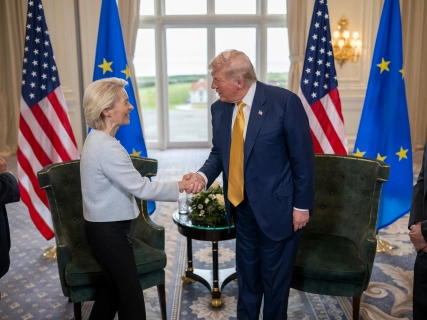

Time was pressing. Lawmakers were aware that they were facing a real race against time. This Wednesday, in the early morning, the Council, the Parliament, and the European Commission reached an agreement on the application and deployment of the legal texts linked to the so-called "zero tariffs" with the United States, after the political pact signed last year by the President of the Commission, Ursula von der Leyen, and her US counterpart, Donald Trump.
In the EU capital, the idea that it was necessary to honor what was agreed to demand reciprocity from Washington was widely held. "An agreement is an agreement, and the EU honors its commitments," celebrated the EU leader early in the morning, who believes that "soon" "our part" of the deal will be fulfilled. "Now I urge lawmakers to act quickly and finalize the process," she also warned on social media, referring to the next steps planned in the European legislative procedure.
Before the meeting, the Republican leader had threatened the Europeans with a new tariff ultimatum in case they were unable to close the text before next July, when the first anniversary of the well-known photo of Turnberry, in Scotland, will be celebrated. The pressure fell especially on the clauses that the European Parliament had introduced into the agreement initially negotiated by the Community Executive. These modifications had to do with the conditions for the suspension of the tariff benefit, its effective application, as well as the planned expiration date.
MEPs argued that Brussels could activate the suspension of all or some of the trade preferences if Washington chose to impose additional tariffs exceeding the agreed maximum limit of 15% or any new customs duty on goods from the European Union. This clause could also apply if the United States "undermined the objectives of the agreement, discriminated against EU economic operators, or threatened the foreign or defense policies of the Twenty-Seven."
Europe toughens conditions
Regarding the practical application of the mechanism, Strasbourg proposed that the agreement could only fully enter into force once Washington respected its commitments. This involved reducing its tariffs to a maximum of 15% for European products with a steel and aluminum content of less than 50%.
“In the case of products with more than 50% steel and aluminum, if Washington does not lower the levies to a maximum of 15%, the tariff preferences for US exports of steel, aluminum, and other derivatives would cease to apply six months after the regulation enters into force,” the sources consulted explained at the time.
The European Parliament thus sought to introduce a system of reinforced conditionality that would avoid automatic application of the agreement without sufficient legal guarantees from the United States. In Brussels, there was a fear that the Trump Administration would opt to unilaterally reinterpret certain trade commitments once the text was fully operational.
The battle for the expiration date
However, Parliament had also put on the table during negotiations the need for this sort of commercial approval to expire on March 31, 2028, just one year before the end of the American leader's presidential term. Negotiators, however, opened the door to a possible postponement through a new legislative proposal drawn up after a detailed assessment of the impact of the tariff cut, especially on the most exposed industrial sectors.
The objective was to gain political leeway to align the duration of the agreement with the evolution of the transatlantic relationship and with Trump's permanence in the White House.
Finally, after hours of negotiation between the three Community institutions, the planned expiration date will be set for the end of 2029, according to sources familiar with the agreement.
Mechanisms that, according to negotiators, will be expressly reflected in the text agreed upon overnight. “The co-legislators agreed to strengthen the main regulation by establishing a robust safeguard mechanism, reinforcing the provisions of the suspension clause, and introducing a start-up clause, among other elements,” according to sources from the European Council, who also qualify that part of these elements were transferred to the second regulation concerning imports of American lobster.
The new safeguard mechanism
Specifically, the safeguard mechanism will function in such a way that, following a duly substantiated request from three or more Member States, from EU industry or trade unions, or even on its own initiative, the European Commission will initiate an examination to assess whether the increase in imports has caused serious damage to Community products.
If sufficient evidence is found, Brussels will be able to partially or totally suspend the trade agreement.
The inclusion of this clause was one of the main demands of both the European Parliament and several Member States from southern and eastern Europe, concerned about the impact that asymmetric trade liberalization could have on certain manufacturing sectors, especially those linked to steel, aluminum, and certain strategic industrial components.
EU sources maintain that the objective of this mechanism is to offer the Union a rapid reaction tool against potential trade imbalances or practices considered unfair by Washington.
The pressure of the calendar marks the negotiations
The truth is that the calendar was clearly working against those who still demanded more time to legally shield the proposal. The agreement reached will now have to pass, once again, through the filter of the European Parliament, as well as receive the formal backing of the Twenty-Seven in the Council.
In Brussels, there was a fear that any further delay could be interpreted by Washington as a political breach of the pact reached last year between Von der Leyen and Trump. The Commission had been insisting for weeks that the community bloc should send a signal of institutional reliability and regulatory stability at a time marked by rising international trade tensions and growing geoeconomic competition between powers.
Brussels Renounces Retaliation in Exchange for a 15% Cap
Brussels ultimately gave up imposing retaliatory tariff measures against the White House in exchange for a fixed cap of 15% for European products exported to the United States.
A limit that, however, will not be applicable to European steel and aluminum, which will continue to face a 50% levy, one of the most controversial points of the political understanding reached between both parties.
The text, which already provoked no small amount of criticism against Von der Leyen inside and outside the European Parliament, also includes the political commitment of the European Union to acquire American energy worth 750 billion dollars and to boost investments in the United States by another 600 billion.
Commitments that, however, were not part of the legislative proposals discussed on Tuesday night, as they correspond fundamentally to national and not strictly community competencies.
Several MEPs also questioned the real viability of these figures and warned of the risk of presenting political commitments that are difficult to materialize legally. The Commission, for its part, has defended that these forecasts should be interpreted as indicative objectives linked to strengthening the transatlantic economic relationship and not as legally enforceable obligations on the Member States.
European Industry Demands Certainty
"It would be beneficial for the main aspects of the agreement to be in force before its first anniversary," stated a few weeks ago an official from the Community Executive familiar with these discussions, emphasizing the urgency that has prevailed for months in the European institutions.
In this context, the pressure was not solely due to political deadlines, but also to the need to offer regulatory certainty to the markets and to the most exposed industrial sectors, especially the automotive industry, which fears a deterioration of trade relations with the United States at a particularly delicate moment for the European industrial transition.
“It is useful and important to maintain frequent dialogue to clarify each party's position in the agreement implementation process,” stated the European Executive in recent weeks. The Commission believes that the legal architecture finally agreed upon provides sufficient tools to react to potential US non-compliance without jeopardizing the general framework of the political understanding.
Fear of a new trade escalation
Von der Leyen even warned that the Twenty-Seven were prepared for “any scenario” in the event that the pact ended up being broken if Trump ultimately chose to impose a 25% tariff on European automobiles, as he hinted after his political confrontation with German Chancellor Friedrich Merz, regarding European military contributions and the burden-sharing in defense matters.
Despite the technical agreement reached early this morning, no one in Brussels yet considers the transatlantic trade crisis to be over. The EU institutions are aware that the stability of the pact will largely depend on political developments in Washington and the willingness of the US administration to respect commitments that, although legally binding in part, remain deeply conditioned by the geopolitical and electoral context.
In parallel, various European diplomats acknowledge that the Union has opted for an eminently pragmatic strategy: to avoid an open trade war with the United States at a particularly delicate moment for the European economy, marked by industrial slowdown, rising energy costs, and growing Chinese competition in strategic sectors.
Therefore, although the agreement reached early this morning allows Brussels to gain time and temporarily stabilize the transatlantic relationship, within European institutions the perception persists that the tariff dispute with Washington is far from being definitively resolved.