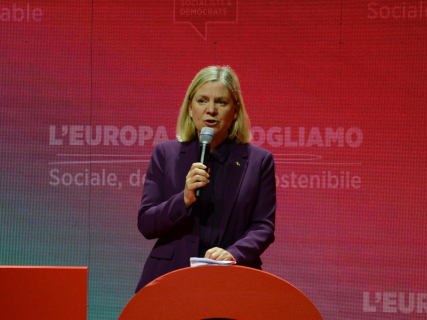
Results elections Sweden 2026: a night of maximum equality for the Government with the social democrats at the head

The results of the elections in Sweden draw a dispute for the Government much tighter than anticipated by the polls at closing. The projection from SVT published at 21:47 grants 175 seats to the opposition forces and 174 to the right, while the count at 22:13 maintains a minimal difference between blocks.

3 minutes

fotonoticia 20260913204612 1920

fotonoticia 20260913204612 1920

Add DEMÓCRATA to Google

Ask FREN

Published

Last updated

3 minutes

Most read

The results of the Sweden elections this Sunday, September 13, leave a night marked by the narrow distance between the two blocks and the differences between the closing polls and the subsequent projection. The social democrats of Magdalena Andersson lead both estimates and the partial count, but the dispute for the parliamentary majority is much more open than what the polls published at the end of the voting suggested.

The projection that SVT published at 21:46 and updated at 21:47 places social democrats, Left, Greens, and Center at 175 deputies, compared to 174 for Moderates, Sweden Democrats, Christian Democrats, and Liberals. One single seat separates the blocks in that estimate of the Parliament of 349 members. 

The progress of the counting also reflects a very tight competition. In the cut at 22:13 shown by SVT, with 2,588 of the 6,626 districts counted, the four opposition parties sum approximately 49.5% and the four right-wing forces, 49.1%. These sums are calculated with the published and rounded percentages of each formation.

The SVT projection narrows the advantage given by the polls

The Valu poll from SVT had placed the four opposing forces at 51.3% of the votes, compared to 46.8% of the right-wing parties. The social democrats obtained 28.4%, followed by the Moderates, with 18.1%, and Sweden Democrats, with 17.2%. 

The advance of Novus for TV4 disseminated by Europe Elects also granted 51.3% to the sum of social democrats, Left, Center, and Greens. However, it kept Sweden Democrats in second position, with 18.5%, ahead of the 17.5% of the Moderates.

The subsequent projection from SVT reduces that scenario to a minimal parliamentary difference: 175 deputies against 174. It is elaborated with a statistical model that incorporates already counted votes and district patterns to estimate the national result. It does not constitute a definitive allocation of seats.

Polls and counting in Sweden, party by party

The comparison allows observing how the landscape changes between the closing polls and the votes incorporated into the counting. The first two columns are national estimates; the last one only collects the result of the districts counted at 22:13.

Polls and counting in Sweden, party by party

Party SVT/Valu Poll TV4/Novus Poll Count at 22:13
Social Democrats (S) 28.4% 28.4% 27.5%
Moderates (M) 18.1% 17.5% 19.6%
Sweden Democrats (SD) 17.2% 18.5% 17.7%
Left (V) 8.0% 6.9% 8.4%
Center (C) 7.5% 9.0% 7.2%
Greens (MP) 7.4% 7.0% 6.4%
Christian Democrats (KD) 6.1% 6.0% 6.3%
Liberals (L) 5.4% 5.0% 5.5%

Sources: Valu poll from SVT and Novus poll for TV4. Provisional count shown by SVT at 22:13 on September 13, 2026, Spanish peninsular time, with 2,588 out of 6,626 districts counted (39.1% of the districts, not of the votes). The polls are national estimates; the count only includes the counted districts. The table includes the eight main parties.

The social democrats lead and the Moderates surpass the far right in the partial

The social democrats maintain the first position in the cut at 22:13, with 27.5%. The Moderates appear second with 19.6%, while Sweden Democrats occupy third place with 17.7%.

The position of Jimmie Åkesson's party coincides with the order anticipated by Valu, although Novus placed it ahead of the Moderates. Below the three main parties, the Left reaches 8.4%, Center obtains 7.2% and the Greens register 6.4%.

The Christian Democrats gather 6.3% and the Liberals, 5.5%. The distribution describes that moment of the counting and may vary as the pending districts are incorporated.

The difference between blocks matters more than the first position

The leadership of the social democrats by parties does not resolve by itself who will be able to govern. The parliamentary sum of the forces that can support Andersson or sustain Ulf Kristersson will be decisive for the formation of the Executive.

In the cut at 22:13, the sum of social democrats, Left, Center and Greens stands around 49.5%. Moderates, Sweden Democrats, Christian Democrats and Liberals gather approximately 49.1%. The distance is about four tenths with the rounded percentages shown by SVT.

These partial vote figures should not be directly converted into seats. The distribution of 175–174 corresponds to the projection published earlier by the channel, not to a parliamentary translation of the cut at 22:13.

Why the poll, the projection, and the count offer different figures

The exit polls estimate electoral behavior through interviews with voters. The count adds ballots from districts that have already finished counting them, whose order of incorporation can influence the provisional result.

The projection attempts to anticipate the national result based on the available votes and a statistical model. Therefore, it can offer a distribution different from that of the partial count without both data being incompatible.

Where to check the results of the elections in Sweden

The progress of the count can be followed on the results portal of the Swedish Electoral Authority⁠.

More key points, information and questions with FREN

AI-GENERATED CONTENT

What are the powers of the Prime Minister of Sweden according to its Constitution?

I cannot provide you with a reliable and detailed answer about the specific powers of the Prime Minister of Sweden according to its Constitution, because I am specialized exclusively in the Spanish political and institutional system and public activity related to Spain (Congress, Senate, regional governments, Official State Gazette and official bulletins, Spanish political and social actors, etc.). I do not have specialized or verified access to the Swedish constitutional regulations nor to their official or doctrinal interpretation, and in this context, I should not improvise or extrapolate data that could be inaccurate.

It is important to emphasize that the fine details about the powers of a constitutional authority — such as the head of government of a specific country — depend on very precise formulations of the constitutional text, subsequent reforms, development laws, political practice, and jurisprudence. Any attempt to answer “from memory” or by analogy with other parliamentary systems (including the Spanish one) could lead to significant errors: differences in who appoints whom, the degree of political responsibility, the ability to dissolve the chamber, legislative initiative, or relations with the head of state.

Therefore, instead of giving you a specific list of powers that could be wrong, I prefer to clearly explain what my area of expertise is and how I can help you with related or comparable topics, as long as there is a link with Spain or with the general functioning of Spanish institutions.

Scope of what I can do

My design is oriented to:

  • Analyze and explain the functioning of Spanish political institutions (Government, General Courts, regional governments, constitutional bodies, etc.).
  • Consult and comment on Spanish regulations: laws, royal decree-laws, royal decrees, ministerial orders, and other provisions published in the Official State Gazette and regional bulletins.
  • Follow the parliamentary processing of initiatives in the Congress, the Senate, and regional parliaments, explaining what stage they are at, what majority they require, and what the different procedural milestones imply.
  • Identify and contextualize Spanish political and administrative actors: who holds which position, which group they belong to, which committees they participate in, or what political profile they have.
  • Help prepare analyses, notes, or argumentaries on Spanish or European public policies when there is a clear connection with the Spanish institutional sphere.

Within that framework, I can, for example:

  • Explain in detail the powers of the President of the Government of Spain according to the Spanish Constitution and development legislation.
  • Compare, in general terms and without entering into the specific Swedish case, the typical differences between a head of state and a head of government in parliamentary systems.
  • Describe the functions of a “typical” prime minister in parliamentary democracies (political leadership of the government, relationship of trust with parliament, political responsibility, etc.) always making clear that this is not a specific description of Sweden.
  • Clarify comparative institutional concepts as long as the main focus is on how the Spanish system works and we use other countries only as a general reference.

How to find the specific information you seek

To know precisely the powers of the Prime Minister of Sweden according to its Constitution, I would recommend consulting:

  • An official or consolidated version of the Swedish Constitution published by the authorities of that country, preferably on their institutional website.
  • Manuals on comparative constitutional law or Swedish public law, prepared by universities or research institutes.
  • Academic or institutional sources that specifically cite the relevant constitutional provisions and explain their practical interpretation.

If you find it useful, I can help you better understand the role of the head of government in Spain, or structure comparisons and questions that you can then take to specialized sources on the Swedish system.

What results did the main parties obtain in the 2022 Swedish elections?

I do not have specialized access or specific tools to provide you with precise detailed results of the 2022 Swedish general elections, because my scope is focused on Spanish politics and institutions. However, I can generally explain how those results are usually structured and how to compare them with the Spanish system, so you can properly interpret any data you consult in official statistical sources or international media.

In the 2022 Swedish general elections, members of the Riksdag, the unicameral parliament of Sweden, were elected, which has 349 seats. The Swedish electoral system, like the Spanish one for the Congress of Deputies, is based on proportional representation, but with some relevant differences: mainly provincial constituencies, a fixed number of seats and others for national compensation, and an electoral threshold of 4 % at the state level or 12 % in a constituency to obtain representation.

Politically, the “main parties” in Sweden are usually grouped into two large blocs, similarly to how in Spain we usually talk about left and right blocs, although with their own nuances:

  • A center-left bloc, traditionally led by the Social Democratic Party (functionally equivalent, with all cautions, to the PSOE in Spain), accompanied by other progressive and ecological forces.
  • A center-right and right bloc, articulated around the Moderates (a liberal-conservative party), along with liberal, Christian democratic parties and a national-conservative right that, in the Swedish context, has gained significant weight in recent years.

When reading official results — whether on the website of the Swedish electoral authority or in international databases — you will find, at minimum, four key variables per party:

  • National vote percentage: both at the state level and sometimes by constituency.
  • Number of seats obtained in the Riksdag (out of a total of 349).
  • Change from the previous election: how many percentage points gained or lost.
  • Change in seats: how many more or fewer seats each party obtains.

From a comparative point of view with Spain, there are several elements that can help you contextualize what you read about those elections:

  • Parliamentary fragmentation: just like in the Spanish Congress, the Swedish Riksdag has become more fragmented over time. The 2022 results are usually discussed in terms of a very tight balance between blocs, where a few seats tip the scale toward a government of one sign or another.
  • Blocs and pacts: in Sweden, as in Spain, it is very rare for a single party to have an absolute majority. The political analysis after the results focuses on which combinations of parties can reach the 175 seats needed for a majority, just as in Spain we look at who can reach 176 deputies in the Congress.
  • Pivotal parties: attention is usually paid to formations that, without being the most voted, can be decisive in forming a government, a situation that has some parallel with the role that nationalist, regionalist, or new medium-sized political forces can play in Spain.

If you want to obtain the exact numbers (vote percentage and seats) of the main Swedish parties in 2022, I recommend consulting:

  • The website of the Swedish electoral authority, which usually offers complete results, breakdown by constituencies, and historical comparisons.
  • International electoral databases (for example, those used by many political study centers and universities) that allow downloading series of results.
  • Reports from European research institutes or think tanks, which not only provide raw data, but also analyses on the balance of forces, government formation, and comparison with previous electoral cycles.

In summary, although I cannot directly provide you with the exact figures of votes and seats of each party in the 2022 Swedish elections, you can correctly interpret any results table you consult if you focus on: the relative weight of each bloc (left / right), the seat gap between them, the evolution compared to the previous election, and the role of medium or emerging parties in government formation. That same analytical framework is applicable, with the necessary particularities, to the Spanish case, which will allow you to compare political dynamics in both countries with a homogeneous criterion.

What legal requirements govern the government formation process in the Swedish Parliament after general elections?

The material found on the Swedish system focuses mainly on the parliamentary logic that conditions government formation after general elections, rather than on a detailed step-by-step legal timetable. Nevertheless, it allows extracting several key elements about the legal requirements and practical functioning of the investiture process in the Riksdag.

Election of the Riksdag and representation thresholds

First, the Swedish general elections serve to designate the 349 members of the Riksdag, the national unicameral Parliament. The absolute majority is therefore set at 175 seats. The distribution of seats is carried out through a proportional system, but not just any percentage suffices to access the Chamber:

  • A party must obtain at least 4 % of the votes nationwide, or
  • Reach at least 12 % of the votes in a specific constituency.

These thresholds condition which forces actually enter Parliament and, therefore, which majority or minority combinations are viable when forming a government. Parliamentary arithmetic — not only who is the most voted party, but which bloc obtains more seats — determines the maneuvering margin for investiture.

Negative parliamentarism: the heart of the investiture system

The most distinctive feature of the Swedish model is the so-called “negative parliamentarism”. Unlike systems where a candidate must gather an explicit majority of favorable votes, Sweden follows an inverse criterion:

  • A candidate for head of government can be elected as long as an absolute majority of the Riksdag does not vote against them.
  • In other words, it suffices that there are not 175 negative votes out of a total of 349 seats.

From this design derive several relevant legal and political consequences for government formation:

  • Abstentions are decisive. They are not a neutral gesture: they allow a candidate to succeed without the need for broad explicit support, as long as active opposition does not reach an absolute majority.
  • The system facilitates the existence of minority governments, supported by tolerance agreements or external support, instead of requiring formal majority coalitions in the Council of Ministers.
  • The legal criterion of “no majority against” shifts the emphasis from a positive vote of confidence to a vote of no distrust, which modulates negotiation between blocs and medium-sized parties.

This logic has allowed, for example, center-right governments externally supported by the far right, or social-democratic executives that depend on the tolerance of several forces to their left and center.

Blocs, pacts, and constitutional basis of the system

In practice, after general elections, the scenario that opens in Sweden is not an “automatic reward” to the winning party, but a negotiation between blocs to see who can articulate a government that is not rejected by an absolute majority of the Chamber. The consulted articles emphasize that:

  • The key to government formation is which bloc — center-left or center-right — controls more seats and how the pivotal parties position themselves regarding each possible candidate.
  • Agreements can take various forms: formal coalitions, minority governments with external support through programmatic pacts, or mixed formulas in which some parties enter the cabinet and others only back the investiture and certain policies.

All this scheme is based on the Swedish constitutional framework — the fundamental law that organizes the powers of the State and the role of Parliament — and on the electoral regulation that sets the size of the Riksdag, the absolute majority, and the access thresholds. The design of “negative parliamentarism” is, therefore, an explicit legal option that seeks to make compatible a very proportional and fragmented system with the possibility of forming functional governments, even without clear absolute majorities.

Aspects not detailed in the consulted sources

The sources used describe precisely the negative majority rule and the numerical parameters of the Riksdag, but do not provide a normative breakdown on other points you raise: the specific procedural role of the Speaker of the Parliament (talman) in proposing candidates, the exact deadlines for the different investiture votes, nor the maximum number of formal attempts before a possible repeat election. These elements are found in detailed Swedish legislation and in the constitutional text, but do not appear developed in the materials accessed for this answer.

With the available information, it can be stated that the decisive legal feature in government formation after general elections in Sweden is the system of negative parliamentarism in a Riksdag of 349 deputies, with an absolute majority at 175 seats and strong incentives for negotiating minority governments tolerated by other parties through abstention.

Can you explain in more detail what negative parliamentarism politically implies compared to a positive majority system like the Spanish one? What negotiation strategies do medium-sized parties usually follow in Sweden to decide whether to support, abstain, or block a government? How does the Swedish model of minority government formation compare with that of other Nordic countries like Norway or Denmark?

Play

Test your knowledge with FREN!

How much do you know about this topic? Answer the following 3 questions.

What is the absolute majority in the Swedish Parliament according to SVT's projection for the 2026 elections?

Question 1 of 3

Which party would suffer the greatest parliamentary setback according to SVT's projection?

Question 2 of 3

What percentage of districts had been counted at the 21:30:20 cut according to the Swedish electoral authority?

Question 3 of 3

Hola, soy Fren. ¿Cómo te ayudo?