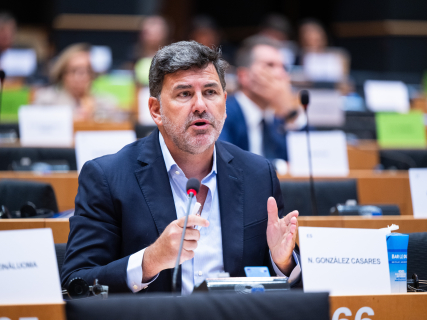
Socialists want to take advantage of the European AI law to tighten control over data centers

The socialist group seeks to introduce higher requirements for transparency and sustainability in future Community regulations, with special attention to the real energy consumption of these infrastructures, their environmental impact, and their compatibility with European climate objectives for 2050.

20260901 EP 209579B LD1 0037

20260901 EP 209579B LD1 0037

Add DEMÓCRATA to Google

Ask FREN

Published

6 minutes

Most read

Elecciones 29N · Encuestas

La media de las encuestas

Media a 19 de noviembre de 2026 · 18 institutos

  • PP31,1 %
  • PSOE27,4 %
  • Vox19,1 %
  • Frente Amplio6,2 %
  • ERC2,5 %
01020304050ene 2024jul 2024ene 2025jul 2025ene 2026jul 2026

Media del último estudio de cada instituto en 30 días y su evolución semanal desde el 23J. Partidos con al menos un 2 %.

Todas las encuestas

Elecciones generales del 29 de noviembre · Demócrata

Members of the European Parliament already have on their desks the draft of the future Cloud and Artificial Intelligence Development Act (Cloud and AI Development Act, CADA). The rapporteurs have presented their proposed report, thereby opening the phase in which the different political groups will try to incorporate their positions into an initiative that aims to consolidate the continent’s technological sovereignty and reduce its dependencies on third countries.

The text sets out four different levels of assurance at EU scale to regulate security, operational autonomy, and the location of data in computing services. In this scenario, the Socialist group intends that the rule that comes out of its processing in the European Parliament, before negotiations begin with the member states, guarantees a “people”-centered approach. This is a position that the Spanish government has been defending in the different legislative debates on the digital sphere that are currently taking place in Brussels.

“Each law is an opportunity,” the Socialist MEP and member of the Committee on Industry, Research and Energy (ITRE), Nicolás González Casares, said this week during a closed-door meeting. The parliamentarian argued that the continent “needs rules to also recover citizens’ trust” in technological development that works “not only for the digital world, but also for people.” One of the aspects he considers fundamental in the future legislation is precisely the regulation of the minimum performance standards of the infrastructures.

Four levels of assurance and common criteria for the Twenty-Seven

What the EU Executive is pursuing with this initiative is to harmonize the efforts of the member states and establish a common framework that will make it possible to guarantee the development of a sector considered strategically important for the Union. Regulatory fragmentation and differences in national criteria can hinder both the expansion of infrastructures and Europe’s capacity to compete in a market increasingly shaped by computing and the development of artificial intelligence model.

"If you cross Germany, Finland, Denmark or Portugal you will find different approaches," explained González Casares. Hence the MEP argues for the need to establish common requirements at the European scale, although with room to adapt them to the characteristics of each territory. In his view, the objective should be to prevent harmonization from turning into regulation alien to the material conditions in which infrastructures operate.

"You have to take geographical realities into account. Not all Member States have the same energy mix or the same climate," he added. A particularly relevant consideration for legislation that will have to address the impact of data centers on electricity consumption, the availability of water resources, and the needs of national networks.

The issue takes on a particular dimension at a time when the expansion of artificial intelligence is multiplying the capacity needs for computing. Data centers have become an essential infrastructure to support this transformation, but their growth also raises questions about access to energy, the sustainability of the facilities, and their integration into European power systems.

A sustainability label that does not reflect all of the consumption

González Casares is critical of some of the approaches being developed by the Community Executive, especially regarding the assessment scheme for these infrastructures. The socialist believes that the proposed classification system does not provide sufficient information to know the real impact of data centers.

"It is not enough," he argues. In his view, the mechanism works like a sustainability label that makes it possible to evaluate facilities based on certain indicators related to energy, water and resource consumption. However, the system does not allow knowing in a complete way the total volume of resources each data center needs to operate.

The parliamentarian regrets that the assessment includes no specific data on absolute electricity consumption, expressed in megawatt-hours or kilowatt-hours, as well as the total volume of water used and the amount of renewable energy consumed over the course of the year. He considers that these indicators would make it possible to have a more accurate picture of the environmental impact of the facilities, beyond the classification they obtain across the different efficiency parameters.

"We have a very nice label, but we do not know the reality," he states. One of its main demands is that the future legislation allows a "clear" image to be obtained of what is happening with total emissions and the consumption of these infrastructures.

"When labels are added without knowing the total energy consumption of these data centers, we probably do not have a complete picture," he pointed out. The concern of the socialist therefore lies in the difference between measuring the relative efficiency of a facility and knowing the absolute impact that its operation generates. A relevant distinction in a scenario of accelerated growth in computing capacity, in which an improvement in efficiency indicators does not necessarily mean a reduction in overall consumption if the number or size of the facilities increases.

The growth of data centers, shaped by climate targets

Energy sustainability also occupies a prominent place in the draft report proposal presented by the rapporteur. The draft links the expansion of data center capacity to its compatibility with the European climate targets for 2050 and proposes that these infrastructures must actively contribute to the decarbonisation of the Community energy system.

Among the measures proposed is that, before declaring a particular area as an acceleration area for data centers, Member States must carry out an impact assessment. The exercise would have to verify that the projected electricity demand for the new installations is compatible with the objectives set out in their respective Integrated National Energy and Climate Plans (PNIEC), as well as with households’ supply needs.

It is a matter of introducing a planning criterion that allows anticipating the consequences of the concentration of these infrastructures in certain territories. Authorization of new areas would not depend solely on the availability of land or on the ability to attract investments, but also on the possibility of guaranteeing electricity supply without compromising other uses or the climate commitments undertaken by the Member States.

The draft adds that these areas must endeavor to cover practically 100% of their energy demand through local, zero-emission renewable sources. When it is not technically feasible to achieve that supply directly and continuously, the rest of the needs may be met through grid electricity, storage systems, or flexible demand management mechanisms.

The proposal thus seeks to reconcile the rollout of new computing capacity with the energy transition, preventing the expansion of digital infrastructure from translating into additional pressure on national power systems. In this sense, the availability of clean energy becomes one of the elements that will condition the establishment and growth of data centers.

Interconnecting facilities to reduce pressure on the grid

Another of the aspects addressed by the document is the possibility of taking advantage of the combined capacity of smaller data centers or those distributed geographically. The draft analyzes the feasibility of interconnecting these facilities so that they can train artificial intelligence models in parallel, rather than concentrating all computing capacity in large infrastructures.

This approach would make it possible to leverage resources already available and to connect facilities more quickly, while also opening the door to more flexible management of workload. Among its possible advantages is the reduction of electricity consumption during periods of peak demand on the grid, through distributing computing tasks across different facilities. The issue connects with one of the major challenges that future legislation will have to address: how to increase Europe’s computing capacity without shifting all the energy and environmental costs of that growth to the territories where the infrastructures are concentrated.

With the draft already on the table, political groups now begin to shape their priorities and the modifications they intend to introduce in the report. The socialists see in this phase an opportunity to strengthen demands for transparency, sustainability, and control of consumption, in legislation that not only aims to promote European digital infrastructure, but also to determine under what conditions it must be developed.

More key points, information and questions with FREN

AI-GENERATED CONTENT

What parliamentary phase is the draft Cloud and Artificial Intelligence Development Act currently in within the European Parliament, and what are the next steps for its approval?

As of November 19, 2026, the Cloud and Artificial Intelligence Development Act, known as CADA, is in the committee work phase of the first reading in the European Parliament. The rapporteurs have already presented a draft report, but the committees have not yet approved it and the Plenary has not set its position. Therefore, it is not an approved regulation nor is it in force.

What is being processed

Although commonly called a "law," legally it is a proposal for a Regulation of the European Parliament and of the Council to strengthen the European cloud and artificial intelligence ecosystem. The European Commission presented it on June 3, 2026, as COM(2026) 502, and it is processed through the ordinary legislative procedure: Parliament and Council must agree on the text. Its progress can be consulted in the EUR-Lex history.

The file number is 2026/0138(COD). Its referral to parliamentary committees was announced on September 17, 2026. The examination is jointly assigned to Industry, Research and Energy —ITRE— and Internal Market and Consumer Protection —IMCO—, with Diego Solier and Reinier Van Lanschot as rapporteurs. Official references are the Legislative Observatory and the Parliament tracking.

What the current phase means

The presentation of the draft report opens internal negotiations on what changes the European Parliament wants to introduce to the Commission's proposal. Demócrata reported on November 19 that the groups are shaping their priorities and the amendments they will try to incorporate. That draft is a proposal from the rapporteurs, not the Parliament's final position.

Among the issues being discussed are the four levels of guarantees for cloud services, technological sovereignty requirements, public procurement, and the energy and environmental conditions of data centers. These are subjects subject to change during the process, as explained in the draft analysis.

Next steps and schedule
  • Report debate and amendment negotiation. ITRE and IMCO must examine the draft and the groups' proposed modifications. The next joint debate is scheduled for December 1, 2026.
  • Committee vote. The provisional schedule points to mid-March 2027. This vote will determine the text supported by the responsible committees.
  • Plenary intervention. The plenary vote is tentatively set for April 2027. These forecasts, included in the institutional audiovisual information, may change.
  • Negotiation with the Council. Parliament and Member States must bring their positions closer to agree on a common text. Trilogues are negotiations between Parliament, Council, and Commission to facilitate this agreement.
  • Final approval and publication. The agreed text must receive formal approval from Parliament and Council. Afterwards, it will be published in the Official Journal of the European Union; its entry into force and application will depend on what the final version establishes.

The practical conclusion is that the next milestone is the committee debate, not the final approval. April 2027 is a reference for the parliamentary vote, not a guaranteed date for final approval or regulation application.

What are the competencies and powers of a Member of the European Parliament in the Committee on Industry, Research and Energy (ITRE) according to the European Parliament's rules of procedure?

Being a Member of the European Parliament in the Committee on Industry, Research and Energy (ITRE) does not grant "special powers" different from those of any other committee member, but the European Parliament's Rules of Procedure clearly define, on one hand, the material competencies of the ITRE committee and, on the other, the powers that each MEP has within a parliamentary committee. The combination of both determines their practical attributions.

1. Material scope of the ITRE Committee according to the Rules of Procedure

The European Parliament's Rules of Procedure, through its annex on the competencies of standing committees, assign to ITRE matters related to:

  • Union industrial policy, including:
    • Industrial competitiveness, especially of SMEs.
    • Innovation policy, reindustrialization, and resilience of value chains.
    • Industrial aspects of the single market policy in sectors within its competence.
  • Research and innovation:
    • Framework programs for research and technological development (such as Horizon Europe and successors).
    • European Research Area, scientific infrastructures, and international scientific cooperation.
    • Technology transfer policies and support for business R&D.
  • EU energy policy:
    • Security of supply and diversification of sources.
    • Internal market for electricity and gas.
    • Regulation of trans-European energy networks.
    • Energy aspects of decarbonization (energy efficiency, renewables, etc.).
  • Information society and digital economy:
    • Telecommunications and electronic communications networks.
    • Digital agenda, digital services, and new information technologies.
    • Industrial and innovation aspects linked to digitalization.
  • European space policy, insofar as it affects industry, technology, and space services (for example, programs like Galileo or Copernicus).

In all these matters, ITRE is the committee competent to legislate and politically oversee the European Commission, unless the Rules assign a specific aspect to another committee (for example, purely environmental issues to ENVI or general internal market to IMCO).

2. Powers of an MEP within ITRE

The above competencies are exercised through the functions that the Rules of Procedure recognize for every member of a parliamentary committee. An MEP who is part of ITRE can, in particular:

  • Participate in legislative drafting:
    • Be appointed rapporteur of a legislative file within ITRE's scope (directives, regulations, decisions, etc.). As rapporteur, they draft the Parliament's report and negotiate compromises.
    • Act as shadow rapporteur on behalf of their political group, overseeing the rapporteur's work and defending the group's position in negotiations.
    • Submit amendments to the legislative text and report draft, both individually and on behalf of their group.
    • Debate and vote on amendments and the report in committee, determining the position ITRE proposes to the Plenary.
  • Exercise political oversight functions over the European Commission and other institutions:
    • Submit and debate oral questions in committee addressed to the Commission or Council in industrial, energy, and research areas.
    • Request and participate in hearings, appearances, and structured dialogues with responsible commissioners (e.g., Industry, Energy, Internal Market, or Innovation) and with agencies or regulatory authorities.
    • Promote non-legislative ITRE resolutions that set the Parliament's political position on strategies, plans, or crises in those sectors.
  • Intervene in appointments and programs:
    • Participate in hearings of designated commissioners when their portfolio affects ITRE's competencies, asking questions and assessing suitability.
    • Examine and amend research and energy programs and financial frameworks (e.g., budgets for R&D programs or energy infrastructures) during the parliamentary phase.
  • Study and monitoring activities:
    • Propose and participate in information missions and delegations of the committee (e.g., visits to energy facilities, research centers, or industrial companies).
    • Request studies and briefing notes from the Parliament's research service on ITRE-related issues.
  • Internal procedural rights:
    • Submit proposals to include items on the committee agenda within ITRE's matters.
    • Request roll-call or separate votes on specific sections or amendments.
    • Raise procedural questions and participate in the committee's organizational decisions.

3. Practical outcome

In summary, the European Parliament's Rules assign ITRE responsibility for industrial policy, research and innovation, energy, information society, and space policy, and grant each MEP member the full capacity to legislate, amend, oversee, and guide the Union's action in these areas through participation in reports, amendments, debates, votes, hearings, and committee missions.

Can you specify which aspects of EU energy policy fall under ITRE's competence and which fall under other European Parliament committees? What is the practical difference between being a rapporteur and a shadow rapporteur on a file processed in the ITRE Committee? How does the ITRE Committee coordinate with other European Parliament committees when a file affects both industry and environment or internal market?

What legal and regulatory requirements must Member States meet to authorize new data center areas according to current European legislation?

There is no single European authorization for creating new data center areas. Member States authorize their establishment through their territorial, environmental, and sectoral procedures, respecting applicable European obligations. It is important to distinguish the requirements to approve an area or project from the obligations the operator must comply with during its operation.

1. Territorial planning and environmental assessment

The location must be compatible with national, regional, and local territorial and urban planning and obtain the corresponding permits. If the area delimitation is done through a plan or program, it must be determined whether it requires a strategic environmental assessment, distinct from the assessment of the specific project.

Directive 2011/92/EU, amended by Directive 2014/52/EU, requires certain projects to be assessed before authorization. Although data centers are not an autonomous category, they may fit into urbanization projects, industrial parks, or energy infrastructures. A full assessment or preliminary examination will apply depending on their characteristics and national regulations. Associated infrastructures and cumulative effects must be considered, without artificially fragmenting the project to avoid assessment.

2. Biodiversity, water, and public participation

If there may be a significant impact on a Natura 2000 site, Article 6 of Directive 92/43/EEC requires an appropriate assessment. Authorization must respect its protection conditions; exceptions require meeting legal demands and adopting compensatory measures. Birds and other species must also be protected.

Directive 2000/60/EC requires respecting environmental objectives for water bodies. Authorities must verify the legality of abstractions and discharges, resource availability, and cooling effects. Flood risks must also be addressed. Public information and participation must be guaranteed when required by applicable environmental procedures.

3. Electricity, efficiency, and heat utilization

The project needs access and electrical connection according to applicable rules and technical network conditions. Land availability does not replace these permits.

  • From 500 kW of installed IT power: Directive (EU) 2023/1791 and Delegated Regulation (EU) 2024/1364 establish information obligations on energy performance and sustainability, including energy, water, renewables, and reused heat, with corresponding confidentiality safeguards.
  • Above 1 MW of total energy input: the Directive foresees the utilization of residual heat, unless technical or economic infeasibility is demonstrated through the corresponding analysis.

These are different thresholds: IT power should not be confused with total energy input. The European Commission explains this framework.

4. Auxiliary installations and operational obligations

Generators, fuel tanks, and cooling systems may trigger requirements on industrial emissions, combustion, fluorinated gases, hazardous substances, and waste. Their application depends on the characteristics and thresholds of each installation; not every data center automatically requires an integrated environmental permit.

During operation, providers covered by NIS2 —Directive (EU) 2022/2555— must manage cybersecurity risks and notify incidents. The GDPR conditions the processing of personal data but does not equate to an urban planning license. Physical resilience and fire safety must be verified according to the applicable regime.

5. Do not confuse proposals with current obligations

The requirement to specifically analyze the compatibility of new acceleration areas with national energy and climate plans and domestic supply appears as a proposal, not as a general current European requirement, in the Demócrata information. Future minimum European standards or national renewable consumption proposals should also not be presented as uniform conditions already enforceable throughout the EU.

Play

Test your knowledge with FREN!

How much do you know about this topic? Answer the following 3 questions.

What is one of the main objectives of the future Cloud and Artificial Intelligence Development Law in the EU?

Question 1 of 3

According to the draft, what percentage of the energy demand of new data center areas must be covered by local and emission-free renewable sources?

Question 2 of 3

What aspect do the socialists criticize about the data center evaluation system proposed by the Community Executive?

Question 3 of 3