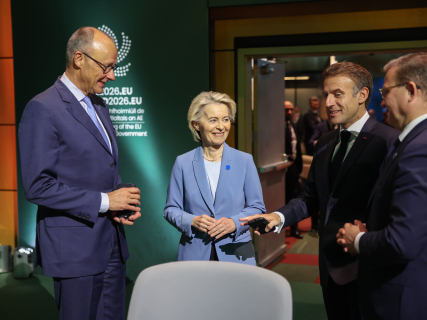

From Dublin, special envoy.- The hour of truth. The moment to move into action. The time to turn European talent and technological capabilities into "true advantages". This is how the leaders of the European Union define the scenario the bloc faces in the development of artificial intelligence (AI). A transition which, according to the President of the European Council, António Costa, "depends on the decisions we make" and which will require mobilizing public and private resources to reduce the continent’s technological dependencies.
For her part, the President of the European Commission, Ursula von der Leyen, has warned that each generation faces a technological turning point that "determines the decades that follow". "For us, that moment is now," she said this Friday during the appearance after the first summit of the European Council dedicated specifically to advances in artificial intelligence. The German has placed funding and the ability to attract private investment among the necessary conditions for Europe to be able to compete in the development of this technology.
"We need Europe to be able to attract private investment," the German has said, who has defended the need to expand financial support to start-ups and make it easier for those that have already managed to develop technological solutions to take the leap toward projects of greater scale. The aim is to prevent European companies from finding it difficult to grow once they have passed the initial stages of development.
The problem of financing and the leap in scale
The Community Executive estimates that at least 5,000 million euros are needed to meet these financing needs. The first phase of the work, aimed at creating a dynamic ecosystem of start-ups, is under way, as the President of the Commission has explained. However, the next challenge is to ensure that these companies can access the capital needed to scale their projects and compete with major international players.
The difficulty, therefore, no longer lies solely in fostering the creation of new technology companies, but in preventing those that manage to develop competitive products from being left without the necessary resources to expand their activities. A funding gap that Brussels considers especially relevant in the field of advanced artificial intelligence, where developing proprietary models requires very large-scale investments and increasingly greater computing capabilities.
At the same time, Von der Leyen has placed business adoption as another of the indicators that will determine the European position in this race. According to the figures presented during the appearance, 37% of the companies in the European Union used artificial intelligence tools in 2025. The penetration of these technologies, however, shows significant differences between Member States. Finland stands out in particular, with a 66% of its companies already incorporating AI solutions into their activities.
Five sectors to accelerate industrial adoption
The President of the Commission has advanced that Brussels will present next year a strategy to boost the application of artificial intelligence in industry. "We will focus on five sectors in which AI can have a significant impact," she explained. The initiative aims to set out a roadmap for each of them, with a specific vision and a set of concrete actions that make it possible to transfer technological capabilities to the productive fabric.
The text will involve the main actors in each sector in defining those priorities. The Commission seeks in this way for the deployment of artificial intelligence not to be limited to developing models and tools, but to result in effective improvements in productivity and competitiveness in the European economy.
In this regard, Costa has linked the success of the community strategy to the capacity to mobilize public-private investment and develop competitive European models. The President of the European Council has insisted that the Union must seize the opportunities offered by this technology in order to realize its economic benefits, especially in terms of productivity and the modernization of public services.
In his view, initiatives such as the Savings and Investment Union and the so-called Regulation 28, aimed at facilitating and standardizing the corporate conditions for operating in the single market, can contribute to achieving that objective. Both initiatives form part of the Community effort to improve the financing conditions for businesses and to make it easier for innovative projects to be developed and grow within the European market.
Trust as a condition for the rollout of AI
Alongside the industrial and financial dimension, European leaders have placed the governance of artificial intelligence among the central elements of the Community strategy. Costa argued that the capacity to manage the risks associated with this technology constitutes an indispensable condition for ensuring its social acceptance.
"Working to manage the risks and challenges of AI is the prerequisite for public trust," the President of the European Council has stated. The Portuguese leader recalled that the European Union has been the first region in the world to establish a specific governance framework for artificial intelligence and argued that Community experience can help shape international standards.
Both Costa and Von der Leyen pointed out the negotiation of the next Multiannual Financial Framework (MFF) as an opportunity to translate that technological ambition into the Union’s budgetary priorities. The debate on the Community accounts for the period 2028-2034 will have to determine which resources are allocated to strengthen European industrial, technological and research capabilities.
"It will be especially important," Costa emphasized when referring to the next long-term budget. More specifically, both leaders pointed to the future European Fund for Competitiveness as one of the instruments that will have to help finance this process and strengthen the position of European companies against their international competitors.
Von der Leyen has openly argued that the European budget should reflect the commitment of the Member States to the development of artificial intelligence. The MFF negotiations thus become one of the main routes to concretize the political priorities that the Commission and the European Council have put on the table during the Dublin summit.
The debate leaves a twofold task for the Union. On the one hand, mobilizing the capital necessary so that European companies can develop and scale their own models and technologies. On the other, ensuring that the adoption of artificial intelligence reaches the entire fabric of the productive sector under rules that make it possible to preserve public trust. European technological ambition will now have to find its counterpart in investment decisions and in the design of the next Community accounts.