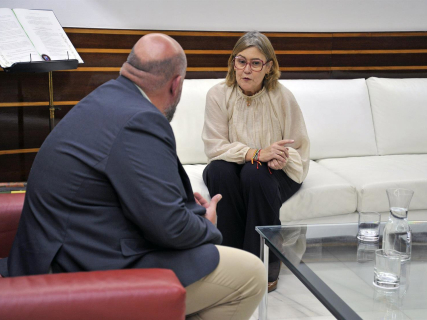

The government delegate in Extremadura, María Teresa Macías, has defended that the relationship between representatives of the different political forces in institutions must be based above all on mutual respect, placing it above ideological differences in order to guarantee democratic coexistence.
"Respect for the representatives of the institutions is the respect that must be owed to the people regardless of what their ideology or political option is. If we don’t have respect for one another, coexistence is altered," Macías warned.
Asked about the recent protests by the Grupo Socialista over the "insults" and put-downs that, according to the complaint, she receives from Vox, the delegate recalled that "courtesy is not something that is granted in a gracious way. It is a commitment to citizens."
In statements to Europa Press, made moments before holding a formal meeting with the president of the Assembly, Manuel Naharro, and after specifying that this is a strictly personal assessment, one that she does not even consider it necessary to raise in that meeting, she insisted that "if we don’t have respect in the places where the people are represented, we do not respect the people."
Macías has explained that this reflection comes from her career in local administration as a councilor for 12 years in her municipality, Calamonte, from the four years she served as a member of parliament in the Assembly — in the IX Legislature, between 2015 and 2019 — and from her experience in three legislatures in the Senate.
In her view, the people responsible for setting up debates and ensuring the progress of "any discussion in the broadest and most beautiful sphere of the word that may exist in parliamentary chambers must attend to that observance: that there is respect for the institutions, for good governance, for the bodies of the Chamber."
"If there is no respect there is no coexistence, and if there is no coexistence we break our model of society, therefore we always have to be very alert about this," she emphasized.
The meeting with Naharro is part of the round of contacts she is carrying out with the main institutions of the autonomous community, after the meetings already held with the president of the Superior Court of Justice of Extremadura, with the senior prosecutor of Extremadura, with the presidents of the provincial councils of Badajoz and Cáceres, with that of Fempex this same morning and, last Monday, with the mayor of Badajoz.
With this agenda, Macías intends to make it clear that the political and institutional "links" with the autonomous legislative power must be "permanent", since "the voice of Extremadura through the female and male deputies is something that the Government of Spain also listens to through the multiple initiatives" that are promoted in this Parliament, an expression of the political will that arises from the ballot boxes that the public attends.