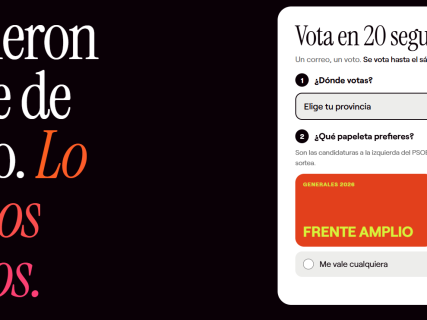

The failure of the negotiations between Frente Amplio and Podemos to run together in the general elections on November 29 has led to an initiative that aims to convey to voters the agreement that the parties did not reach. "Ya lo hacemos nosotros" is a platform that proposes to choose, province by province, which candidacy to the left of the PSOE should concentrate the support to avoid the dispersion of the vote.
The initiative, driven by the political dissemination channel Pues Ya Estaría, is based on a premise: "They could not agree. We will do it." Its promoters argue that it was not necessary to reach a state coalition, but rather to achieve a single ballot per constituency. In the absence of that agreement, they have opened a consultation to find out which candidacy those participating prefer.
"It is not a survey. It is an agreement among voters", explain the platform's managers, who aspire for the results to serve as a reference for voters on November 29.
A vote to choose a candidacy in each province
The operation is simple. Participants must select the province in which they vote and choose among the candidacies to the left of the PSOE that are running in that constituency. They can also indicate that they are indifferent to any of the options.
The consultation allows participation until November 21 at 21:00 hours. To avoid duplicities, it requests an email address and only counts the last vote made from the same address. According to its managers, they do not keep the email, but rather a hashed footprint that will be deleted after the elections.
The website includes a national tracker and a provincial map to show which candidacy receives the most support among participants. The results of a province do not appear until it reaches at least 50 votes.
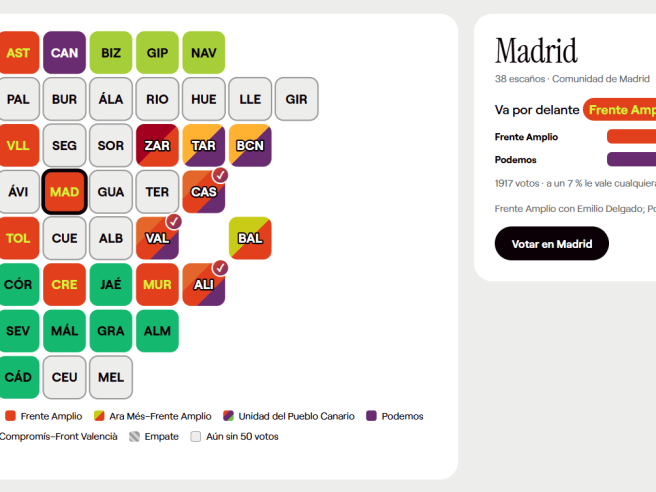
The promoters have planned to publish the final results on November 21 and keep them visible until the 22nd. From November 23 until 22:00 hours on election day, they will stop showing the figures, with the purpose of respecting legal restrictions on the publication of electoral surveys.
The disagreement between Frente Amplio and Podemos, at the origin
The platform was born after Frente Amplio and Podemos closed negotiations for a joint candidacy throughout Spain without an agreement. Although both formations have reached territorial pacts with other organizations, in several constituencies they will compete separately for the electorate to the left of the PSOE.
Its promoters believe that this division could harm the parliamentary representation of both candidacies due to the system of seat distribution by provinces. To illustrate this, the website includes electoral simulations that compare different scenarios of joint and separate participation.
Among the territories mentioned are Asturias, A Coruña, Madrid, and Cádiz, where, according to their estimates, the fragmentation of the vote could hinder the obtaining of seats. The calculations are based on an average of polls published up to October 14 and on the electoral results of 2023.
The initiative also contemplates the already agreed territorial coalitions, such as the candidacies of CHA and Frente Amplio in Aragón or Ara MÉS and Frente Amplio in the Balearic Islands, as well as the presence of Podemos candidates on the ERC lists in Catalonia.
An open consultation, without statistical representativeness
The results of "We do it ourselves" do not constitute a representative electoral survey. The platform itself acknowledges that it does not use a random sample, that anyone who wishes can participate, and that, therefore, it is not possible to calculate a margin of error or extrapolate the preferences collected to the entire electorate.
Its managers insist that the goal is not to predict the results of November 29, but to facilitate that participants know which candidacy has the most support within the consultation in their province.
The project is promoted by Pues Ya Estaría, a channel of short videos about current events. Its promoters claim that they do not work for any party nor receive funding from political formations.
The initiative thus introduces a new proposal in the debate on the fragmentation of the alternative left: to coordinate the vote from a citizen consultation after the party leaderships failed to agree on a common state candidacy.