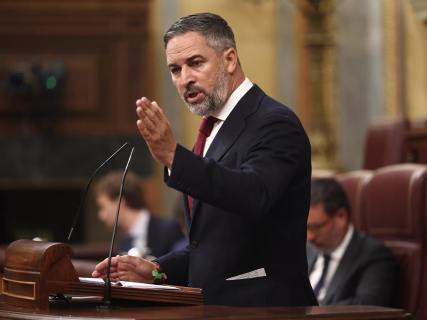
Abascal accuses Sánchez of being “the candidate of Morocco” ahead of the elections on 29N

The leader of Vox celebrates "deeply" the electoral advance, accuses the president of calling the elections with Ceuta "invaded" and assures that he does not trust the polls even when they favor his party.

2 minutes

fotonoticia 20260929224002 1920

fotonoticia 20260929224002 1920

Add DEMÓCRATA to Google

Ask FREN

Published

Last updated

2 minutes

Most read

The leader of Vox, Santiago Abascal, reacted this Monday to the advance of the general elections to November 29 announced by Pedro Sánchez and accused the president of the Government of being “the candidate of Morocco”, a statement he linked to the management of the migration crisis in Ceuta.

In an interview on Antena 3, Abascal stated that he is “deeply” pleased with the electoral call and has attacked Sánchez after the president framed the elections as a choice between a Government that works for “the interest of the social majority” and a “far-right majority”.

The Vox leader maintained that the main beneficiaries of the legislature have been “nationalist minorities and investment funds” and directly blamed the president of the Government for this situation. He also accused him of “dehumanizing” the opposition with the speech used to announce the electoral advance.

“Sánchez is the candidate of Morocco”

Abascal reserved his main criticisms for the Executive's relationship with Morocco and the management of the migration crisis in Ceuta. When asked about his differences with the leader of the PP, Alberto Núñez Feijóo, he stated that both agree “on a large part of the diagnosis,” although not so much on the solutions, discrepancies he considered minor compared to what, in his opinion, Sánchez represents.

“Sánchez is the candidate of Morocco”, Abascal stated, who assured that Morocco “has invaded Spain” and pointed to the possibility that there is “some kind of blackmail” over the president of the Government. He also referred to the capacity of the “Moroccan lobby” to influence the European Parliament and added: “One day we will know”.

The leader of Vox defended that his party would have militarized the border during the crisis in Ceuta and would have tried to prevent entries by sea. In addition, he accused Sánchez of having caused a “catastrophe” by allowing access to Spanish territory.

Abascal also criticized Sánchez for calling elections with Ceuta “invaded”, after the “crime” of Adamuz and without having assumed, as he stated, responsibilities for the DANA in Valencia. “Corruption kills”, he stated.

Distrust of polls and mail-in voting

Asked about the polls ahead of the general elections, Abascal has assured that he does not trust the polls even when they favor Vox. The leader has stated that “the devil loads them” and has asked Spaniards not to trust them and to remain mobilized ahead of the appointment with the ballot boxes.

Abascal has also expressed his distrust towards voting by mail and has encouraged Spaniards to go in person to the polls on the upcoming November 29. The leader of Vox has asked voters to, whenever possible, vote in person.

He has also referred to the possibility that the Government might try to approve new measures before the constitution of the next Cortes and has warned that he expects “any attempt” by Sánchez to make “tricks”. Regarding a potential use of the Permanent Deputation, he has maintained that it would be a “manifest illegality” and has pointed to the Constitutional Court as a possible backing of the Executive.

(NEWS IN EXPANSION)

More key points, information and questions with FREN

AI-GENERATED CONTENT

What is the status of the processing of the call for general elections on November 29 and what parliamentary steps does it require?

As of October 5, 2026, the available information indicates that:

  • The Prime Minister has announced his intention to bring forward the general elections and set the vote for Sunday, November 29, 2026, as reported by numerous media outlets and political analyses.
  • However, the call will only be legally effective when the royal decree dissolving the Cortes and calling the elections is published in the BOE. Searches in official sources do not yet show that royal decree published as of today, October 5.
  • Therefore, the “call for general elections for November 29” is politically announced or planned, but its formal processing has not yet been completed: the approval and publication of the royal decree is pending.

1. Legal fit of November 29

The Organic Law of the General Electoral Regime (LOREG) establishes that, when the president dissolves the Cortes early:

  • The royal decree of dissolution and call is published in the BOE the day after its issuance and comes into force that same day.
  • The elections must be held on the fourteenth day after the call (in practice, a period of 54 days between the publication of the decree and election day is used).

Various analyses agree that November 29 fully fits within the LOREG if the decree is published between October 1 and 6, with October 6 being the deadline for November 29 to be the 54th day after the call.

The scenarios considered are:

  • Publication of the decree between October 1 and 5: November 29 would be the 59th‑55th day after.
  • Publication on October 6: November 29 would be the exact fourteenth day after (54 days).

In all these cases, November 29 is a legally viable date. The decisive factor is that the decree is effectively in the BOE, which has not yet happened.

2. What formal steps does the call require

The call for general elections and the setting of its date is not a parliamentary act, but an act of the executive power with the intervention of the head of State. The scheme is as follows:

  • Decision of the Prime Minister (art. 115 CE): he can propose the dissolution of the Congress, the Senate, or both Chambers, after deliberation of the Council of Ministers and under his exclusive responsibility, provided there is no motion of censure in process.
  • Deliberation of the Council of Ministers: the Government debates and supports the proposal of dissolution and the text of the royal decree.
  • Proposal to the King and signing of the royal decree:
    • The Prime Minister proposes the dissolution.
    • The King signs the royal decree that dissolves the Cortes and sets the election date.
    • The decree is countersigned by the Prime Minister.
  • Publication in the BOE:
    • The decree is published in the Official State Gazette, usually the day after its issuance.
    • With the publication, the electoral process is formally considered called and the Cortes dissolved.
  • Counting of electoral deadlines:
    • From that day, the 54 days until the vote are counted.
    • All milestones are chained: communication of coalitions, presentation and proclamation of candidacies, campaign, postal voting, etc.

3. What “parliamentary steps” are there?

The call for general elections does not require any prior parliamentary procedure in Congress or Senate:

  • Neither the Plenary nor the Boards “vote” on the dissolution of the Cortes.
  • The chambers may debate motions or political statements requesting elections, but these are non-binding and do not replace the constitutional power of the president.

The only truly parliamentary steps come after the elections:

  • Constitutive session of the new Cortes:
    • Within the period set by the Constitution and LOREG, the Congress and Senate are constituted.
    • The Boards of both Chambers are elected (president of Congress, Senate, etc.).
  • Investiture of the Prime Minister:
    • The King holds a round of consultations with the groups and proposes a candidate.
    • The Congress holds the investiture debate and votes: absolute majority in the first vote or simple majority in the second.

4. Conclusion on the current status

In summary:

  • The scenario of general elections on November 29 is fully aligned with the legal calendar and has already been announced and detailed in the political and media sphere.
  • However, as of October 5 the royal decree of dissolution and call is not yet recorded in the BOE; without that decree, the call is not legally in force.
  • The pending processing is essentially executive and constitutional (Council of Ministers, King's signature, BOE), without prior formal parliamentary steps.
Can you detail the day-by-day calendar that would be activated if the decree is finally published on October 6 to vote on November 29? What effects does the dissolution of the Cortes have on the functioning of the Congress and the Senate until the constitution of the new chambers? How do these deadlines compare with those of other recent calls, such as the 2023 general elections?

What are the powers and functions of the Prime Minister according to the Spanish Constitution?

According to the 1978 Spanish Constitution, the Prime Minister is the highest authority of the executive power and the core of the country's political leadership. His powers and functions are distributed throughout several provisions, although the core is found in articles 97, 98, and 99, complemented by others on political responsibility and dissolution of the Cortes.

1. Head of the executive power and political leadership (art. 97 CE)

Article 97 establishes that the Government directs domestic and foreign policy, the civil and military administration, and the defense of the State, and exercises executive function and regulatory power. Within that Government, the Prime Minister holds effective leadership:

  • Drives and sets the general line of political action: sets the Executive's priorities and coordinates the actions of the different ministries.
  • Directs the Government's action: decides the orientation of public policies and resolves internal conflicts within the Council of Ministers.
  • Represents the Government both domestically (before the Cortes Generales and other institutions) and abroad, without prejudice to the King's powers in State representation matters.

2. Appointment, dismissal, and relationship with ministers (art. 98 CE)

The Government is composed of the Prime Minister, vice presidents if any, ministers, and other members that the law may establish. In this structure, the Prime Minister has specific powers:

  • Proposal of appointment and dismissal of ministers: the King appoints and removes Government members exclusively on the Prime Minister's proposal.
  • Internal organization of the Government: decisions about creating or suppressing vice presidencies, merging or dividing ministerial departments, or reassigning portfolios are practically the Prime Minister's initiative, although formalized by royal decree.
  • Coordination among ministers: the Prime Minister resolves disagreements between ministries and ensures the coherence of the government program.

3. Parliamentary designation and investiture (art. 99 CE)

The Prime Minister obtains his main legitimacy from the Cortes, specifically the Congress of Deputies:

  • After each renewal of the Congress or in cases of vacancy, the King, after consulting parliamentary group representatives and through the president of the Congress, proposes a candidate for Prime Minister.
  • That candidate must obtain the confidence of the Congress through the investiture procedure, which initially requires an absolute majority and, if not reached, a simple majority in a second vote.
  • Once confidence is obtained, the King appoints him Prime Minister.

Therefore, his constitutional position rests on a dual legitimacy: the King's proposal and, above all, the Congress's confidence.

4. Political responsibility and parliamentary control (arts. 108, 112–114 CE)

The Prime Minister is politically accountable, along with the rest of the Government, before the Congress of Deputies:

  • Vote of confidence (art. 112): the Prime Minister can submit a confidence vote to the Congress on his program or a general policy declaration; if lost, he must resign.
  • Motion of censure (art. 113): the Congress can demand the Prime Minister's resignation through a constructive motion of censure, which must propose an alternative candidate for the Presidency.
  • The Government, especially its Prime Minister, is subject to permanent control by the Congress through questions, interpellations, and appearances.

5. Dissolution of the Cortes and call for elections (art. 115 CE)

One of the Prime Minister's most relevant powers is to propose to the King the dissolution of the Congress, the Senate, or the Cortes Generales as a whole, and the call for general elections:

  • The initiative is the Prime Minister's; the King formalizes the dissolution.
  • It cannot be exercised when a motion of censure is in process nor before one year has passed since the previous dissolution.

6. Other notable functions

  • Relationship with the King: the Prime Minister maintains a privileged institutional relationship with the King, informing him of State matters and countersigning many of his acts (for example, certain appointments and decisions in foreign policy).
  • Leadership in crisis situations: in states of alarm, exception, and siege (art. 116), the Government, under the Prime Minister's direction, assumes reinforced powers, always with authorization and control of the Cortes.
  • Regulatory power: as head of the Executive, the Prime Minister promotes the approval of regulations and other norms of lower rank than law to develop and execute laws approved by the Cortes.

Overall, the Constitution configures the Prime Minister as the system's center of gravity: he is ultimately responsible for the Executive's action, the main interlocutor before the Cortes, and the Government's political reference before the citizenry and other State powers.

Can you detail the investiture procedure of the Prime Minister step by step? What differences are there between the functions of the Prime Minister and those of the King according to the Constitution? How does the motion of censure work and what implications does it have for the Prime Minister?

What is the political and professional trajectory of Santiago Abascal, leader of Vox?

Santiago Abascal Conde (Bilbao, 1976) is a Spanish politician with a degree in Sociology and leader of Vox since 2014. He is currently a deputy in the Congress for Madrid and one of the main references of the radical right in Spain. His trajectory combines a long stage in the Basque People's Party, the creation of the DENAES Foundation, and, since 2013, the promotion and leadership of Vox.

Education and origins

According to available biographies, Abascal holds a degree in Sociology, which is his main academic qualification. He comes from a family with a political tradition in the Basque Country, and his biography highlights that he suffered ETA threats, an element that has marked both his discourse and his stance on the fight against terrorism and the defense of Spain's unity.

Stage in the Basque People's Party

Abascal joined the People's Party young, around the mid-1990s, and began his political career there. His first positions were local and organizational:

  • Councilor in Llodio (Álava) between 1999 and 2007, where he became politically known in a context of strong pressure from terrorism and radical nationalism.
  • President of the New Generations of the Basque PP between 2000 and 2005, which positioned him as one of the party's youth references in the autonomous community.
  • Procurator in the General Assemblies of Álava between 2003 and 2004.
  • Deputy in the Basque Parliament between 2004 and 2009, a stage in which he focused his activity on security issues, defense of victims, and opposition to the ruling nationalism.

Besides these representative positions, he held internal responsibilities in the Basque and Álava PP, being part of territorial executive bodies. After leaving the Basque Parliament, between 2010 and 2013 he held appointed positions in the administration of the Community of Madrid, within the regional PP political environment.

DENAES and break with the PP

In 2006 he promoted the Foundation for the Defense of the Spanish Nation (DENAES), conceived as a civic platform for the defense of national unity and criticism of the autonomous model and concessions to nationalism. Various sources agree that he was its president for several years and that this space functioned as the intellectual and organizational embryo of the project that later became Vox.

Over those years, he distanced himself from the PP leadership, which he criticized for its management of terrorism, regional policy, and lack of internal democracy. In 2013 he left the People's Party, breaking with almost two decades of membership.

Foundation and leadership of Vox

At the end of 2013, he participated in the founding of Vox along with other former PP leaders and members. The party was officially registered and publicly presented in January 2014. In September of that same year, Abascal was elected president of Vox, a position he has renewed in successive internal assemblies and continues to hold.

From that position, he has steered the party's growth: first as an extra-parliamentary force, then entering regional parliaments, and finally with the breakthrough in the Congress of Deputies, where Vox has consolidated as the third national force in various general elections.

Recent institutional career and current positions

At the state level, biographical sources place him as a deputy in the Congress for Madrid since 2019. In the current legislature, he is a member of the Permanent Deputation of the Congress, integrated into the Vox Parliamentary Group. His figure concentrates both the party's political leadership and its most visible parliamentary representation: he leads interventions in major investiture debates, motions of censure, and government control sessions.

Foundations, Patriotas.eu, and international projection

Alongside the leadership of Vox, Abascal has reinforced his profile through think tanks and international alliances:

  • He is founder and reference of DENAES, which acted as a platform prior to Vox's birth.
  • He presides over the Disenso Foundation, a think tank associated with Vox that promotes an agenda defending the Spanish nation and alliances with like-minded leaders and parties in Europe and America, and which has received funding linked to the party.
  • Since 2024, he leads Patriotas.eu / Patriots, a European political group that brings together national-conservative forces and seeks to articulate a common agenda in the European Parliament against the popular-socialist-liberal axis.
Political profile and public image

Abascal's discourse focuses on Spain's unity, opposition to separatism, criticism of the PP–PSOE “two-party system,” toughening immigration policy, revision of historical memory policies, and a markedly conservative social and cultural agenda. His leadership has been accompanied by intense activity in media and social networks, as well as controversies over the financing of Vox and the Disenso Foundation, subject to political reproaches and rulings by the Court of Auditors.

With all this, Abascal has consolidated himself as a key actor in contemporary Spanish politics, articulating from Vox a national-populist right-wing project with international projection and stable presence in the Congress.

Can you order Santiago Abascal's trajectory in a year-by-year chronology with approximate dates? What role have the DENAES Foundation and the Disenso Foundation played in building Abascal's political leadership? How has Vox's weight in the Congress evolved since Abascal became its president and what impact has it had on national politics?

Play

Test your knowledge with FREN!

How much do you know about this topic? Answer the following 3 questions.

Who did Santiago Abascal accuse of being 'Morocco's candidate' in relation to the migration crisis?

Question 1 of 3

What action did Vox defend during the Ceuta migration crisis?

Question 2 of 3

How did Abascal describe his relationship with Alberto Núñez Feijóo?

Question 3 of 3