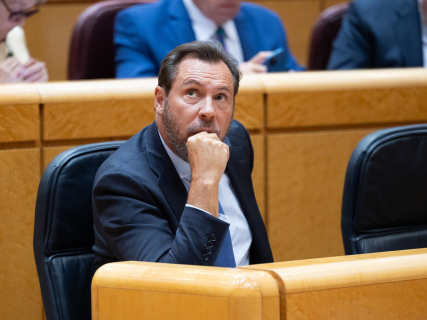

An internal survey that gave the PSOE better results than those anticipated by the rest of the polls was, in part, what pushed Pedro Sánchez to call the general elections on November 29. This estimate, however, placed the socialists as the second force. That seems to have changed in less than a week, because the Minister of Transport, Óscar Puente, has assured that his internal studies say that the PSOE will be the most voted party. In fact, he has expressed himself “absolutely sure” that they will be the first force.
In an interview on Cadena SER, the former mayor of Valladolid has shown his hope that Pedro Sánchez can govern again, and, for that, he is clear that there must be unity to the left of his party: “I make a call, with what is happening, with the risk that exists, please come to an agreement and make a candidacy that reflects the feelings of the people who do not want to vote for the PSOE, but do want to vote for other progressive options.” What looms, Puente emphasized, “is serious enough for egos and less important circumstances to be set aside, and to think about the future of the country.”
In his words, “the left-wing electorate has been deactivated for some time, it is in doubt, in abstention, and it needs to be brought out of there.”
What do the polls say?
The internal survey that Puente claims to handle differs significantly from the polls that are being published. The 40dB survey for El País and Cadena SER, published this Friday, places the PP as the first force, with 31.9% of the votes and 132 seats, followed by the PSOE, which would reach 28.1% and 110 deputies. Vox would obtain 18.9% of the votes and 66 representatives. Thus, the sum of PP and Vox would reach 198 seats, above the absolute majority of Congress.
The survey also reflects the difficulties of the alternative left. Sumar and Podemos would gather 7.6% of the vote if they run separately, while a joint candidacy would reach 9.5% and between 15 and 19 deputies. However, that possible unity would not prevent PP and Vox from maintaining the absolute majority, according to the estimate published this Friday.
For its part, the IMOP survey for El Confidencial also places the PP in the lead, with an estimate of 130 seats, compared to the 110 that the PSOE would obtain. Vox would grow to 70 deputies, while Sumar would remain at 11 and Podemos would achieve one. The distribution outlines a scenario in which the socialists would continue as the second force, far from the popular party.
The sum of PP and Vox would reach 200 deputies, to which the representative of UPN could be added, reaching a total of 201. The survey also attributes four seats to Junts, eight to ERC, six to EH Bildu, four to the PNV, and three to the BNG, among other parties. The results of both polls contrast with the statement by Óscar Puente about the internal studies of the PSOE, which, he has claimed, place the socialists as the most voted party.