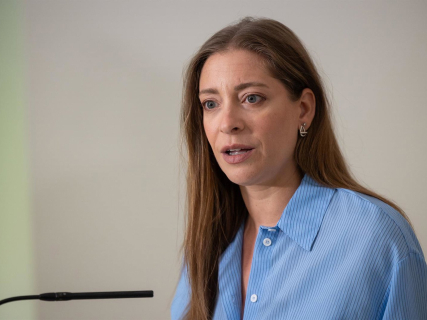
Ester Muñoz mocks the absence of Zapatero, the "moral beacon" of Sánchez: "On November 29, one chooses between saunas and sewers or national reconstruction."

The spokesperson of the PP contrasts in a rally in Ponferrada the project of Feijóo with that of the president of the Government and accuses the PSOE of having used the institutions and public money for their own benefit.

3 minutes

fotonoticia 20261011141121 1920

fotonoticia 20261011141121 1920

Add DEMÓCRATA to Google

Ask FREN

Published

Last updated

3 minutes

Most read

The leader of the Popular Party, Ester Muñoz took advantage of the rally held this Sunday in Ponferrada to attack Pedro Sánchez for the absence of José Luis Rodríguez Zapatero at the event in León and question the role that the former socialist president plays in the narrative of the head of the Executive. The spokesperson for the PP in Congress has mocked the figure of the "Etruscan jewel" and has recalled that Sánchez had referred to Zapatero as his "moral lighthouse."

"He said he would use the Etruscan jewel in his rallies and it turns out that Zapatero did not come to today's in León", Muñoz has stated, attributing the absence to the difficulty of bringing the former president to the province where he is from. "It must be very complicated to bring him to the province where he has caused the most damage and where he makes people feel the most shame," she added.

The popular leader has linked her criticisms of Zapatero with the cases and suspicions that the PP attributes to the Government's environment. "Knowing that Zapatero is from León, when he is a person who has lied to all Spaniards, a presumed jewel smuggler. That is the moral lighthouse that Pedro Sánchez was talking about", she maintained.

Muñoz has raised the tone of her intervention by questioning the trajectory of the former president: "He was neither a humanist nor a socialist nor did he have little and give a lot; in reality, he was keeping what belonged to everyone." She has also accused him of using his power and influence to intervene in rescues with public money and "taking it all for himself."

Taxes, housing, and public services

The spokesperson for the PP has combined criticisms of the PSOE with references to the economic situation of citizens. During her visit to the Fair of typical products of León, she has stated that several merchants conveyed their difficulties in making ends meet and hiring workers, as well as the need to reduce taxes.

"Never before have Spaniards paid more taxes and never have we had worse public services", Muñoz has stated, placing tax pressure, access to housing, and loss of purchasing power among the issues that, in her opinion, should focus the electoral campaign.

"We are not condemned to not make ends meet, to have our Government rig contracts, or for people to be unable to rent a house, buy a home, or change cars; we are not condemned to be working poor," she has pointed out.

The popular spokesperson has insisted that there are people with jobs who need to resort to public aid because their income does not allow them to cover their expenses.

In that line, she has recovered the message that Alberto Núñez Feijóo conveyed on Saturday in Madrid, when he defended that "the effort and sacrifice of the Spaniards will be worth it again." Muñoz has criticized the left's reaction to that statement: "Of course, the left does not know what sacrifice is. People do not have problems with sacrifice. What they do not want is for others to live off their sacrifice."

The leader of the PP has maintained that the fiscal effort of citizens has not translated, in her opinion, into an equivalent improvement of public services. In her speech, she has listed healthcare, education, housing, infrastructure, dependency, and transportation, before accusing the Executive of allocating public resources to irregular practices.

"The effort was taken in rigging, with ministers convicted of rigging contracts, or the Government paying with public money to prostituted women," she has stated.

«The Government of saunas, sewers, and jewels»

Muñoz has closed her argument with a direct appeal to the general elections on November 29. The popular spokesperson has framed the call as a choice between two political models and has contrasted the accusations she directs at the PSOE with the proposal for national reconstruction that the PP defends.

"Spaniards have to decide between the party of saunas, of sewers, and of jewels, the party of Pedro Sánchez, or the party that bets on a national reconstruction so that Spain has a future ahead", she has stated.

The leader has insisted on this dilemma by denouncing what she has described as the "moral abyss" of the left and presenting the 29N as «the great opportunity» for political change. Among the accusations she has made against the current Executive, she has included alleged rigging of contracts, the use of public resources, and the hiring of people linked to criminal activities to act against judges.

"Spaniards must choose between the Government of saunas, of sewers, of those who hired clans of criminals to eliminate judges and those who trafficked in jewels, or the Government of national reconstruction," she has concluded.

More key points, information and questions with FREN

AI-GENERATED CONTENT

What is the current status of the electoral campaign for the general elections on November 29 and what are the next steps in the electoral calendar?

As of today, October 11, 2026, the campaign for the general elections on November 29 has not yet officially started: we are in the already called electoral period but in the pre-campaign phase. The calendar is activated and several technical deadlines are running (census, coalitions, lists, postal voting), but the formal campaign vote request does not start until November 13.

Current status of the call

  • The Royal Decree 806/2026, of October 5, dissolving the Congress and the Senate and calling elections, was published in the BOE on October 6, 2026. The elections for the Congress and the Senate will be held on Sunday, November 29 and the new Chambers will be constituted on December 23 at 10:00. See the text in the BOE: Royal Decree 806/2026.
  • With that decree, the General Courts (XV Legislature) have been dissolved and the Permanent Deputations are functioning; the Government's activity continues in ordinary caretaker mode.
  • The Congress note confirms these dates and details the duration of the campaign: Congress press release .

From a political-media point of view, the parties are already in pre-campaign, but legally the official electoral campaign has not started:

  • The campaign will last 15 days, from November 13 to 27. This is set by Royal Decree 806/2026 itself and is recorded by Congress and Senate.
  • November 28 will be the reflection day, without propaganda or campaign events.
  • November 29 is the voting day.

Milestones already underway

As of today, the following elements of the calendar are in progress or have already been activated:
  • Counting of the electoral period: since the publication of the decree in the BOE on October 6, the 54 days established by LOREG between the call and the vote are running.
  • Postal voting: according to the scheme collected by Demócrata ( postal voting guide ), it can already be requested and the deadline extends until November 19. November 25 is the ordinary deadline to deposit the vote at the Post Office.
  • Electoral census:
    • The INE has published the note on the census and voters: INE press release .
    • In application of article 39 LOREG, the census used is the one closed on August 1, 2026.
    • The public consultation of the census will be held between October 12 and 19 in town halls and provincial delegations of the Electoral Census Office, as announced by various municipalities (for example, Pamplona or Alicante).
  • Vote of residents abroad: the Resolution of October 9, 2026 sets the centers enabled abroad and confirms that voting in ballot boxes at consulates and designated centers may be deposited from November 21 to 26 (from the eighth to the third day before the election).
  • Electoral financing and subsidies:
    • Order HAC/1062/2026 sets the amounts of subsidies per seat, vote, and propaganda mailing for these elections.
    • Royal Decree 809/2026 tightens the conditions to access electoral subsidies when there are convicted persons for rebellion, terrorism, or serious crimes on the lists.

Next steps in the electoral calendar

From today, the most relevant milestones, according to the calendar reconstructed by Demócrata and LOREG, are:
  • Until October 16: deadline for parties to communicate electoral coalitions to the electoral administration.
  • From October 21 to 26: submission of candidacies to the Congress and Senate before the provincial electoral boards.
  • October 28: publication of submitted candidacies.
  • November 2: definitive proclamation of candidacies.
  • November 3: official publication of proclaimed candidacies.
  • November 13–27: official electoral campaign, with explicit vote requests and specific rules on propaganda, polls, and events.
  • November 19: last day to request postal voting.
  • November 23: deadline to publish and disseminate electoral polls.
  • November 25: ordinary deadline to deposit postal votes.
  • November 28: reflection day.
  • November 29: election day, with polling stations open from 9:00 to 20:00.
  • From December 2: general scrutiny by the electoral boards.
  • December 23: constitutive sessions of Congress and Senate to open the XVI Legislature.

In summary, the campaign has not yet started: we are at a moment of intense pre-campaign with dissolved Courts, census under review, postal voting already available, and parties closing coalitions and lists to reach the official campaign from November 13 to 27.

What are the powers and functions of the PP spokesperson in the Congress according to the Rules of the Congress of Deputies?

The Rules of the Congress of Deputies do not regulate a “PP spokesperson” as such, but the figure of the spokesperson of each Parliamentary Group. Therefore, the spokesperson of the Popular Group has exactly the same regulatory powers as any group spokesperson: they are the person who, on behalf of the group, exercises the powers that the Rules attribute to the Parliamentary Group itself. What changes from one group to another is the internal organization and political weight, not the formal powers.

a) Functions in the Board of Spokespersons

Although the articles that expressly mention the “spokesperson” do not detail the Board of Spokespersons, it is conceived in the rules as the body in which the groups are represented by their presidency or by their spokesperson. In practice, the regulatory functions of the PP spokesperson in the Board can be summarized as follows:

  • Group representation: acts as the formal representative of the Popular Group before the Presidency and the Board in that body.
  • Participation in setting the agenda of the Plenary: participates in meetings where the Presidency's proposals for the agenda, times, and structure of debates are negotiated and known.
  • Defense of the interests of their group: raises objections, alternative proposals, thematic priorities, and requests for inclusion or withdrawal of items.
  • Channeling agreements between groups to organize debates, time distributions, or specific sessions.

All this derives from the general regulation of the Board of Spokespersons in the Rules and from the fact that the group only has one “formal voice” in that Board: its spokesperson (or whoever replaces them).

b) Functions in the Plenary

In the Plenary, the Rules attribute the rights of speech, turns, and times to the Parliamentary Groups, and it is their spokespersons who usually exercise or internally distribute them. From this derive for the PP spokesperson:

  • Request and exercise speaking turns on behalf of the group (interventions in total debates, motions, interpellations, general policy debates, etc.).
  • Internally distribute times among the different deputies of the group, according to the rules set by the Rules on Group turns.
  • In the case of the Mixed Group, the Rules expressly mention that the agreement on who intervenes is communicated “through the spokesperson or whoever replaces them” (art. 75.1); although it refers to the Mixed Group, it illustrates the general principle: the spokesperson is the formal communication channel with the Presidency about who uses the group's turn.
  • Intervene in turns “on behalf of the group”, with the highest internal political authority; in practice, the PP spokesperson usually assumes the debates of greatest political relevance.
c) Functions in the committees

In the committees, the Rules follow the same logic: they attribute rights of initiative, amendment, and speech to deputies and groups, but often require the participation or signature of the group's spokesperson:

  • Article 110.1 requires that the written amendments to a bill taken to committee bear “the signature of the spokesperson of the Group to which the deputy belongs or of the person who replaces them, for mere knowledge purposes”. This makes the PP spokesperson the formal guarantor of the amendments presented by their group.
  • They participate — directly or by delegation — in the coordination of the presence and action of the group in the different committees (designation of deputy spokespersons, distribution of initiatives, etc.), although that organizational dimension is mainly articulated by the group's internal rules.
d) Relationship with the Board and the Presidency of the Congress

The Rules foresee multiple formal communications between the groups and the Presidency/Board (for example, internal agreements, designation of representatives, initiatives…). Here the spokesperson is the typical channel:

  • Article 75.1 itself shows a general model: the internal agreements of a group on how to use their turns are sent to the Presidency “through the spokesperson or whoever replaces them”.
  • In practice, the PP spokesperson is the person who signs formal writings on behalf of the group (designations, agreements, political communications) and who maintains the usual political interlocution with the Presidency and the Board.
e) Other organizational powers and legislative initiative

The Rules also explicitly link the spokesperson with the group's legislative initiative capacity:

  • Article 126.1.2.º establishes that a bill proposal can be adopted by “a Parliamentary Group with the sole signature of its spokesperson”. That is, the PP spokesperson can, with their signature, exercise that initiative on behalf of the entire group.

Beyond this, many functions — distribution of matters among deputy spokespersons, direction of parliamentary strategy, voting discipline, political communication — are not set by the Rules, but by the organizational autonomy of the Popular Group itself (its internal rules and political decisions). The Rules are limited to:

  • Recognizing groups as subjects of rights and powers.
  • Requiring the signature or intervention of the spokesperson in certain acts (amendments, bills, communications to the Presidency).
  • Channeling the group's representation in the Chamber's bodies through the spokesperson.

In short, according to the rules, the PP spokesperson is the formal representative of the Popular Group before the Presidency, the Board, the Board of Spokespersons, the Plenary, and the committees, with the capacity to sign amendments and bills and to communicate the group's internal agreements. Everything else (internal hierarchy, role distribution, effective political weight) depends on the group's own organization and decisions, not on the Rules.

What political career and positions has José Luis Rodríguez Zapatero held throughout his career in the PSOE and the Government?

José Luis Rodríguez Zapatero (Valladolid, 1960) has developed a political career that spans the internal organization of the PSOE, the Congress of Deputies, and the headship of the Government of Spain. Below are summarized his main positions and stages, focusing on his role within the PSOE and the State institutions.

Early steps in the PSOE and leadership in León

Zapatero joined the Spanish Socialist Workers' Party at the end of the seventies, during his university years. After moving to León and starting his professional activity as a Constitutional Law professor, he began to take on responsibilities in the socialist territorial structure.

During the eighties, he was involved in the youth organization and the provincial federation. The turning point came in 1988, when he was elected general secretary of the Socialist Federation of León, a responsibility he held approximately until 2000. From that position, he led the León PSOE for more than a decade, being re-elected in successive provincial congresses and building his own organic base.

At the same time, he joined the federal leadership bodies, being part of the Federal Committee of the PSOE, which placed him already in the party's strategic conversation at the state level before making the leap to national leadership.

Parliamentary stage in the Congress of Deputies

Zapatero entered the Cortes in the general elections of 1986, elected as a deputy for León. He kept his seat for this constituency in the elections of 1989, 1993, 1996, and 2000, so he was a deputy for León between 1986 and 2004, chaining several consecutive legislatures.

In Congress, he held various internal parliamentary positions. Throughout the nineties, he participated in commissions such as:

  • Justice and Interior Commission.
  • Constitutional Commission.
  • Ombudsman Commission.
  • Public Administrations Commission.

After the socialist defeat in 1996, he consolidated as a reference of the parliamentary group. In that phase, he was spokesperson of the PSOE in the Public Administrations Commission, and participated in key debates on the territorial organization of the State and regional financing.

Secretary general of the PSOE and leader of the opposition

The great break in his internal trajectory came at the XXXV Federal Congress of the PSOE (July 2000), when, being a little-known deputy outside political circles, he won by a narrow margin against José Bono and other veteran leaders. From then until February 2012, he was secretary general of the PSOE.

As secretary general, he also assumed the leadership of the Socialist Parliamentary Group and the status of leader of the opposition against the governments of José María Aznar. In that stage, he promoted the so-called “new way,” with a discourse focused on democratic regeneration, institutional dialogue, and the expansion of civil rights. He also participated in major State agreements such as the Agreement for Freedoms and against Terrorism.

President of the Government (2004‑2011)

The general elections of March 14, 2004, gave victory to the PSOE and Congress invested Rodríguez Zapatero as President of the Government of Spain in April 2004. From that moment, he became a deputy for the constituency of Madrid, leading the socialist list in 2004 and 2008.

He served as President of the Government for two consecutive legislatures, between 2004 and 2011. His first term was characterized by an intense program of social reforms: the Comprehensive Law against Gender Violence, the Dependency Law, the approval of same-sex marriage, and the deepening of equality policies. In foreign policy, one of his first decisions was the withdrawal of Spanish troops from Iraq.

In 2008, he renewed the socialist majority and continued as president during the IX Legislature. This second stage was marked by the international financial and economic crisis that began in 2008, which led to strong political and social tensions. In 2010, his Government approved fiscal adjustment measures and structural reforms to contain the deficit and respond to European pressures.

In April 2011, he announced that he would not run again as a candidate for the Presidency. After the PSOE's defeat in the general elections of November 2011, he left office when the new Government of Mariano Rajoy took office on December 21, 2011.

Subsequent responsibilities and role in the PSOE

After leaving La Moncloa, Zapatero remained at the head of the PSOE for a few more months, until the congress of February 2012 in which he was replaced as secretary general. Since then, he has not held executive organic positions in the party, although he continues to be a reference figure in socialist political culture.

Institutionally, he became a natural counselor of the Council of State, a position linked to his status as former president of the Government, and developed an intense activity as a lecturer and international mediator, especially in Latin America. Formally, his career can be summarized as follows: provincial leader of the PSOE in León (late 80s-2000), deputy for several legislatures (1986-2011), secretary general of the PSOE (2000-2012), and President of the Government of Spain (2004-2011).

Play

Test your knowledge with FREN!

How much do you know about this topic? Answer the following 3 questions.

What event motivated Ester Muñoz's intervention in Ponferrada?

Question 1 of 3

What did Ester Muñoz refer to when talking about the 'Government of saunas, sewers, and jewels'?

Question 2 of 3

What is the date indicated by Ester Muñoz as key to deciding between the two political models she contrasted in her speech?

Question 3 of 3