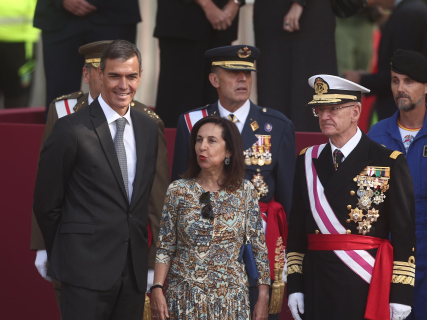
Parade of October 12, 2026: schedule, route, and where to watch it in Madrid

fotonoticia 20260713121227 1920

fotonoticia 20260713121227 1920

Add DEMÓCRATA to Google

Ask FREN

Published

Last updated

3 minutes

Most read

Elecciones 29N · Encuestas

La media de las encuestas

Media a 13 de noviembre de 2026 · 15 institutos

  • PP31,5 %
  • PSOE26,8 %
  • Vox19,1 %
  • Frente Amplio6,4 %
  • ERC2,4 %
01020304050ene 2024jul 2024ene 2025jul 2025ene 2026jul 2026

Media del último estudio de cada instituto en 30 días y su evolución semanal desde el 23J. Partidos con al menos un 2 %.

Todas las encuestas

Elecciones generales del 29 de noviembre · Demócrata

Madrid hosts this Monday, October 12, 2026, the military parade of the National Day, one of the main institutional events of the year, which will bring together the Armed Forces and representatives of the main institutions of the State. The central event will begin at 11:00 hours and will proceed along the Paseo del Prado, the Plaza de Cibeles, and the Paseo de Recoletos until reaching Colón.

The City Council of Madrid expects the attendance of about 80,000 people, for which it has prepared a special security and mobility device that will include traffic restrictions on the main streets of the route and its surroundings.

Those who want to witness the parade will be able to do so from the areas designated for the public along the itinerary, although it is recommended to arrive early to avoid crowds and follow the instructions of the security services.

What time does the parade on October 12 start

The central event of the National Day is scheduled for 11:00 hours on Monday, October 12. From that moment, the institutional program will unfold, which traditionally includes the arrival of the Kings, military honors, the tribute to those who gave their lives for Spain, and the aerial and ground parade.

The start time of the event does not necessarily mean that the ground units will begin to parade at 11:00 sharp, as the protocol ceremonies must take place beforehand.

The total duration will depend on the final program and the development of the different acts.

Route of the military parade in Madrid

The planned itinerary for this year's parade crosses some of the main streets in the center of Madrid, from the area around Atocha to the Plaza de Colón.

Start: Glorieta de Carlos V (Atocha)

  1. Glorieta de Carlos V
  2. Paseo del Prado
  3. Plaza de Cibeles
  4. Paseo de Recoletos
  5. Plaza de Colón

Where to watch the parade on October 12

The public will be able to follow the parade from the spaces designated by the organization along the route. Among the main areas from which the passage of the military units can be witnessed are the Paseo del Prado, the area around Cibeles, and the Paseo de Recoletos.

The choice of location will depend on the influx of spectators and the restrictions that are established in each section. Some areas near the authority stands may have limited access.

For those who want to avoid the most crowded spots, it may be convenient to look for space in the designated areas of the Paseo del Prado or Recoletos, although there are no official occupancy forecasts by zones.

The broadcast of the event is also planned through RTVE, an alternative for those who prefer to follow the ceremony and the parade without traveling to the center of Madrid.

Traffic cuts for the parade on October 12

The municipal device includes traffic cuts between 07:00 and 15:00 hours on Monday, October 12, approximately, along the parade route and numerous nearby streets.

The restrictions will particularly affect the roundabout of Emperor Charles V, the Paseo del Prado, Cibeles, Recoletos, and Colón, in addition to roads such as Alfonso XII, Felipe IV, Antonio Maura, Santa María de la Cabeza, and the Paseo de la Infanta Isabel.

Restrictions have also been planned during the night from Saturday 10 to Sunday 11 for rehearsals and preparations.

How to get there by public transport

The City Council recommends using public transport and avoiding traveling by car in the center of Madrid.

The Cercanías stations of Atocha and Recoletos are two of the main alternatives to access the route. The nearby Metro stations can also be used, as long as they remain open and no specific access restrictions are established for security reasons.

The device will affect several EMT bus lines and certain taxi stops. In addition, seven BiciMAD stations will remain closed between 07:00 and 15:00 hours, including those located in Cibeles, Recoletos, and the vicinity of the Museo del Prado.

What time does the parade end

The municipal program places the lowering of the flag at 13:30 hours and anticipates that the events will conclude around 15:00 hours, although the development of the ceremony may introduce changes.

During the day, units of the Armed Forces and security forces will participate, with land and air resources. The program includes the review of the force, honors to the flag, tribute to the fallen, and the air and ground parades.

Where to watch the parade on television

RTVE will offer the broadcast of the military parade through La 1 and RTVE Play. The special coverage will begin at 10:00 hours, before the start of the central event, scheduled for 11:00.

Those who attend in person must take into account that 11:00 hours marks the start of the institutional ceremony, not the immediate passage of all military units along the route.

The municipal recommendation is to check the mobility restrictions and arrive well in advance, especially in the areas near Cibeles and Colón, where a good part of the institutional device is concentrated.

More key points, information and questions with FREN

AI-GENERATED CONTENT

What is the process for organizing and authorizing a military parade in Madrid and which authorities are involved in its planning?

The organization of a military parade in Madrid combines decisions from the State (mainly the Ministry of Defense), the governmental authorities of the General State Administration in the Community, and the territorially competent administrations (Community of Madrid and Madrid City Council), as well as the protocol dimension when it comes to state acts with the presence of the King or the Prime Minister.

1. Initiative and decision within the Ministry of Defense

In military parades, especially the National Day parade (October 12), the initiative comes from the Ministry of Defense itself:

  • Political decision: the Government, at the proposal of the Minister of Defense, determines that a parade will be held, its character (state act, with participation of the Royal Family, etc.) and its approximate location (for example, a specific road axis in Madrid).
  • Military planning: the Defense Staff and the commands of the Armies and the Navy define the device: participating units, air and land means, duration, routes, formation and dispersal points, as well as military security needs.
  • Technical direction of the military act: a military authority is designated as responsible for the parade (parade command), who coordinates rehearsals, schedules, internal security rules, and personnel and material arrangements.

In parallel, the protocol and communication part of the Ministry is activated: coordination of guests, stands, accreditations, and relations with other State bodies.

2. Coordination with the General State Administration in Madrid

The presence of military units in public roads and the impact on the city requires involving the territorial structure of the State:

  • Government Delegation in the Community of Madrid: it is the State authority competent in citizen security matters in the Community. It participates in:
    • Coordination of the State Security Forces and Corps with the municipal police and other services.
    • Definition of perimeter security devices, access control, protection of authorities, and incident management.
    • Convocation and chairing of coordination meetings with Defense, Community, and City Council (coordination centers or similar).
  • Other state bodies: state civil protection services and specialized agencies may intervene when the device requires it, integrated into general emergency plans.

3. Role of the Community of Madrid

The Community of Madrid mainly intervenes through its competencies in civil protection and emergencies, health, and, where appropriate, regulation of shows:

  • Integration of the parade into the autonomous civil protection and emergency plans, assessing risks and defining resources (SUMMA, firefighters, etc.).
  • Participation in coordination committees where evacuation routes, health care points, and response protocols to incidents are agreed upon.
  • In certain cases, fitting the parade as a large human gathering or relevant event for emergency planning purposes.

4. Competencies of the Madrid City Council

The Madrid City Council is key because the parade occupies and conditions the urban public road:

  • Use of public roads and traffic:
    • Municipal authorization for the temporary occupation of streets and squares by troops, vehicles, stands, and assembly elements.
    • Design and execution of traffic plans: street closures, public transport detours, signage, and communication to citizens.
  • Noise and coexistence:
    • Application of the noise ordinance and municipal urban environment regulations to rehearsals, salutes, military music, and loudspeakers.
    • Management of schedules and conditions to minimize impact on neighbors and businesses.
  • Municipal services:
    • Municipal police, cleaning, lighting, assembly and disassembly of urban elements, as well as local civil protection services.

5. Royal Household and Presidency of the Government in state acts

When the parade has the character of a state act (such as October 12), two fundamental actors are added:

  • His Majesty the King's Household: coordinates the Royal Family's agenda, their participation in the act, symbolic elements (troop review, flag salute, awarding of decorations), and the protocol that directly affects the Head of State.
  • Presidency of the Government: through its protocol structure and the General Secretariat of the Presidency, it handles the Government's representation, relations with other high State authorities, precedence distribution, and institutional image.

All this is framed within a general regulatory framework that, rather than regulating a specific parade, establishes principles on official acts, precedences, citizen security, local regime, and administrative procedure. Based on this, each year internal orders, instructions, and specific operational plans are approved that specify the route, schedules, security devices, and conditions for the use of urban space.

Could you detail what specific authorizations the Madrid City Council must grant for a military parade and which municipal ordinances apply? How is the security and civil protection device organized in a large military parade in Madrid and which bodies participate? What organizational and competency differences exist between the October 12 parade and other minor military acts in the city of Madrid?

What competencies does the mayor of Madrid have in managing security and mobility during institutional events of this magnitude?

The mayor of Madrid is the highest municipal authority and, as such, plays a key role in security and mobility during large institutional events. However, these competencies are always exercised within a framework of function distribution with the State and the Community of Madrid, and under clear limits of legality, proportionality, and respect for fundamental rights.

1. Own competencies of the City Council and the mayor

Generally, local regime regulations and the specific regulations of Madrid's capital status attribute to the municipality and its mayor competencies in:

  • Regulation and management of traffic on urban roads, including regulation of traffic directions, speed limits, lane reservations, street closures, and detours due to official acts, works, or mass events.
  • Urban mobility and municipal transport: planning of recommended routes, reinforcement of urban buses, regulation of private vehicle access to certain areas, and establishment of pedestrian or residential priority zones related to the event.
  • Municipal police: the mayor holds the superior command of the Municipal Police, which is responsible for regulating urban traffic, monitoring compliance with municipal ordinances, controlling capacities and access in public spaces, and operational support to other bodies in major events.
  • Local civil protection: development and activation of municipal emergency and self-protection plans, coordination of municipal fire services, assistance services, and preventive devices (health, evacuation, temporary shelters, etc.).
  • Municipal ordinances: the City Council approves mobility, coexistence, and public space use ordinances that specifically provide for temporary restrictions, pedestrianizations, and special measures in case of high-impact events.
2. Coordination with the State and Community of Madrid

In "high intensity" institutional events (visits of heads of state, international summits, state acts), citizen security in the strict sense is a state competence, exercised through the Ministry of the Interior and the Government Delegation in Madrid, with the participation of the National Police and, where appropriate, the Civil Guard.

In this context:

  • The Government Delegate assumes the direction of citizen security and high personality protection devices, and sets the overall security scheme together with Interior.
  • The Community of Madrid coordinates the emergency system (112), autonomous civil protection services, and regional transport (Regional Transport Consortium, Madrid Metro, interurban services).
  • The Municipal Police integrates into the joint device, focusing on urban traffic, access control, support to local civil protection, and compliance with ordinances.

The basic institutional tool to articulate this cooperation is the Local Security Board of Madrid, in which the City Council, Government Delegation, and usually Community representatives participate. In it, devices are agreed upon, functions are distributed, and action and communication protocols are established.

3. Formal instruments of the mayor

To specify his competencies in security and mobility, the mayor has several instruments:

  • Edicts and mayoral decrees, with which he can establish temporary circulation restrictions, route reservations, access limitations to certain areas, special schedules, or public space use rules linked to the event.
  • Special mobility plans, approved by the competent municipal bodies, detailing street closures, alternative routes, loading and unloading zones, resident parking, and public transport devices.
  • Municipal emergency and self-protection plans, which set evacuation protocols, meeting points, reinforcement of fire and health services, and alert levels for specific risks (crowds, fires, terrorist incidents, etc.).
  • Operational instructions to the Municipal Police and municipal services (cleaning, lighting, social services, etc.) to adapt their functioning to the event device.
4. Legal limits and effective scope

The mayor's capacity to impose circulation restrictions, street closures, or temporary pedestrianizations is not unlimited:

  • It must comply with state traffic and road safety legislation and the constitutional distribution of competencies, without invading those corresponding to the State in citizen security.
  • Measures must be proportionate, necessary, and justified due to security, authority protection, or traffic regulation, and respect fundamental rights such as freedom of movement and assembly.
  • He cannot use his mobility powers to condition or prevent state decisions on security devices, nor interfere in exclusive Government Delegation competencies (e.g., escorts, interior security perimeters of a summit, control of authorized demonstrations).
  • Traffic restrictions and temporary pedestrianizations must fit within the framework of current municipal ordinances and may be subject to judicial review if considered arbitrary or disproportionate.

In summary, the mayor of Madrid has broad scope to regulate mobility and deploy municipal services around a large institutional event, but the ultimate direction of citizen security and protection of high authorities lies with the State, so management is always based on coordination between government levels rather than a unilateral City Council decision.

What laws and regulations govern the celebration of the National Day and associated institutional acts in Spain?

The celebration of the National Day (October 12) and associated institutional acts are supported by a relatively small core of state norms, which complement each other: a law that sets the date and its meaning, several royal decrees that regulate military and civic-military acts, and general regulations on flags and labor holidays.

1. Law that sets the date and name of the National Day

The basic norm is Law 18/1987, of October 7, which establishes the National Day of Spain on October 12 (BOE-A-1987-22831).

This law:

  • Expressly declares that October 12 is the National Day of Spain, for all purposes.
  • Justifies the choice of the date for its symbolic value: a relevant moment in common history, linked to the linguistic and cultural projection of Spain beyond Europe.
  • Seeks to unify previous civic or official dates, repealing Royal Decrees 1358/1976 and 1728/1977, and giving a single date the highest solemnity.
2. Rules on the celebration of October 12 and institutional acts

Before Law 18/1987, Royal Decree 3217/1981, of November 27, which establishes rules for the celebration of October 12, National Day of Spain and Hispanic Day (BOE-A-1982-1), had already configured October 12 as:

  • A permanent national labor holiday.
  • A date for which public authorities will program official and popular commemorative acts of the National Day and Hispanic Day.
  • With international projection, whose coordination is attributed to the Ministry of Foreign Affairs.

This generic provision of "official and popular acts" is the legal basis for the institutional programming of October 12, both domestically and abroad (embassies, consulates, etc.).

3. Military acts and National Day parade

In the specifically military sphere, the central piece is Royal Decree 862/1997, of June 6, which regulates the commemorative acts of the National Day of Spain within the Ministry of Defense (BOE-A-1997-13927).

This royal decree:

  • Transfers to October 12 the most significant acts that had been held on Armed Forces Day (military parade, flag tribute, etc.), thus reinforcing the identification of the Armed Forces with society.
  • Orders that, on National Day, military personnel wear full dress uniform and a general decoration of Ministry of Defense buildings and ships is carried out, where the national flag will fly.
  • Provides for the celebration of a military parade and a solemn tribute of respect and exaltation to the Flag of Spain, as the emblem of the homeland and symbol of its unity and national coexistence.
  • Allows the celebration on nearby dates of civic-military acts, training exercises, and cultural, sports, or other activities to bring the Armed Forces closer to the public.
  • Empowers the Minister of Defense to issue development provisions, which provide regulatory coverage for the annual planning of the parade and associated acts (stage, participating units, format of the homage to the fallen, etc.).

The Decree is issued "in relation" to Law 18/1987 and Royal Decree 530/1987 (Armed Forces Day), on which an emphasis shift to October 12 operates.

4. Flag, national symbols, and labor holidays

Aspects related to the flag and national symbolism are framed in Law 39/1981, of October 28, regulating the use of the flag of Spain and other flags and emblems (BOE-A-1981-26082), which:

  • Configures the flag of Spain as a symbol of the nation and of sovereignty, independence, unity, and integrity of the homeland.
  • Requires it to fly outside and occupy a preferred place inside all buildings and establishments of public administrations.
  • Establishes rules on treatment and honors, preference positions when flying alongside other flags, and prohibition of adding symbols or acronyms of private entities.

This framework is completed by Royal Decree 441/1981, of February 27 (BOE-A-1981-6317), which technically defines the official colors of the flag in the CIELAB system, ensuring uniformity in its use by official bodies and Armed Forces.

Finally, the status of October 12 as a national paid and non-recoverable labor holiday is integrated into the general labor holiday regime regulated by Royal Decree 2001/1983, of July 28, to which annual resolutions such as that of October 23, 2023, on labor holidays for 2024 refer (BOE-A-2023-22014).

Together, these norms set the date and meaning of the National Day, guarantee its labor consideration, and provide the legal framework for parades, flag tributes, and other institutional acts held every October 12.

Play

Test your knowledge with FREN!

How much do you know about this topic? Answer the following 3 questions.

Through which streets of Madrid will the military parade on October 12, 2026, take place?

Question 1 of 3

Which medium will broadcast the military parade live for those who cannot attend in person?

Question 2 of 3

At what time is the conclusion of the military parade events expected according to the municipal program?

Question 3 of 3