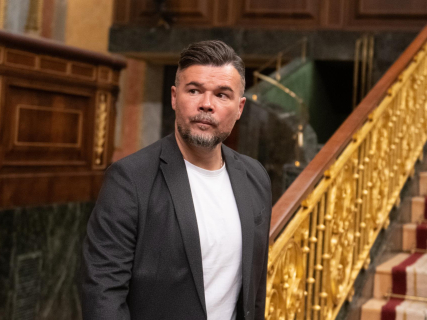
Alamany (ERC) confirms Rufián as head of the list on November 29.

Elisenda Alamany confirms that Gabriel Rufián will lead the ERC list on 29N and criticizes the blockage by Junts and the management of Salvador Illa.

fotonoticia 20261009203256 1920

fotonoticia 20261009203256 1920

Add DEMÓCRATA to Google

Ask FREN

Published

Last updated

1 minute

Most read

Elecciones 29N · Encuestas

La media de las encuestas

Media a 18 de noviembre de 2026 · 17 institutos

  • PP31,4 %
  • PSOE27,4 %
  • Vox19,0 %
  • Frente Amplio6,1 %
  • ERC2,4 %
  • SALF2,0 %
01020304050ene 2024jul 2024ene 2025jul 2025ene 2026jul 2026

Media del último estudio de cada instituto en 30 días y su evolución semanal desde el 23J. Partidos con al menos un 2 %.

Todas las encuestas

Elecciones generales del 29 de noviembre · Demócrata

The general secretary of ERC, Elisenda Alamany, has confirmed that the current spokesperson for the party in the Congress of Deputies, Gabriel Rufián, will head the republican candidacy in the elections on the upcoming November 29, according to an interview with "El Nacional" collected by Europa Press this Saturday.

Alamany has pointed out that the party arrives prepared for this date with the polls and has emphasized that the electoral advance occurs "after three years in which Junts has blocked any progress, any improvement for the Catalans."

Likewise, she has criticized that the president of the Generalitat, Salvador Illa, "has not lamented that Catalunya loses 4.700 million for its financing" as a consequence of the electoral call, nor has he shown concern for the cancellation of the debt of the autonomous liquidity fund (FLA) or for completing the transfer of Rodalies.

In relation to the possible return of the former president of the Generalitat, Carles Puigdemont, after his amnesty, the republican leader has defended that the recovery of the full political activity of leaders like Puigdemont or the president of ERC, Oriol Junqueras, will contribute to improving the quality of Catalan politics "and leaving behind the blockade."

The general secretary has also linked the campaign for the general elections with that of the municipal elections scheduled for next May, in which she will be a candidate for the City Council of Barcelona, and has warned: "It is a mistake to propose electoral campaigns in just 15 days, in the sense that for 4 years we have tried to convince people that we are the ones who are closest to the problems."

More key points, information and questions with FREN

AI-GENERATED CONTENT

What is ERC's internal procedure and timeline for ratifying its lists for the general elections?

The internal procedure of Esquerra Republicana de Catalunya (ERC) to approve and ratify its lists for the Congress and the Senate is structured through a specific regulation for each call, approved by the Consell Nacional. Based on that, the Executiva Nacional drives the timeline, the territorial structures propose names, and finally, the Executiva and Consell Nacional ratify the complete candidacies. In recent calls, the scheme and timing have been quite stable, although adapted to the legal calendar of each general election.

1. Involved bodies

The main bodies involved are:

  • Consell Nacional: it is the highest political body between congresses. It approves the specific internal regulation for the general elections and ratifies the final lists for the Congress and the Senate submitted by the leadership.
  • Executiva Nacional: initiates the process, proposes or validates the timeline, promotes the constitution of the electoral commission, and prepares the proposal of final lists based on territorial and sectoral candidacies.
  • Electoral Commission: a technical body dependent on the leadership that receives and verifies candidacies, applies the regulation criteria (balances, quotas, parity), and has the authority to order the lists.
  • Federations and territorial and sectoral assemblies: propose the candidates for each constituency and for the different sections of the lists, both for the Congress and the Senate, according to the approved regulation.
  • Presidency and national leadership: the recent regulation reserves for the Presidency the possibility to directly propose up to around 25% of the candidates, integrating them into the lists that are then submitted for ratification.
2. Formal phases of the procedure

Although each call has its own regulation, the usual phases are as follows:

  • Approval of the internal regulation: the Consell Nacional approves a regulation for that general election. It sets the requirements to be a candidate, the weight of the membership, the competencies of the bodies, the reserved percentages for the leadership, and the complete timeline of endorsements, primaries, and ratifications.
  • Presentation of pre-candidacies for head of list: after activating the regulation, a brief period opens (in the last process, about six days) for those who want to lead a candidacy to the Congress to present endorsements. The options are: gather around 5% of the membership of the corresponding scope or have the support of one-third of the Executiva Nacional or one-quarter of the Consell Nacional.
  • Proclamation and, if applicable, primaries: if only one pre-candidacy meets the requirements, it is automatically proclaimed as head of the list and primaries are not held. If there is more than one, an internal vote of the membership is organized within a very limited period; in the 29N cycle, the primaries were scheduled to conclude on October 17.
  • Territorial and sectoral proposals: in parallel or immediately after resolving the list leadership, territorial congresses and sectoral assemblies are held. From there comes a list of proposed people to complete the candidacies for the Congress and the Senate in each constituency.
  • Preparation of the final list by the Executiva: the Executiva Nacional integrates the territorial proposals, incorporates the names that the Presidency may reserve, and applies the established criteria (territorial balance, parity, sector representation, continuity of outgoing positions, etc.). In the last publicly described process, the Executiva set the final list on a specific date (for example, October 20).
  • Ratification by the Consell Nacional: the proposal of complete candidacies for the Congress and the Senate is submitted to the Consell Nacional for final political endorsement. With that ratification, ERC closes its internal procedure and is in a position to formally register the lists before the electoral boards within the timeline set by the LOREG.
3. Typical timeline in recent cycles

In an early election situation like the current one, the timeline is compressed but maintains the same sequence. Based on the most recent published examples, this pattern can be summarized:

  • Approval of the primaries and lists regulation by the Consell Nacional: a few weeks before the official candidacy deadline.
  • Window of several days to gather endorsements of 5% of the membership or from national bodies.
  • If applicable, primaries for head of list, with a deadline (for example, October 17 in the case of 29N).
  • Territorial congresses and sectoral assemblies to outline the rest of the names.
  • Meeting of the Executiva Nacional (for example, October 20) to approve the final proposal.
  • Ratification by the Consell Nacional shortly before the legal deadline for candidacy registration expires.

In practice, the entire ERC cycle from the activation of the regulation to the final ratification of the lists for the Congress and the Senate can be concentrated around two or three weeks when the early election leaves little margin, always respecting the mandatory deadlines of the general electoral legislation.

What are the competencies of ERC's secretary general and what has been Elisenda Alamany's political trajectory?

Available information indicates that Elisenda Alamany is currently the secretary general of Esquerra Republicana de Catalunya (ERC), as well as the leader of the party's municipal group in Barcelona and a central figure in its political strategy. Below, I detail, on one hand, the political competencies she exercises as secretary general and, on the other, her political trajectory up to this position.

Competencies of ERC's secretary general

No statutory text of ERC has been found that literally lists the functions of the Secretary General, but there is a consistent pattern in the party's own communications and in the press: the secretary general appears as the main executive position and number two of the organization, immediately below the presidency (held by Oriol Junqueras).

According to the sources consulted, the political and organizational responsibilities that Elisenda Alamany exercises from the secretary general are, in practice, the following:

  • Daily political leadership: she shares with the presidency the daily management of ERC's political line, marking the party's stance before the central government, the Generalitat, and the main state and Catalan debates (budgets, amnesty, transfers like Rodalies, etc.).
  • Organization coordination: she is responsible for articulating the party's territorial and sectoral structure, as well as "opening" and "modernizing" ERC, in her own words at the first meeting of the new leadership, aiming to reconnect with the membership and Catalan society.
  • Execution of leadership bodies' decisions: she promotes and operationalizes the resolutions adopted in the party congress, the Consell Nacional, and the executive, translating the major strategic lines into concrete political work.
  • Public representation and spokesperson role: she regularly acts as ERC's spokesperson in media and press conferences, defending the party's position in debates such as amnesty, Catalan budgets, or relations with PSOE and PSC, and setting the discourse against other actors (Junts, Aliança Catalana, etc.).
  • Interlocution and negotiation: she participates in high-level meetings with other formations (for example, with EH Bildu's leadership) and leads part of the political negotiation on behalf of ERC, both in Catalan and state contexts.
  • Strategic electoral orientation: she plays a central role in designing the strategy for general and municipal elections, including promoting candidacies (such as Gabriel Rufián's for Congress and her own for Barcelona's mayoralty).

Overall, ERC's secretary general combines a function of operational party leadership with a very visible role in discourse direction and electoral strategy, both at the Catalan national and municipal levels in Barcelona.

Elisenda Alamany's political trajectory

Sources agree in outlining Elisenda Alamany as a leader of municipalist origin, with training in Catalan Philology and teaching experience, who has evolved from local platforms and the common space to ERC's top leadership.

Municipalist and common space stage
  • Local municipalism: from 2007 she promoted grassroots candidacies in Castellar del Vallès, such as L’Altraveu per Castellar and later Decidim Castellar, with which she obtained municipal representation and consolidated as a local reference.
  • Parliament of Catalonia: in the 2017 Catalan elections she was elected deputy for Barcelona on the Catalunya en Comú–Podem list. Between January and October 2018 she served as group spokesperson in the Parliament.
  • Non-attached deputy: in 2019 she left the common group, although she kept the seat as a non-attached deputy until the end of the legislature, distancing herself from the common space leadership.
Integration into ERC and projection in Barcelona
  • Joining ERC (2019): after breaking with the commons, she joined Esquerra Republicana. Since then, her career has fully developed within the republican sphere.
  • Barcelona City Council: she ran as number two on ERC's list for the City Council headed by Ernest Maragall in 2019 (and later in 2023). She is a councilor and became one of the party's visible faces in the Catalan capital.
  • Municipal leadership: after Maragall's departure, she became president of ERC's municipal group in Barcelona and emerged as the party's main reference in the council, with a discourse very focused on housing, city model, and tourism regulation.
  • Candidate for mayor in 2027: in 2026 she consolidated as the only aspirant in the internal primaries to be ERC's candidate for Barcelona's mayoralty, reinforcing her profile as both municipal and national leader.
Rise to ERC's secretary general

At the end of 2024, in the context of a party leadership renewal, ERC's membership supported a new executive headed by Oriol Junqueras. Within that new team, Alamany assumed the secretary general, forming a tandem in which Junqueras maintains the presidency while she concentrates on daily management, internal reorganization, and much of the media projection.

Since then, her trajectory has been characterized by the dual dimension of national ERC leader and municipal leader in Barcelona, with a very prominent presence in debates on amnesty, territorial model, relations with the central government, and the party's electoral strategy.

Can you detail recent concrete examples in which Alamany, as ERC's secretary general, has set the party's position on state issues such as amnesty or budgets? How does the internal weight of ERC's secretary general held by Alamany compare with that of other number twos in state parties like PSOE, PP, or Sumar? What role is Elisenda Alamany playing in preparing ERC for the November 29 general elections and what scenarios are being considered for the party?

What were the results of the last general elections in Catalonia and how many seats did ERC obtain in the Congress?

The last general elections held in Spain were on July 23, 2023 (23‑J). In that election, in the four Catalan constituencies (Barcelona, Girona, Lleida, and Tarragona), Esquerra Republicana de Catalunya (ERC) obtained a total of 7 seats in the Congress of Deputies.

The provincial distribution of votes and seats for ERC in Catalonia was as follows:

  • Barcelona:
    • Votes for ERC: 328,697
    • Percentage of the provincial total: 12.32 %
    • ERC seats: 4 deputies
  • Girona:
    • Votes for ERC: 47,531
    • Percentage: 14.72 %
    • ERC seats: 1 deputy
  • Lleida:
    • Votes for ERC: 34,331
    • Percentage: 18.60 %
    • ERC seats: 1 deputy
  • Tarragona:
    • Votes for ERC: 55,461
    • Percentage: 15.07 %
    • ERC seats: 1 deputy

Adding the four provinces, the overall result for ERC in Catalonia in the 2023 general elections was:

  • Total votes in Catalonia: 466,020 ballots
  • Overall percentage in the community: 13.15 %
  • Representation in the Congress: 7 seats

From a territorial distribution perspective, Barcelona clearly concentrates the bulk of ERC's support: more than three quarters of all its Catalan votes come from this constituency and there it obtains 4 of the 7 seats it holds in the Congress. This is consistent with the demographic weight of the province (the one that distributes the most deputies in Spain after Madrid) and with the fact that even relatively contained percentages can translate into several seats when the district distributes many deputies.

In the smaller constituencies (Girona, Lleida, and Tarragona), ERC's behavior is different: in relative terms, the vote percentage is higher than in Barcelona (especially in Lleida, with 18.60 %), but the total number of seats at stake is smaller. This means that, despite being above 14–15 % in votes in the three provinces, the result in each is limited to 1 single seat in the Congress.

The sum of these four districts –4 deputies from Barcelona and 1 from each of the other provinces– defines ERC's presence in the XV legislature. Subsequent analyses of the Spanish political scenario include this data and point out that in later polling projections for future general elections, it is usually taken as a reference that ERC starts from 7 deputies, those obtained in the 23‑J of 2023, when evaluating possible changes in the balance within the investiture bloc.

In summary, answering your two questions:

  • The last general elections held to date in Spain were on July 23, 2023, and in them ERC obtained representation in the four Catalan constituencies (Barcelona, Girona, Lleida, and Tarragona).
  • Overall, ERC secured 7 seats in the Congress of Deputies: 4 from Barcelona and 1 from each of the other three Catalan provinces.

Play

Test your knowledge with FREN!

How much do you know about this topic? Answer the following 3 questions.

By what date does ERC plan to close its internal process to prepare the lists for the general elections?

Question 1 of 3

Which party does Elisenda Alamany accuse of blocking progress for Catalonia over the last three years?

Question 2 of 3

What annual amount does ERC consider Catalonia could lose in regional financing due to the early election?

Question 3 of 3