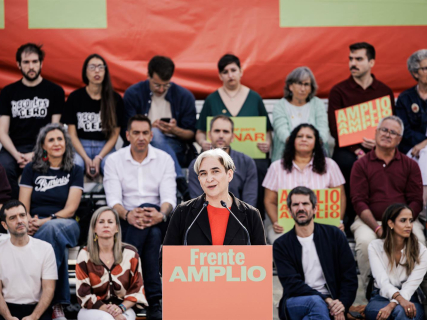
Frente Amplio renews its lists to Congress: only ten deputies repeat and Urtasun will be the only minister

Frente Amplio faces the 29N with a deep renewal: only ten deputies repeat, Urtasun is the only minister, and new territorial leaderships emerge.

fotonoticia 20261025140652 1920

fotonoticia 20261025140652 1920

Add DEMÓCRATA to Google

Ask FREN

Published

Last updated

4 minutes

Most read

Elecciones 29N · Encuestas

La media de las encuestas

Media a 27 de octubre de 2026 · 15 institutos

  • PP31,0 %
  • PSOE27,3 %
  • Vox18,9 %
  • Sumar6,3 %
  • Podemos2,9 %
  • ERC2,3 %
010203040ene 2024jul 2024ene 2025jul 2025ene 2026jul 2026

Media del último estudio de cada instituto en 30 días y su evolución semanal desde el 23J. Partidos con al menos un 2 %.

Todas las encuestas

Elecciones generales del 29 de noviembre · Demócrata

The Frente Amplio candidacies for Congress for the general elections on November 29 represent a broad renewal compared to those presented by Sumar in 2023, given that only 10 deputies who have held seats during the legislature that has just concluded are repeating.

At the same time, the Minister of Culture, Ernest Urtasun, is the only member of the minority wing of the Executive who is included in the lists, as number two for the province of Barcelona.

The new visible faces of Frente Amplio are the candidate for the Presidency of the Government, Ada Colau, and the head of the list for Madrid, the leader of Más Madrid Emilio Delgado. The coalition thus faces a profound reconfiguration of this political space, although it also maintains names with parliamentary experience and management experience.

The Sumar candidacy achieved 31 deputies, but the plurinational group was left with 27 after the break with Podemos at the state level. In addition, throughout the legislature, various resignations occurred that allowed candidates in more delayed positions on the lists to access the seat.

Within the Executive, they have decided not to run in the lists the second vice president, Yolanda Díaz, who was the candidate in 2023, and the Minister of Health, Mónica García. Neither the head of Youth and Childhood, Sira Rego, nor the Minister of Social Rights, Pablo Bustinduy, who acts as the campaign spokesperson for Frente Amplio, are part of the candidacy.

Among those repeating on the lists are the spokesperson for the plurinational group and general coordinator of Movimiento Sumar, Verónica Barbero, the deputy from Más Madrid, Tesh Sidi, and the leader of IU, Toni Valero. The three occupy the second, third, and fourth positions of the candidacy for Madrid.

Other parliamentarians from the previous legislature who will try to revalidate their seats are Esther Gil de Reboleño, who returns to lead the list for Cádiz; Lander Martínez, who will head the candidacy for Vizcaya; and the general secretary of the PCE, Enrique Santiago, who will be number one for the constituency of Seville.

The two members of Compromís, Àgueda Micó and Alberto Ibáñez, also aspire to maintain their representation, although the former ultimately left the Sumar group to join the Mixed group. In their case, the goal is for the Compromís-Frente Valenciano candidacy to achieve its own group and, if that is not possible, they will negotiate with their electoral partners.

DEPUTIES WHO WILL NOT CONTINUE

In the field of the Comuns, Júlia Boada and Viviane Ogou repeat on the lists of Frente Amplio. In contrast, Félix Alonso, Eloi Badia, the coordinator of the formation, Candela López, and the co-spokespersons Gerardo Pisarello and Aina Vidal are left out of the candidacy for Congress regarding 2023. In this last case, their exclusion generated discomfort among part of the membership, which translated into nearly 30% of votes against the ratification of the lists in the highest governing body.

The diplomat Agustín Santos also disappears from the lists of Frente Amplio, who in the previous elections held the number two position of Yolanda Díaz in the candidacy for Madrid.

Other deputies who will not renew their seats are Rafael Cofiño, Txema Guijarro, Francisco Sierra, Carlos Martín, and Manolo Lago, who entered as a quota of Sumar in 2023; Nahuel González and Engracia Rivera, who were part of the group for the IU quota, will also not continue, nor will Alda Recas, from Más Madrid.

Likewise, the Balearic parliamentarian Vicenç Vidal will not repeat, who is replaced as the electoral reference of Ara Més by Carmen Gomila, nor the president of the Chunta Aragonesista, Jorge Pueyo, leader of the party at the regional level, who is replaced as head of the list for Zaragoza of Frente Amplio by the LGTBi rights activist Marina Rodríguez. The deputy Laura Vergara, who replaced Pueyo when he was a candidate for the regional elections in Aragón, also leaves the lists.

Among the constituencies where the Sumar coalition, along with Podemos, obtained representation in 2023 and now there has been a renewal, Galicia stands out. There, the former mayor of A Pobra do Caramiñal, Xosé Lois Piñeiro, and the leader of Sumar in Vigo, Gloria Alonso, will head the lists of Frente Amplio for Congress for A Coruña and Pontevedra, respectively.

In Asturias, IU will lead the constituency with Antonio González Ponte as number one, while in Murcia the head of the list will be the coordinator of IU in the region, Penélope Luna.

In Málaga, also at the proposal of IU, the first position of the candidacy will be occupied by the lawyer and activist of the Flotilla heading to Gaza, Rafael Borrego; in Córdoba, the provincial leader of IU, Sebastián Pérez, will head it; and in Granada, the number one will also be a representative of this formation, the councilor in Huétor, Jesús Fernández.

In Barcelona, the list led by Colau and Urtasun is completed with the leaders of Comuns Júlia Miralles (3), Andrés García Berrio (4), Lucía Martín (5), and Joan Mena (6), who was already a deputy in the legislature 2019-2023. Viviane Ogou will occupy the seventh place on the candidacy for Barcelona, in a more delayed position, and Boada will be the head of the list for Girona.

In the constituency of Las Palmas (Canary Islands), the number one will be the leader of Nueva Canarias Luis Campos (NC), within the coalition alongside Frente Amplio and Podemos under the brand Unión del Pueblo Canario.

TWO FORMER LEADERS OF PODEMOS ON THE ANDALUSIAN LISTS

In Andalusia, Frente Amplio has incorporated former leaders of Podemos into relevant positions on its lists, such as the former leader of the party in Almería, José Miguel Ramos, who is listed in fifth place for this province, and, above all, the former regional coordinator of the purple formation, Raquel Martínez, who is integrated as number 4 in the candidacy for Congress for Málaga.

Another striking note from the list is that the painter and sculptor Antonio López and the historic environmental leader Inés Sabanés will symbolically close the candidacy of Frente Amplio for Congress in Madrid for the general elections on November 29.

More key points, information and questions with FREN

AI-GENERATED CONTENT

What is the parliamentary status of the Frente Amplio candidacy and what are the next steps for its establishment as a group in Congress?

As of October 27, 2026, Frente Amplio is an electoral candidacy, not a constituted parliamentary group. Its eventual group in Congress can only be formed after the November 29 elections, with the elected deputies and through a formal communication to the Board. Therefore, it is not pending a parliamentary vote on the candidacy: first the electoral process must be completed and then the new Chamber organized.

Current situation: electoral phase, not parliamentary

Frente Amplio is organizing its candidacies around Movimiento Sumar, Izquierda Unida, Más Madrid, and Comuns. The information from October 27 describes renewed lists, but not a definitive parliamentary composition nor a spokesperson for the future group. It is important to distinguish between those who lead the candidacies, those who perform campaign functions, and those who will ultimately assume responsibilities in Congress (Demócrata, October 27).

The existence of the previous Plurinational Sumar Group does not automatically make Frente Amplio its parliamentary successor. The new grouping will depend on the electoral results and the formal will of its deputies, expressed according to the Regulations.

Next steps to constitute the group
  • Obtain representation and proclaim the elected. After the elections and the corresponding scrutiny, the deputies who can participate in the constitution of the group will be known. Running in coalition does not guarantee by itself having a group of its own.
  • Constitute the new Congress. The constitutive session will take place when established by the convocation decree. In it, the Board will be elected and the oath or promise of adherence to the Constitution will be taken. To fully acquire the status of deputy, the electoral credential and declaration of activities must also be presented, according to article 20 of the Congress Regulations.
  • Communicate the formation of the group. Article 24 requires submitting a written document addressed to the Board within five days following the constitutive session, counted as working days according to article 90. It must be signed by those wishing to constitute it and include its name, all its members, the person who will act as spokesperson, and their possible substitutes.
  • Verify the requirements. The Board will examine whether the request meets the numerical, electoral, and formal conditions. This is not an investiture nor a Plenary vote: the Board must apply the rules on group constitution.
Thresholds to be considered

There is a relevant difference between the consulted regulatory text and the reform announced for the next legislature. The former includes the general rule of 15 deputies and the alternative of five seats with certain vote percentages. However, Demócrata explains that the reform approved on July 23, applicable from the XVI legislature, maintains the 15 deputies and allows the alternative of five seats plus 3% of the valid national vote, or an average of 10% in the constituencies where representation is obtained. These latter percentages come from that journalistic information.

Alliances and alternative to having a group of their own

Competing electorally in different candidacies does not prevent later sharing a group. However, article 23.2 limits the creation of separate groups by deputies of the same party or formations that did not compete against each other before the electorate. Territorial agreements must be examined according to their specific configuration, without presuming they allow freely dividing a coalition.

If their deputies do not constitute their own group nor are integrated into another according to the Regulations, they will join the Mixed Group. The decisive sequence will therefore be: electoral result, constitution of Congress, signed document, and Board examination.

What are the main competencies and powers of Ada Colau as leader of the Frente Amplio coalition according to current regulations?

Ada Colau exercises political and electoral leadership in Frente Amplio, but that status alone does not grant her administrative competencies or legal powers over the member parties. The consulted sources identify her as a candidate for the Presidency of the Government; they do not provide a coalition agreement or regulation listing personal leadership powers. Therefore, it is necessary to distinguish her accredited public functions from the formal faculties that would require an express designation.

1. What position she holds

On October 12, 2026, Movimiento Sumar, Comuns, Más Madrid, and Izquierda Unida agreed to propose her as a candidate for the Presidency of the Government. Later, it was confirmed that she would lead the candidacy for Barcelona. This accredits her role as a statewide electoral reference, but does not equate to naming her president, general coordinator, or legal representative of the coalition (Demócrata, October 12; Demócrata, October 17).

2. Main accredited political functions
  • Lead the electoral offer. Her candidacy places her as the main face of Frente Amplio's proposal for the Presidency, without this implying she already exercises government functions.
  • Publicly represent the project. She participates in the communication and public presentation of the candidacy. This political representation should not be confused with the legal capacity to sign electoral actions on behalf of all organizations.
  • Facilitate agreements among organizations. Her public intervention has been aimed at expanding the candidacy and facilitating consensus. On October 13, she explained that she understood her proposal as a mandate to continue working for a joint candidacy (Colau's Statement).

These are observed political functions, not a catalog of competencies established by a norm. It is also not recorded that she has exclusive spokesperson status: on October 22 she publicly recognized Pablo Bustinduy as campaign spokesperson, showing a distribution of communicative responsibilities (Colau's Post).

3. What depends on regulations and internal pact

The electoral framework distinguishes the candidacy from the responsibilities of representation and organization of a coalition. The consulted sources indicate that its electoral communication must identify the name, scope, rules or regulatory pact, and holders of the leadership or coordination bodies. However, the official text that would assign these responsibilities specifically to Colau has not been located.

Additionally, a journalistic reference describes a Joint Commission responsible for coordinating the coalition, supervising compliance with the pact, and resolving conflicts through binding decisions. This is relevant information about the collective structure but does not replace the signed agreement nor accredits individual powers of Colau (Information about the pact).

4. Powers that cannot be assumed

There is no evidence in the consulted sources of a personal authorization for Colau to unilaterally:

  • Approve or modify the electoral lists of the member organizations.
  • Legally commit the entire coalition before the Electoral Administration.
  • Manage its funds or authorize expenses by virtue of her candidacy.
  • Impose binding agreements, resolve internal conflicts, or replace collegiate bodies.

In conclusion: what is accredited is leadership of candidacy, communication, and consensus seeking. There is insufficient documentary basis to present as her own legal competencies the organic direction, economic management, or formal electoral representation. Any such attribution would have to derive from the coalition pact or an express appointment, not from the term "leader."

What has been Ernest Urtasun's political trajectory before joining the Frente Amplio lists?

Before joining the Frente Amplio lists, Ernest Urtasun had been a leader of ICV, diplomat, MEP, and Minister of Culture, as well as spokesperson for Sumar. His trajectory combines activism in Catalan organizations with a long European stage and, since November 2023, responsibilities in the Government of Spain.

The beginnings: youth activism and ICV

Born in Barcelona in 1982, Urtasun joined in 1997, at fifteen years old, Joves d’Esquerra Verda, the youth organization linked to Iniciativa per Catalunya Verds. His early years of activity included participation in student and union movements. He graduated in Economics from the Autonomous University of Barcelona and pursued postgraduate studies in International Relations at the University of Barcelona, according to the profiles of Política Electoral and El Español.

Between 2004 and 2009 he worked as an advisor to ICV MEP Raül Romeva. This was his first extended professional stage in the European Parliament. Within ICV he also assumed responsibilities in international relations and participated in linking the organization with the European Green Party, according to his biographical profile.

The diplomatic career

In 2010 he entered the Spanish diplomatic career. He worked in the cabinet of the Ministry of Foreign Affairs and Cooperation and later as diplomatic advisor to the Secretary-General of the Union for the Mediterranean, an organization based in Barcelona. In 2014 he requested a leave of absence to run in the European elections. This international experience preceded his stage as an elected representative, as reported by El Confidencial.

Nine years in the European Parliament

Urtasun was elected MEP in 2014 on the La Izquierda Plural list and renewed his seat in 2019. He remained in the European Parliament until 2023, integrated in the group of The Greens/European Free Alliance, of which he became vice-president, according to Demócrata.

His European work covered economic policy, taxation, gender equality, international relations, and climate change. He also participated in special committees on tax agreements with companies and on the Panama Papers. Simultaneously, he was spokesperson of ICV between 2016 and 2019. His organizational path continued in the space of Catalunya en Comú and Esquerra Verda, according to Política Electoral.

Sumar and the Ministry of Culture

During the construction of the project led by Yolanda Díaz, Urtasun joined Sumar and assumed its spokesperson role. Thus, before his candidacy for Frente Amplio, he already combined responsibilities of state political communication with his link to the Comuns, as explained by Demócrata.

On November 21, 2023, he took office as Minister of Culture, succeeding Miquel Iceta in the government presided over by Pedro Sánchez. The portfolio was separated from Sports and included historical heritage, museums, archives, arts, books, reading, cinema, and audiovisual. Among the decisions of his mandate are the elimination of the National Bullfighting Prize and the review of the role of state museums, according to his profile on Demócrata.

Therefore, he arrived at the candidacy as minister and spokesperson of Sumar, after nine years of European parliamentary experience. In October 2026, the Comuns confirmed his incorporation as number two for Barcelona, behind Ada Colau, for the November 29 elections. His inclusion on the list did not by itself imply immediately leaving the Ministry, according to Demócrata.

Play

Test your knowledge with FREN!

How much do you know about this topic? Answer the following 3 questions.

Who currently leads the Broad Front coalition?

Question 1 of 3

How many deputies from the Plurinational Group Sumar are repeating candidacy with the Broad Front?

Question 2 of 3

Which party leads most of the Broad Front candidacies in the absence of Podemos?

Question 3 of 3