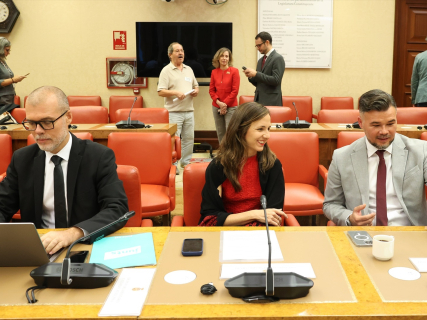

The Standing Committee of the Congress meets this Thursday, 12 November, starting at 9:00 a.m., to decide the future of the two housing decrees approved by the Government following the call for general elections of 29N. The session, which comes one day after the general strike for housing, will be marked by two votes with very different prospects: while the Executive has the necessary support to validate the bulk of its measures on rentals, the decree that provides for the stabilization of contracts faces a new parliamentary rejection.
In addition to the votes, the third vice president and Minister for Ecological Transition, Sara Aagesen, will appear to provide information on the planning of the electricity grid through 2030, in a session that will bring together the deputies who make up the only parliamentary body that remains active after the dissolution of the Cortes.
A majority that depends on PNV
The two decrees entered into force after publication in the Official State Gazette (BOE) on 7 October last, but they need to be validated by Congress within the constitutional deadline of 30 days. The election call transferred this responsibility to the Standing Committee, which will have to decide whether it maintains the rules or repeals them.
The first brings together the main intervention measures in the rental market. Among them are the extension of contracts, protection against evictions, the regulation of seasonal and room rentals, and tax incentives for owners who reduce rents.
It also incorporates a loan mechanism of up to 50,000 euros to facilitate the purchase of the first home, managed through the Official Credit Institute (ICO) and endowed with 10,000 million euros.
To these measures is added a social impact fund of 400 million euros intended to promote affordable housing, as well as the expansion of the access conditions to certain funds for social projects.
The decree also includes the prohibition of evictions for vulnerable people without alternative housing until 2030 and an automatic extension of rental contracts until 2028.
This first text, in principle, has its validation ensured. The PSOE, Sumar, ERC, Bildu, and Podemos add up to 34 representatives in the Permanent Committee, compared with the 34 gathered by PP, Vox, and Junts. The vote of the PNV, favorable to this decree, would allow the bloc that supports the measures to gather 35 votes in favor.
The situation is different for the second decree, which provides for the automatic conversion of rental contracts into indefinite contracts once five years have passed, or seven if the landlord is a legal entity, provided that the tenant is up to date with their obligations.
The PNV maintains its reservations about this measure and, unless there is a last-minute change of position, will vote against it together with PP, Vox, and Junts. The expected result would be 35 votes against versus 34 in favor, which would lead to the repeal of the decree.
Electricity planning through 2030
The session will also include the appearance of the Third Deputy Prime Minister and Minister for Ecological Transition, Sara Aagesen, who will attend the Constitutional Chamber to provide information on the new planning for the electricity energy transmission grid through 2030.
Unlike housing decrees, electricity planning does not need to be validated by Parliament. Its approval corresponds to the Council of Ministers through an agreement, although the regulations establish the obligation for the Executive to inform the Chamber.
On previous occasions, this process has been carried out through the submission of documentation and an appearance before the relevant parliamentary committee. However, the dissolution of the Cortes prevents convening the ordinary committees, so Aagesen will appear before the Permanent Committee. The minister will outline the main lines of energy planning for the coming years and respond to interventions by the parliamentary groups.