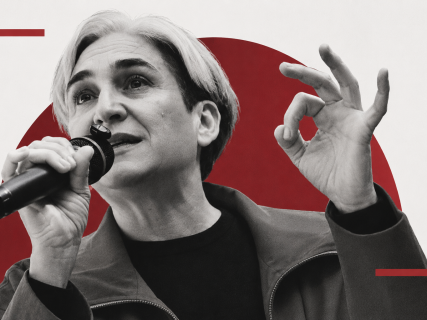
The most viral politician of the day | Ada Colau leads the networks after her stint on 'La Revuelta' and her jab at Abascal

The candidate of Frente Amplio heads the ranking of Poder Digital. The controversy over the interview of Vox leader with Broncano also boosts the publications of Abascal and Alvise Pérez asks Jordi Wild to invite him to his podcast after the cancellation of the Vox leader

Ada Colau en discurso editorial

Ada Colau en discurso editorial

Add DEMÓCRATA to Google

Ask FREN

Published

5 minutes

Most read

Elecciones 29N · Encuestas

La media de las encuestas

Media a 10 de noviembre de 2026 · 15 institutos

  • PP31,5 %
  • PSOE26,8 %
  • Vox19,1 %
  • Frente Amplio6,2 %
  • ERC2,5 %
01020304050ene 2024jul 2024ene 2025jul 2025ene 2026jul 2026

Media del último estudio de cada instituto en 30 días y su evolución semanal desde el 23J. Partidos con al menos un 2 %.

Todas las encuestas

Elecciones generales del 29 de noviembre · Demócrata

The controversy over the electoral interviews on 'La Revuelta' continues to fuel political conversation on social media, but this time it is Ada Colau who leads the ranking of Poder Digital by Vinces. The Frente Amplio candidate for the general elections on November 29 has achieved 177,825 interactions with a video of her visit to David Broncano's program, broadcast one day after the controversial interview with Santiago Abascal.

Vox leader occupies second place with his response to the criticisms of Pedro Sánchez, while Alvise Pérez completes the podium after publicly asking Jordi Wild to interview him.

Colau's post, shared on Instagram, accumulates 170,938 'likes' and 6,887 comments. In the excerpt shared, the former mayor of Barcelona refers to the controversy from the previous night and asserts the need to respond to Abascal's claims during the election campaign.

"I came to have a good time. I don't know the audience from tonight and I'm glad. Many rumors cannot go unanswered and have them refuted at the ballot box," says Colau in the video that leads the ranking.

Her appearance came after Broncano acknowledged that he had made a mistake in accepting the agreed conditions for the interview with Abascal, including the selection of the audience attending. The controversy, far from ending with Monday's broadcast, continued over the following days with reactions from the candidates, messages exchanged between parties, and the cancellation of the interview of Vox leader with Jordi Wild.

1. Ada Colau responds to Abascal and Broncano recognizes his mistakes

Colau's visit to 'La Revuelta' was conditioned by what happened just 24 hours earlier. During Monday's interview, Santiago Abascal had been the focus of several tense moments with Broncano, who subsequently received criticism for the conditions under which the meeting took place.

Before talking with the Frente Amplio candidate, the presenter acknowledged that he had not been up to the task and apologized for having accepted certain demands related to the theater audience. He also explained that the decision had conditioned the program's usual development.

In that context, Colau took advantage of her intervention to question the statements made by Vox president about immigration and housing, two central issues of the pre-campaign. The former mayor defended the need to combat what she considers misinformation and asked that the public’s response arrive in the elections on 29N.

The interview also left room for other matters. Colau spoke about the state of housing, the need to mobilize the left-wing electorate, and her political career. She even brought back her past as an activist by gifting Broncano the outfit of 'Supervivienda', the character she used in her protests before becoming Mayor of Barcelona.

However, it has been the segment in which she alludes to the controversy with Abascal that has achieved the greatest impact. Its 177,825 interactions make it the lead character in today’s political conversation, ahead of the videos posted by Vox and Alvise Pérez.

2. Abascal responds to Sánchez for his criticisms of the interview on 'La Revuelta'

The second place goes to Santiago Abascal, with 109,225 interactions on Instagram, split between 105,306 'likes' and 3,919 comments. His post responds directly to a message from Pedro Sánchez on X, in which the head of the Government criticized the conduct of the Vox leader during his conversation with Broncano.

"Threatening while smiling is not doing humor, it is degrading our democracy," Sánchez wrote. The president added: "This is what we are fighting for: so that Spain does not become a country again where far-right extremists threaten comedians and journalists. Faced with regression, mobilization."

The message was accompanied by an excerpt from Abascal’s interview on 'La Revuelta'. Vox responded with a video circulated on Instagram under the headline "Vox replies to Pedro Sánchez", in which it accuses the president of using cropped images to present its candidate’s intervention in a biased way.

"Sánchez is not going to give us lessons in anything. And much less by cropping videos to manufacture fear", the post says, which ranks second.

The dispute has dragged on throughout the entire pre-campaign, with Vox claiming credit for the impact of the interview and its opponents questioning both some of Abascal’s statements and the conditions agreed for his participation.

1. Alvise asks Jordi Wild to interview him after Abascal’s cancellation

The third post with the most interactions belongs to Alvise Pérez, which gathers 93,305 interactions and 715,117 views on TikTok. The video adds 80,107 'likes', 2,014 comments, and 11,184 shares.

The leader takes advantage of the suspension of Santiago Abascal’s interview on 'The Wild Project' to publicly ask Jordi Wild to invite him to his podcast, despite admitting that it does not seem that he has the interest of the content creator.

"I am fully aware of the impropriety of asking to be invited where you don’t want me, but I do it with no interest other than defending my country, my voters, and the ideas of freedom reflected in our electoral contract", he says in the video.

His request comes after Vox suspended the recording planned for this Wednesday with Jordi Wild, as DEMÓCRATA advanced, due to a lack of agreement on the interview’s conditions.

The formation’s decision was made amid the standoff with RTVE and El Terrat over the 40 minutes removed from Abascal’s interview on 'La Revuelta'. Vox demanded that it be able to have the full recording and to use the answers of its candidate—conditions it also conveyed in negotiations with Jordi Wild’s team.

Alvise has taken advantage of that disagreement to demand his own space in the podcast. His insistence is not limited to TikTok: he also occupies the fifth place in the ranking with an Instagram post that accumulates 56,367 interactions.

What moves the most on social media

The television controversy continues to dominate the following positions in the ranking. Santiago Abascal appears again in fourth place, with 70,481 interactions on Instagram, thanks to a post in which he lays claim to the audience data from his interview with Broncano: "Common sense breaks audience records. Santiago Abascal breaks audience records".

The fifth place goes to the second post by Alvise Pérez, with 56,367 interactions, in which he again insists on his request to Jordi Wild. In sixth place is Ione Belarra, whose TikTok video adds up to 52,434 interactions and 827,922 views, although the ranking consulted does not include the text of that post.

The seventh spot goes to Irene Montero, with 52,286 interactions on TikTok. Podemos’s candidate also comments on Abascal’s interview: "Broncano didn’t do it well but the problem is who thinks it benefits him to make the monster grow".

Ada Colau reappears in eighth place with the video in which she announced her visit to 'La Revuelta', which adds up to 51,935 interactions. Abascal also occupies the ninth spot, with 48,841, for some later statements about Broncano in which he claims that the presenter was worried about the criticisms from his own political circle. The top ten closes with Pablo Bustinduy, with 32,321 interactions on Instagram.

The classification of Poder Digital by Vinces analyzes 2,455 posts by Spanish politicians on X, Instagram, TikTok and LinkedIn, published between November 10 at 12:46 and November 11 at 18:46.

More key points, information and questions with FREN

AI-GENERATED CONTENT

What is the status of Ada Colau and Frente Amplio's candidacy for the general elections on November 29?

The candidacy of Ada Colau and Frente Amplio is confirmed and running in the general elections on November 29: it is no longer in the proposal or leadership negotiation phase. As of November 11, the information consulted places Colau as number one for Barcelona and the coalition's candidate for the Presidency of the Government, with the candidacies proclaimed and published and no record of a challenge that has nullified her candidacy (EFE, November 3).

From the political agreement to the proclaimed candidacy

Movimiento Sumar, Izquierda Unida, Más Madrid, and Comuns agreed on October 12 to propose Colau to lead the project; that announcement resolved the political leadership but did not yet equate to the electoral proclamation of the lists (Demócrata, October 12).

The subsequent formal phase has also concluded: the provincial electoral boards proclaimed the candidacies on November 2 and their publication occurred on November 3. Therefore, early October news describing her candidacy as a possibility or a pending proposal no longer reflect the current status (EFE, November 2).

Colau runs for Barcelona, not Madrid

Colau heads the candidacy to the Congress of Comuns-Front Ampli for Barcelona, accompanied by Ernest Urtasun in second place; the brand for the Senate is Comuns-Front Ampli per la democràcia. The coalition pact received 94.8% support in the extraordinary Consell Nacional of Comuns, while Urtasun's designation obtained 94.1% (Demócrata, October 17).

In Madrid, the lead candidate is Emilio Delgado, followed by Verónica Martínez Barbero, Tesh Sidi, and Toni Valero. This configuration was recorded on October 27, after the initial proposals about the order of those positions (Demócrata, October 27).

The alliance is closed but does not include Podemos nationwide

Frente Amplio maintains as its core Movimiento Sumar, IU, Más Madrid, and Comuns, along with territorial agreements; it did not reach a general state alliance with Podemos, although there are shared formulas in certain territories (Demócrata, October 27).

  • In Canary Islands and the Valencian Community, Podemos participates in broad candidacies alongside organizations linked to Frente Amplio (Demócrata, October 19).
  • In Catalonia, Podemos agreed to incorporate representatives into ERC's lists, while Colau runs with a candidacy differentiated from Comuns-Front Ampli (Demócrata, October 20).
  • In Balearic Islands, a later agreement allowed the incorporation of Podemos representatives as independents in Ara Més-Front Ampli, including Lucía Muñoz in third place (Demócrata, October 25).
Renewal of names and campaign organization

The candidacy represents a change from Sumar in 2023: Yolanda Díaz, Mónica García, Sira Rego, and Pablo Bustinduy are not running for Congress; Bustinduy serves as campaign spokesperson and Urtasun is the only minister included in the lists. In Barcelona, neither Aina Vidal nor Gerardo Pisarello repeat (Demócrata, October 27).

In short, what has been resolved is the leadership, Colau's list, and the electoral configuration; what did not materialize was a single state candidacy with Podemos. This lack of general agreement should not be confused with a Colau candidacy still pending confirmation (El Periódico, October 17).

What are Ada Colau's competencies and political trajectory before running as a Frente Amplio candidate?

Ada Colau arrived at her Frente Amplio candidacy with a trajectory focused on housing activism and municipal management: she was co-founder and spokesperson of the Platform for People Affected by Mortgages (PAH) and mayor of Barcelona for eight years, between 2015 and 2023. Before that electoral return, she had already left the City Council, so it is advisable to distinguish her accumulated experience from the public competencies she exercised then.

From activism to municipal politics

Born in Barcelona in 1974, she studied Philosophy at the University of Barcelona without completing the degree. She worked as a technician and researcher at the Observatori DESC, dedicated to human rights and the right to housing. The City Council itself recognizes that professional trajectory as a background to her arrival at the Mayor's office (municipal profile).

In 2009 she participated in founding the PAH and was its spokesperson until 2014. Her activity focused on families affected by the mortgage crisis, halting evictions, social rent, and payment in kind, that is, handing over the home to cancel the mortgage debt. She also participated in campaigns and promoted a popular legislative initiative on housing (trajectory profile).

In 2014 she left the PAH spokesperson role to promote Guanyem Barcelona, a citizen platform that gave rise to Barcelona en Comú. She headed its municipal candidacy in 2015, obtained first position, and was invested mayor on June 13, 2015, becoming the first woman to hold the position (biography and positions).

Responsibilities exercised as mayor

Her main executive experience was the two terms leading Barcelona. She directed the local government, coordinated municipal policies, and institutionally represented the City Council. Her areas of action should not be confused with state competencies: these were city government responsibilities (institutional profile).

  • Housing: policies against evictions, mobilization of vacant homes, and promotion of public and affordable housing.
  • Urban planning and mobility: transformation of public space, expansion of pedestrian zones, traffic reduction, and development of superblocks.
  • Tourism: regulation of tourist accommodations and their impact on the residential market.
  • Social services and sustainability: actions against poverty and exclusion, along with measures on air quality and urban space recovery.

These were the main areas of her management, not an exhaustive balance of results nor an attribution of all municipal decisions personally to the mayor (summary of responsibilities).

From the Mayor's office to electoral return

She was re-elected mayor on June 15, 2019. In 2023 she left the Mayor's office, which passed to Jaume Collboni, and remained as councilor and president of the Barcelona en Comú municipal group until resigning her seat in October 2024. She had also assumed leadership responsibilities in Catalunya en Comú (municipal and subsequent stage).

Since 2025 she presided over the Sentit Comú Foundation: a political responsibility, not a public office with administrative powers. Therefore, before her designation, she brought municipal and social experience but did not exercise state executive competencies (post-mayoral profile).

On October 12, 2026, Movimiento Sumar, Comuns, Más Madrid, and IU agreed to propose her as a candidate for the Presidency of the Government for the 29N; that electoral designation did not by itself grant her government powers (announcement in Demócrata).

What legal requirements must be met for a political party to participate in a media debate during the electoral pre-campaign in Spain?

There is no prior permission from the Electoral Board nor a universal minimum of seats or votes required to participate in a media debate during the pre-campaign. There is also no automatic right for all parties to be invited. Legality depends on the timing, the type of media, and that the selection and coverage respect the applicable electoral guarantees.

1. Defining what is meant by pre-campaign

It is essential to distinguish between the time before the call and the period between its publication and the start of the official campaign. The Instruction 4/2011 of the JEC defines the electoral period from the publication of the call until the voting: therefore, its guarantees already operate during that second phase, although the campaign has not yet started.

Before the call, that specific electoral regime does not apply, but general obligations of pluralism and audiovisual information remain. Articles 9 and 51 of the Law 13/2022 protect, respectively, informational pluralism and its reflection in public service programming.

2. Requirements to access the debate

Organization corresponds to the media, not the Electoral Board. Being constituted as a party does not guarantee an invitation; nor does lacking representation prevent participation. The lack of proclamation of candidacies does not by itself prohibit intervening in a political program, although it matters for determining the required electoral guarantees.

During the electoral period, selection must respect article 66 of the LOREG and Instruction 4/2011. The results of the last equivalent elections have special relevance; there is no general obligation to gather all candidacies in a single debate.

3. Differences between public and private media
  • Public media: must guarantee pluralism, equality, proportionality, and informational neutrality throughout their programming during the electoral period. Their campaign coverage plans must include the planned debates and be submitted to the competent board. If they broadcast a debate between the two most voted candidacies, they must offer other debates or sufficient compensatory information about the other candidacies that obtained representation.
  • Private radio and television: must respect pluralism and equality during the electoral period. Private televisions must also observe proportionality and neutrality in electoral debates and interviews. They retain freedom to decide whether to organize the debate but must particularly consider previous results.

These rules do not mean distributing exactly the same minutes among all: equality does not mean mathematical equality.

4. New parties and significant political groups

The Instruction 1/2015 requires including significant political groups in public information plans. These are competing formations that did not participate or did not obtain representation in the previous equivalent elections and that subsequently reached, in recent processes and in the territorial scope of the medium, at least 5% of valid votes.

In a coalition, one of its parties must individually meet that requirement. This condition guarantees informational coverage, not an automatic place in any debate. It also does not turn the 5% into a general threshold to participate.

5. Limits and claims

A journalistic debate must be distinguished from electoral advertising. Article 53 of the LOREG prohibits, from the call until the start of the campaign, electoral advertising or propaganda through the listed media and insertions; it does not prohibit all informative debate. Article 60 prevents contracting electoral advertising in public media and private televisions.

If there is exclusion contrary to pluralism or proportionality, accredited representatives can claim before the competent board. To challenge public broadcasts, Instruction 4/2011 establishes 48 hours from their broadcast; coverage plans have their own claim procedure.

Play

Test your knowledge with FREN!

How much do you know about this topic? Answer the following 3 questions.

Who led the ranking of social media interactions after their appearance on 'La Revuelta'?

Question 1 of 3

What action did David Broncano take before interviewing Ada Colau on 'La Revuelta'?

Question 2 of 3

Why did Alvise Pérez ask to be interviewed by Jordi Wild?

Question 3 of 3