
The call has belonged to the trade unions and housing organizations. The support of the Executive does not allow attributing its organization. But it does open a political discussion about the attempt to take advantage electorally of a protest that challenges different administrations, including the central one.
Before evaluating that strategy, two issues must be separated: the right of workers to go on strike and the electoral convenience of that the Government identifies with it.
Article 28.2 of the Constitution protects the strike to defend the interests of workers. Its placement among fundamental rights grants it reinforced guarantees, including the possibility of seeking amparo.
The Constitutional Court explained in its judgment 11/1981 that it constitutes a counterweight against inequality derived from wage dependence. It is not an instrument reserved for the opposition, nor does it need to be directed exclusively against the Government.
The Executive arrived at 11N after two crises that had provoked demands for resignation also from its left. Podemos demanded Fernando Grande-Marlaska’s departure for Ceuta and Óscar Puente’s after the accident in Urda, before the Minister of Transport left the position. Those demands show that disagreement about government management also cuts across the space that Sánchez intends to mobilize.
The risk for Pedro Sánchez was not in recognizing the right to strike. It was in identifying his electoral project with a protest whose meaning, development, and consequences he could not controlr. The unions called it; the Government backed it. But those who have gone out to demand solutions do not have to accept the distribution of responsibilities that La Moncloa proposes.
The strike has reinforced constitutional protection. Article 28.2 recognizes this right to defend the interests of workers, and the Constitutional Court has defined it as a counterweight against wage dependence. Its purpose is not limited to protesting against a Government: it allows pressure to be exerted in defense of labor and social interests.
This protection does not resolve the political question. Turning support for a strike into an electoral bet can be an unforced error if it amplifies discontent without increasing trust in whoever governs. These are the five ways in which this can happen and what the day has left behind.
1. The protest also points to the Government and wears down the social agents
Housing is a cross-cutting concern. The Government has tried to present the mobilization as a response to the blocking of its proposals, but citizens can share the demands and consider its performance insufficient after eight years in power.
The autonomous jurisdictions do not eliminate the political responsibility of an Executive that has a Ministry of Housing, announces measures, and calls for support to apply them. In a mass demonstration, it is difficult to expect each participant to separate with precision the state, autonomous, municipal and parliamentary responsibilities.
Worse still, research into the electoral effects of strikes points to an additional risk for Sánchez: they can help attribute responsibilities to the officeholder. That is to say, the risk that, at a given moment, housing-related demands take a turn and end up against the Government remains there, as some conveners’ criticisms already show.
There is a second possible cost: the credibility of the social interlocutors. If the unions are identified as an electoral extension of the Government, their ability to represent workers with different preferences may be called into question. Reducing employers’ organizations to the role of representatives of the opposition would produce an equivalent deterioration. In both cases, in a context of extreme polarization, it is the worst that can happen when seeking dialogueo. Even more: once divided into sides, whoever wins the elections may interpret the result as authorization to discredit or sideline the organizations identified with the loser.
Let us remember that Article 7 of the Constitution recognizes unions and business associations as having their own function in the defense of economic and social interests. Its legitimacy does not depend on coinciding with the Executive or confronting it. This is one of the bases of the democratic agreement of the Transition. The more that function is subordinated to party political dispute, the greater the risk of discredit.
Therefore, the problem appears when the campaign replaces that autonomy with a classification between allies and enemies. Let us remember that there is life beyond the 29N and that, at some point, these same organizations will have to go back to negotiating.
El balance of the day has shown to what extent social interlocutors interpret in different ways the same call. UGT and CCOO have argued that the strike exceeded their expectations, even while acknowledging uneven follow-up among sectors and territories. CEOE and Cepyme, in their third statement, have described it as a failure and have placed the follow-up below 5% of the territorial and sectoral average, according to their own data.
These estimates leave a discrepancy that will continue after the strike: there is not even agreement about its scope. That disagreement does not, by itself, demonstrate a loss of legitimacy of social actors; it shows the ground on which its partisan use can grow.
2. The worker may feel forced to display political loyalty
Proximity to elections has facilitated a divisive interpretation: going on strike as a sign of support for Sánchez; working as a rejection of the left. It is an incorrect reading, but that does not prevent it from taking hold in a workplace conversation.
A left-wing voter may feel that they must choose between exposing themselves politically or disappointing their surroundings. A conservative worker may share demands about housing and, at the same time, reject that their participation is presented as support for the Government.
Pressure does not require that someone expressly asks who one votes for. It can arise from the labels assigned to participating or abstaining. That is the risk hypothesis.
The size of the company matters. In a small workforce, each absence is visible and there is less anonymity. According to the INE, as of January 1, 2025, 95% of companies with employees had fewer than 20 workers. Legal protection is essential, but it does not automatically eliminate the fear of a label, the wage cost, or the discomfort in front of coworkers and superiors.
A Government that denounces partisan hostility should be especially careful about that exposure. Freedom to participate must be accompanied by freedom not to do so without having to justify a political identity.
What happened during the day does not allow us to claim that workers had to reveal their vote or that those who went to work reject the demands. Uneven follow-up also does not resolve that question.
3. Displaying support can make uncomfortable the voter who prefers silence
The vote is secret. Participation in a strike, within a company, can be visible. Confusing both behaviors introduces a requirement that does not exist at the ballot box: demonstrating a commitment publicly.
Here comes the debate about the hidden vote. The investigation on Spain has documented that reluctance to declare an electoral preference can affect voters of different ideologies depending on the political moment. It does not constitute a permanent reserve of socialist votes nor a guarantee of a comeback. If Sánchez trusts that he can regain support among those who today prefer not to identify with him, turning the strike into a test of adherence could prove counterproductive. The risk is to bother that voter before they reach the ballot box, not that their participation or absence allow what they will vote for to be discovered.
Sánchez may have mobilized the convinced and still fail to recover the distanced. He could even have activated his adversaries if they have interpreted the call as a demonstration of electoral strength.
The more the Government links the success of the strike to his recovery, the higher the cost of limited follow-up will be. And high turnout will not automatically deliver the votes of those who have protested either.
The electrical trend adds a specific piece of data to the balance. At 14.00 hours, demand was barely 0.25% lower than Tuesday’s and 2.37% lower than what Red Eléctrica had forecast. At 18.00, the difference was 2.42% compared with the previous day and 3.73% versus the forecast without a strike. These are snapshot readings that show a limited impact in those hours, not a measure of the percentage of workers who have stopped.
It would also be inaccurate to claim that the strike has not been felt in consumption throughout the day. EFE reported a cumulative reduction of 7.46% up to 11.00 hours compared with the forecast without work stoppage.
What these data do not prove is a generalized paralysis of the country. They also do not allow converting the evening demonstrations into a forecast of votes. Labor stoppage, the ability to fill the streets, and electoral mobilization are different outcomes.
4. The Government is already receiving criticism for the disorder and for the police response, both on the left and on the right
The day has left incidents that allow observing this double exposure. RTVE has reported road cutoffs and police deployments. The Ertzaintza communicated 13 arrests up to 10:00 a.m., a partial tally that should not be used to characterize the entire mobilization.
In Granada, Adelante Andalucía has denounced the police action—"the PSOE police," it said—against participants in a picket line, including its MP Inma Manzano, and has called for the resignation of the government subdelegate. Police sources consulted by Europa Press argue that the intervention was intended to allow metro circulation. In the Basque Country, they have assaulted two members of the New Generations of the PP and all of the left has ended the day by denouncing police pressure.
The contradiction for the executive is immediate. It can be accused of favoring a mobilization that disrupts everyday activity and, at the same time, of repressing those who participate in it.
Investigations into the U.S. protests of the 1960s help to understand how public conversation can change. Peaceful actions brought attention to civil rights; violence initiated by protesters shifted the debate toward public order. The context is different, but the mechanism allowed for formulating a risk for the 11N.
Sánchez sought to talk about housing and wages; the incidents have introduced security and police action into the close of the day, and even more so in the turbulent European context. They do not need to be the majority for them to acquire information prominence, although their visibility does not authorize holding all the strikers responsible.
The executive backs the demands, but preserves its responsibilities of government. It cannot choose only the part of the day that is electorally favorable to it.
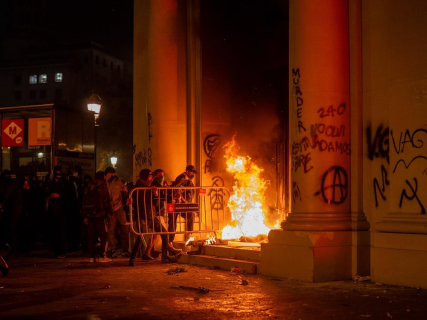
At night, after the demonstrations, in Barcelona there have been releases of pyrotechnics against the Mossos, damage to shops, and fire in the surroundings of Plaça de Catalunya, Passeig de Gràcia and Gran Via. at the end of an afternoon of mobilizations that had passed without notable incidents. There have also been attempts at looting.
In Madrid, there have been police charges since 8:47 p.m. and it has placed new interventions near Plaza de España at 9:12 p.m. The coverage of the close of the day thus incorporated the incidents and police action alongside the demands regarding housing.
Part of the risk described has materialized: the Government backs the protest while it must respond to how public order is managed.
5. France warns about what happens when unrest exceeds its response capacity
The closest European warning is in France. Its crisis brings together several factors that reinforce each other: protests over the cost of living, budgetary difficulties, parliamentary fragmentation, and higher financing costs.
In France, the Government has to respond to demands from the street while trying to balance books that leave little room for maneuver. Giving in costs money; adjusting spending can fuel protests. And getting a budget through requires agreements in a divided Parliament. Fitch revised down the outlook for French credit on 30 October, pointing to fiscal deterioration and political obstacles to stabilizing the debt, and the world is watching with concern a country heading toward polarized elections.
The problem goes beyond the identity of the next ruler. Whoever comes to power will inherit budget constraints and social expectations, even if they have won by promising to resolve them. The possibility of a shift favorable to the far right adds political uncertainty; it does not amount to showing that there will be a change of regime. In this scenario, it could translate into more protests, more social tension, and higher financing costs, with risks that extend beyond French borders.
The European dimension is evident: France is the only power in the European Union with nuclear armaments and, therefore, also in the eurozone. Its stability has consequences that go beyond its borders.
That does not allow describing an implosion as inevitable or presenting Spain as its next chapter, but stirring up unrest believing it can be channeled at will is a bad bet. The lesson is more specific: when demands increase while the margin to address them shrinks, unrest can overwhelm both the Government and the actors who try to represent it. And with elections about to be held, this could become another unforced error for Pedro Sánchez and a dangerous bet on opening the jar of essences, which—more than mobilizing the left—demobilizes the social majority. At this hour, Ferraz, Génova and Bambú are awaiting the first trackings, which will be studied like never before in the run-up to the start of the election campaign.