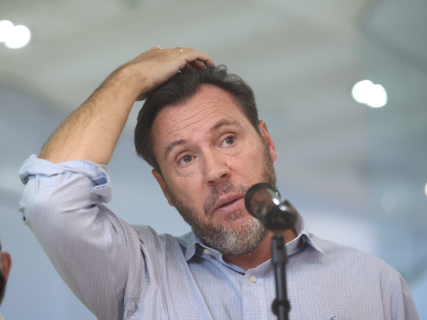
Charges in front of the Ministry of Transport on a day of pressure on Óscar Puente after Urda

A police intervention and the use of pepper spray against some of those gathered have occurred. The minister has ruled out resigning, while UGT questions that he points to Adif staff before the investigation is concluded

EuropaPress 7874784 ministro transportes movilidad sostenible oscar puente rueda prensa centro

EuropaPress 7874784 ministro transportes movilidad sostenible oscar puente rueda prensa centro

Add DEMÓCRATA to Google

Ask FREN

Published

Last updated

2 minutes

Most read

Elecciones 29N · Encuestas

La media de las encuestas

Media a 27 de octubre de 2026 · 15 institutos

  • PP31,0 %
  • PSOE27,3 %
  • Vox18,9 %
  • Sumar6,3 %
  • Podemos2,9 %
  • ERC2,3 %
010203040ene 2024jul 2024ene 2025jul 2025ene 2026jul 2026

Media del último estudio de cada instituto en 30 días y su evolución semanal desde el 23J. Partidos con al menos un 2 %.

Todas las encuestas

Elecciones generales del 29 de noviembre · Demócrata

The Police have charged against some participants in a gathering in front of the Ministry of Transport, in Madrid, according to El Confidencial. The outlet also notes that some people have been sprayed with pepper spray and that riot police have separated a group from the rest of the attendees.

The gathering takes place on a day marked by the Urda railway accident and by the explanations of the Minister of Transport, Óscar Puente, who has ruled out resigning. The criticism of his management has also come from UGT, which calls for all the circumstances of the accident to be investigated without anticipating individual responsibilities.

What is known about the police intervention

According to the information published by El Confidencial, the officers established a cordon and separated several people from the rest of the gathering during moments of tension.

The available information does not allow specifying what triggered the charges, how many people participated in the protest, or whether the intervention ended with arrests or injuries. It also does not include a police version of the circumstances of the action.

For now, the facts described must be limited to that intervention in front of the ministerial headquarters. There are not enough elements to attribute violent behavior to the group of attendees as a whole or to identify the organizers.

Puente rules out resigning and places his priority on clarifying the accident

Hours earlier, Puente had appeared before the media in Atocha. Asked about a possible resignation after the Urda accident and the one that occurred in January in Adamuz, he replied that he was not considering it at that moment and that his objective was to clarify what happened and try to resolve the situation.

The head of Transport expressed his shock at the tragedy and described what happened as «inexplicable». His appearance took place while emergency work and the gathering of information about the sequence of the accident continued.

The Ministry's first explanations place one of the central points of the investigation in the authorization to resume circulation after the failure of the safety system. According to Transport sources cited by Europa Press, that instruction made it possible to recover normal movement when restricted circulation should have been applied. This is the explanation offered by the department, not a definitive conclusion of the investigation.

UGT demands that the Ministry's decisions also be examined

The railway section of UGT has questioned that the minister focuses responsibility on Adif control workers before all the circumstances are clarified.

The union considers it necessary to also analyze the organization of work, staffing levels, outsourcing, and management decisions. Its position is that the review of the professionals' actions must be accompanied by an investigation into the resources and the conditions in which they carry out their functions.

This criticism adds a union front to the explanations that Transportes must offer. The existence of a protest before the Ministry and the public questioning by UGT reflect different expressions of pressure on the department.

More key points, information and questions with FREN

AI-GENERATED CONTENT

What is the parliamentary procedure for a minister to submit their resignation in Spain?

In Spain, there is no parliamentary procedure for a minister to resign. The resignation is communicated to the Prime Minister and the dismissal is formalized by royal decree of the King, at the proposal of the Prime Minister. Neither the Congress nor the Senate must accept, vote on, or ratify this decision.

1. Communication to the Prime Minister

The minister communicates to the Prime Minister their intention to leave the position. In practice, this can be done through a resignation letter and publicly explaining their reasons, but they do not have to submit a request to the Board of the Congress or the Senate.

It is important to distinguish between announcing the resignation and legally ceasing: a public statement or a letter does not replace the formal act of dismissal. A prior parliamentary appearance is also not necessary for the minister's departure from the Government to be processed.

2. Presidential proposal and formalization by the King

The decisive rule is in Article 100 of the Constitution: "The other members of the Government shall be appointed and removed by the King, at the proposal of its President."

Therefore, the ordinary sequence is as follows:

  • The minister communicates their decision to the Prime Minister.
  • The Prime Minister processes their departure and proposes the dismissal to the King.
  • The King formalizes the separation by royal decree, countersigned by the Prime Minister. The countersignature is the signature that accompanies the King's act and attributes the corresponding responsibility.
  • The royal decree is published in the Official State Gazette, making the dismissal official under the terms established.

The King does not politically decide on his own whether to accept the resignation: he acts at the proposal of the Prime Minister. The presidential power to propose the appointment and dismissal of ministers is also reflected in Judgment 222/2006 of the Constitutional Court.

3. The role of the Chambers

Neither Chamber decisively intervenes in the individual dismissal. There is no mandatory debate, acceptance vote, or validation of the royal decree. The departure of a minister does not require a new investiture of the Prime Minister either.

Another matter is political control. A minister may provide explanations before Parliament about their management or the circumstances motivating their departure. In the Congress, Articles 202 and 203 of the Chamber Regulations regulate informative appearances of Government members, at their own request or through the parliamentary mechanisms provided.

These appearances serve to inform and respond to groups, but do not constitute the resignation procedure. Neither does a farewell speech or a public explanation replace the presidential proposal and the royal decree of dismissal.

4. Consequences for the Government and the seat

The resignation of a minister does not cause the dismissal of the entire Government. It is different from the resignation of the Prime Minister, which does constitute a cause for the dismissal of the entire Government according to Article 101 of the Constitution.

If the minister is also a deputy or senator, they retain their seat: the governmental position and the parliamentary mandate are independent. To leave both, they must also process the parliamentary resignation. In the Congress, Article 22 of the Regulations requires submitting that resignation to the Board.

In short, although the resignation may have parliamentary explanations and consequences, its formalization corresponds to the constitutional sphere of the Government and the Crown, not to an authorization by the General Courts.

What are the main competencies of the Minister of Transport according to Spanish legislation?

The Minister of Transport directs the state policy on infrastructures, transport services, and sustainable mobility. Their competencies include land, air, and maritime transport under state jurisdiction, but also lesser-known areas such as postal services and geographic information. It is important to distinguish their political leadership role from the technical and administrative tasks assigned by regulations to other Ministry bodies.

Regulatory framework and scope

The central regulation to identify these matters is Royal Decree 253/2024, of March 12, which develops the structure of the Ministry of Transport and Sustainable Mobility. Its Article 1 assigns to the department "the proposal and execution of the Government's policy" in the enumerated areas. This structure was modified by Royal Decree 690/2025, of July 29.

Main areas of competence
  • Infrastructure and investments. Directing the policy of planning, programming, and executing investments in state transport infrastructures. This includes their maintenance and improvement, safety, territorial integration, and connection between different transport modes. Execution can be carried out directly or through attached bodies and entities.
  • Roads and road transport. Promoting the planning and conservation of the State Road Network and the regulation of road transport within state competencies. The department also exercises oversight and control functions over highway concessions through specifically assigned bodies.
  • Railway. Directing the policy of planning and evaluating the General Interest Railway Network and the state regulation of railway services. Among the regulatory priorities are safety, maintenance, daily mobility, and coordination between services and the infrastructures that support them.
  • Civil aviation. Guiding aeronautical policy and the regulation of air transport, state-competent airports, and air navigation. The Ministry also performs functions regarding international air transport agreements, traffic rights, discounts, and public service obligations through its competent bodies.
  • Maritime transport and ports. Directing the state policy on maritime transport and the planning and investment objectives in ports of general interest. The ministerial scope also includes maritime rescue and safety, with the Maritime Rescue and Safety Society attached through the Directorate General of the Merchant Marine.
  • Sustainable mobility. Promoting strategies for decarbonization, energy saving, active mobility, and coordination between transport modes. It also includes cooperation with other administrations in sustainable urban mobility plans and the promotion of aid and European funds aimed at transport and mobility.
  • Postal services and geographic information. Article 1 expressly includes the normative regulation of postal services and the direction of state services of astronomy, geodesy, geophysics, and cartography. These latter functions are carried out through the National Geographic Institute and the corresponding bodies.
How they are exercised and their limits

The minister does not personally resolve all the above matters. Under their direction act the Secretariat of State for Transport and Sustainable Mobility and the Undersecretariat, along with the general secretariats and directorates general. Additionally, the air and railway safety agencies have functional autonomy to perform their functions.

Finally, these powers are exercised respecting the competencies of other administrations and departments. The management of state roads should not be confused with general traffic regulation: the Directorate General of Traffic is part of the Interior Ministry, according to Royal Decree 1009/2023.

What results did the PSOE obtain in the last general elections in the Community of Madrid?

The PSOE obtained 27.88% of the votes and 10 deputies for Madrid in the general elections of July 23, 2023, the last held until October 28, 2026. It was the second most represented candidacy in the Community of Madrid, behind the PP. These figures correspond to the Congress of Deputies, not the Assembly of Madrid. (Results in Madrid).

The socialist result in Madrid

The main data from that call allow distinguishing between the party's electoral support and its parliamentary representation:

  • Election date: July 23, 2023.
  • Territorial scope: the Madrid constituency, corresponding to the entire Community of Madrid.
  • PSOE vote percentage: 27.88%.
  • Representation obtained: 10 seats in the Congress of Deputies.

Therefore, the summarized answer is that the PSOE gathered just over a quarter of the Madrid vote and obtained ten of the deputies elected by this constituency. The percentage and the seats are two different ways to express the result: the first reflects their support at the polls; the second, the representation obtained for the Congress. (PSOE result).

How the distribution of deputies was

Madrid elected 37 deputies in those elections. The distribution among the candidacies that obtained representation was as follows:

  • PP: 16 deputies.
  • PSOE: 10 deputies.
  • Sumar: 6 deputies.
  • Vox: 5 deputies.

With that distribution, the PSOE was six seats behind the PP, four ahead of Sumar, and five ahead of Vox. Its ten deputies represented approximately 27% of the 37 seats assigned to Madrid. This proportion of seats should not be confused with the 27.88% of the vote obtained by the socialist candidacy. (Seat distribution).

The importance of the external count

There is a relevant nuance when consulting news published during election night: the distribution changed after including the vote of residents abroad. After that count, the PP gained one deputy for Madrid at the expense of the PSOE. Therefore, to describe the socialist representation resulting from that call, the figure to use is ten deputies. (Change due to external vote).

That change had consequences beyond Madrid: it reduced socialist representation in the Congress by one deputy and modified the calculations for Pedro Sánchez's subsequent investiture. Demócrata highlights precisely that episode as an example of how the external vote can alter seat distribution and parliamentary negotiations. (Consequences of the count).

What "last elections" means here

The reference is to the last general elections already held, those of July 23, 2023, and not to polls or forecasts for a subsequent call. It is also not about the Madrid regional elections: although both allow consulting results for the same territory, the data requested here is that of the representatives elected for the Congress. In short, the essential figure to remember is: PSOE in Madrid, 27.88% and 10 deputies. (Last general elections held).

Play

Test your knowledge with FREN!

How much do you know about this topic? Answer the following 3 questions.

Where did the gathering take place where the riot police intervened?

Question 1 of 3

What element did the Police use during the intervention in the protest?

Question 2 of 3

What has the UGT railway section demanded after the Urda accident?

Question 3 of 3