
Vox gets underway: closed lists and Abascal sets out to conquer new seats

The National Executive Committee will give the green light on Monday to some candidacies without major changes, while the leader of Vox prepares a tour of territories where he hopes to gain representation.

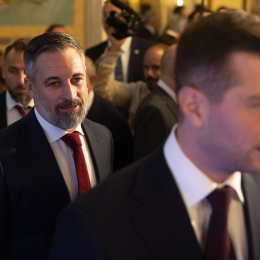
EuropaPress 7838795 imagen lider vox santiago abascal 2d vicepresidente segundo consejero

EuropaPress 7838795 imagen lider vox santiago abascal 2d vicepresidente segundo consejero

Add DEMÓCRATA to Google

Ask FREN

Published

Last updated

2 minutes

Most read

España vota · Congreso y Senado

Elecciones generales 29 de noviembre de 2026

Se eligen 350 diputados y los senadores de elección directa. Encuestas, calendario, candidaturas, programas y todo lo que necesitas saber para votar.

Faltan 41 días y 0 horas para que abran los colegios electorales.Hasta que abran los colegios, el domingo 29 a las 09:00 (hora peninsular).
Entra en el especial

Próximas fechas

  1. Presentación de candidaturas al Congreso y al Senado21–26 oct · Fecha prevista
  2. Voto desde el extranjero (CERA): envío de la documentación24–30 oct · Fecha prevista
  3. Publicación de las candidaturas presentadasFecha prevista
  4. Proclamación de candidaturasFecha prevista
Calendario completo

Everything ready in Vox. This Monday the National Executive Committee (CEN) will give the green light to the party's electoral lists. The formation led by Santiago Abascal will present candidacies to the Congress in the 52 provinces and the two autonomous cities, and will do the same in the Senate, leaving behind the rumors of a possible alliance with the populars for the Upper House.

According to sources close to the leadership conveyed to DEMÓCRATA, there was no room for "experiments" in their ranks and the lists will be continuist. There will be no major changes in the starting positions, and moreover, as the electoral expectations are favorable, the door opens to emerging profiles and the leap of territorial leaders.

Although those of Abascal did not expect an electoral call at this time of year, the Campaign Direction Committee has met several times over the past few weeks to prepare both the strategy and the candidacies.
Starting engines

With the names already on the table, and after a week in which Abascal has sought the backing and support of international leaders of the European far right, his pre-campaign begins to gain momentum. The leader of Vox has planned four campaign events from now until Friday in four different provinces: León, A Coruña, Asturias, and Burgos. In 2023, they only achieved representation in Asturias and are now looking to translate votes into seats in the other constituencies they will visit these days.

The case of León is particularly significant, as the formation had achieved representation in November 2019, but lost it four years later. In Burgos, Vox did not achieve representation in either of the last two general elections, despite exceeding 12% of the votes in 2023. A similar situation occurred in León, while A Coruña presents a different scenario, with a lower percentage of support and no representation in both calls.

The campaign of 29N will be a new test for the territorial implantation of Vox. Although Abascal will again concentrate a good part of the protagonism of the pre-campaign, one of the challenges for the formation will be to make its candidates known beyond the figure of its leader, especially in those provinces where it aims to achieve representation.

The challenge is to consolidate our own references in each constituency, with the focus not only in the general elections, but also in the regional and municipal elections next May.

More key points, information and questions with FREN

AI-GENERATED CONTENT

What is the parliamentary procedure to officially approve a party's electoral lists in Spain?

There is no parliamentary procedure to approve a party's electoral lists in Spain. The question combines two different processes: the selection of candidates within the party and the official presentation and proclamation of candidacies before the electoral Administration. The Congress, the Senate, and the regional parliaments do not vote on or authorize party lists.

1. Selection and approval within the party

First, each party chooses its candidates according to its statutes and internal rules. They may use primaries, proposals from their territorial organizations, decisions of electoral committees, or a combination of these mechanisms. There is no single selection system applicable equally to all parties.

Internal approval corresponds to the body determined by those rules. Therefore, to know who approves a specific list, one must distinguish between those who propose the names, those who select them, and those who have the final word to ratify them. That decision is partisan, not parliamentary, and does not yet equate to the official proclamation of the candidacy.

2. Presentation before the electoral Administration

Once the elections are called, candidacies must be submitted to the competent electoral board within the established schedule for that process. The specific authority depends on the type of election and the constituency: it is not advisable to automatically transfer the procedure from general elections to municipal or regional ones.

The submission is made through the corresponding representatives and must be accompanied by the required documentation. It is not enough to publicly announce the names or publish the list on the party's website. The candidacy must be formalized through the electoral channel and comply with the applicable requirements for those running and the candidates.

3. Verification of requirements

The electoral Administration verifies that the candidacy meets legal requirements. Relevant issues include documentation, acceptance by the included persons, their eligibility, and the composition of the candidacy according to the rules applicable to that election.

This examination does not consist of assessing whether the candidates are politically suitable nor replacing the party's decisions. Its purpose is to verify the legality of the candidacy. If defects that can be corrected are detected, the procedure includes their communication and the possibility of remedying them within the established terms.

4. Official proclamation and possible appeals

After this verification, the electoral board decides on the proclamation of the candidacies and proceeds with their official publication. The proclamation is the milestone that must be distinguished from the party's internal approval. A list announced or ratified by its bodies still has to pass the corresponding electoral procedure.

Decisions on proclamation or exclusion can be challenged through the channels provided in electoral legislation. These are electoral and judicial review mechanisms, not a debate or vote in Parliament.

What "officially approve" means

In short, if you ask who decides the names, the answer lies in the party's internal rules. If you ask who formally recognizes the candidacy to run in the elections, it corresponds to the electoral Administration through its proclamation. Parliament establishes the legal framework but does not approve specific candidacies.

To specify the competent bodies, documents, deadlines, and appeals, it is necessary to identify which elections are held. This distinction avoids confusing the internal authorization of a list with its official recognition as an electoral candidacy.

What are the functions and powers of Santiago Abascal as president of Vox?

Santiago Abascal, as president of Vox, exercises the superior direction and coordination of the party's political and organizational action. It is an internal position within a political party, not a government office: his powers come from Vox's statutes and must be distinguished from the responsibilities he may hold in public institutions.

Functions within the party

According to the statutes published by Vox, the Presidency holds leadership, coordination, and decision execution competencies. Its main functions are as follows:

  • Direct and coordinate the superior political and organizational action. He is responsible for leading Vox's general activity and coordinating its political orientation and internal functioning. This is the attribution that defines the general scope of the Presidency.
  • Preside over the National Executive Committee. He heads this governing body and other party organs of which he is a member. This function places him at the head of meetings and deliberations of the leadership but does not convert all collective competencies into personal decisions.
  • Execute and enforce agreements. He must carry out decisions adopted by the National Executive Committee, the Political Action Committee, the Management Committee, and other bodies in which he participates. Therefore, his role is not only to promote decisions but also to ensure their fulfillment.
  • Issue internal orders and instructions. He can issue directives about the party's functioning within his powers. These instructions have internal organizational scope; they are not legal norms applicable to all citizens.
  • Represent Vox internationally. He assumes the party's international relations unless he delegates this function. This is political representation of the party, not diplomatic representation of the Spanish State.
  • Lead the relationship with the Disenso Foundation. The statutes assign him the management of the relationship between Vox and its linked foundation. This competence must be distinguished from the positions and powers of the foundation's own bodies.
  • Appoint the general electoral representative. He appoints the person who represents the party before the electoral Administration for the corresponding procedures. Appointing this representative does not, by itself, mean personally exercising all electoral functions.
Scope of his political leadership

These powers make Abascal the main person responsible for Vox's general orientation and coordination. However, it is important to distinguish between political leadership and exclusive competence: leading the party does not mean that any decision about organization, teams, or electoral activity corresponds to him individually. The distribution of functions and statutory procedures remain the framework of action.

The Presidency is exercised together with the General Assembly, the National Executive Committee, and other internal bodies. Therefore, to attribute a specific power to him — for example, approving a particular organizational decision — it is necessary to distinguish what he can resolve personally from what corresponds to a collective body.

Limits regarding public powers

Presiding over Vox does not grant him authority over the Government, public administrations, or the Congress. This position does not allow him to approve laws, issue state regulations, order administrative actions, or exercise ministerial powers.

His parliamentary responsibilities are distinct from his party functions and are governed by their own rules. In summary, as president of Vox, he directs, coordinates, represents, and ensures the execution of agreements within the party; he does not thereby exercise governmental powers over Spain.

How many seats did Vox obtain in the last general elections in the provinces of León, A Coruña, Asturias, and Burgos?

In the last general elections, held on July 23, 2023, Vox obtained 0 seats in León, 0 in A Coruña, 1 in Asturias, and 0 in Burgos. Therefore, it totaled one deputy among the four constituencies you mentioned. The only representative elected by Vox in these was José María Figaredo Álvarez, for Asturias.

Result by province

ProvinceVox seats
León0
A Coruña0
Asturias1
Burgos0

These figures correspond to the Congress of Deputies. The result can be cross-checked with the breakdown of Vox seats published by El País and with the July 23 results from Europa Press. Both allow placing the provincial data within the overall result of that election.

León: no seats

Vox did not obtain any deputies for León in the July 23, 2023 general elections. Therefore, the number to record for this province is zero. The list of elected deputies published by Europa Press does not include any Vox representative among those elected for León. This data refers to the representation achieved in that vote, not the number of votes received by the candidacy.

A Coruña: no seats

In A Coruña, Vox also did not gain representation in Congress: it obtained zero seats. The list of deputies elected from this constituency does not include any Vox candidate. Thus, the result matches León in the specific aspect you asked about: in neither province did the party secure a deputy in the July 2023 general elections. The absence of seats should not be confused with the absence of votes.

Asturias: one seat

Asturias was the only one of the four constituencies consulted where Vox obtained representation: one seat. The elected deputy was José María Figaredo Álvarez. Therefore, all the representation obtained by Vox in the group formed by León, A Coruña, Asturias, and Burgos corresponded to this constituency. The Asturian result explains why the sum of the four provinces is one and not zero.

Burgos: no seats

In Burgos, Vox obtained zero deputies. Besides the results and elected lists, the official proclamation published in the BOE confirms that the party did not win seats in this province. For the requested comparison, Burgos presents the same result as León and A Coruña: no Vox representation in Congress from those elections.

How to interpret the sum

The total of one seat is limited to the four provinces you mentioned; it is not Vox's national result. Across Spain, the party won 33 deputies in the 2023 general elections, according to the cited breakdown. The distinction matters because summing these four constituencies only offers part of its parliamentary representation.

In short, if you need to convey the result in a note or territorial comparison, the formulation is: León, 0; A Coruña, 0; Asturias, 1; Burgos, 0. The only name that should accompany that list as a Vox deputy elected in these four constituencies is José María Figaredo Álvarez, for Asturias.

Play

Test your knowledge with FREN!

How much do you know about this topic? Answer the following 3 questions.

Which Vox body will approve the party's electoral lists?

Question 1 of 3

In which constituencies did Vox gain representation in the 2023 general elections among León, A Coruña, Asturias, and Burgos?

Question 2 of 3

What has Vox said about the possibility of alliances with the Popular Party for the Senate?

Question 3 of 3