
San Juan de Dios Spain and Fundación Hospitalarias have launched the PUENTE project, an initiative aimed at strengthening the capacities of adult educators in six European countries, in order to support the educational journey of Ukrainian refugees, make educational centers more inclusive, promote their social and labor integration through effective pedagogical guidelines, and contribute to overcoming trauma, promoting their physical and emotional well-being.
Since 2022, with the onset of the war in Ukraine, nearly six million displacements of Ukrainian citizens have been recorded across the European continent. These people face potential mental health issues and a high risk of social exclusion resulting from the traumatic impact of the conflict, which represents a significant challenge for public health systems and integration policies.
The program has been translated into five languages and has been adapted to the reality of the countries where it will be implemented: Spain, Italy, Portugal, Austria, Poland, and Belgium. In its validation process, social entities such as Cáritas and Cruz Roja have also collaborated, contributing their experience in assisting refugees.
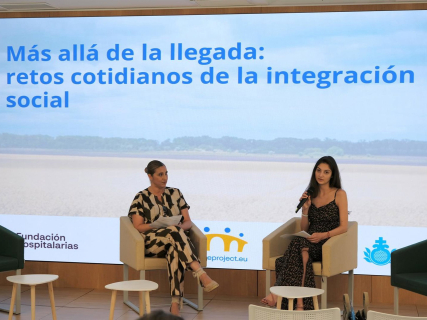
In the presentation of the project in Spain, Juan Jesús Muñoz García, coordinator of Mental Health at the San Juan de Dios Ciempozuelos Center, spoke about the impact that leaving one's country due to a war like that in Ukraine can have on a person. As he explained, uprooting is not limited to a change of location but involves a profound life rupture.
"Forced displacement represents a deep rupture in people's lives. It is not just about leaving a geographical place, but about leaving behind life projects, personal relationships, routines, cultural references, and, in many cases, an important part of one's own identity," he stated.
From a psychological point of view, he adds, "many people experience fear, uncertainty, feelings of loss, constant worry for family members who remain in conflict zones, and difficulties in adapting to a completely new reality. Moreover, direct or indirect exposure to war can generate reactions of intense stress, anxiety, sleep disturbances, or difficulties in concentration."
At the same time, it clarifies that "not all refugees develop mental health problems. Many show an enormous capacity for adaptation and resilience. Therefore, it is essential to avoid a vision exclusively focused on trauma and also recognize the personal and community resources that allow them to rebuild their lives."
It emphasizes that arriving in a safe environment in the host country usually generates relief, but does not imply the end of suffering. In this new stage, other challenges emerge, such as "the uncertainty about the future, the distance from family and friends, language barriers, difficulties accessing employment or housing, and the process of adapting to a different culture. Many people live for months or years with a sense of provisionality, not knowing when they will be able to return to their country or reunite with their loved ones."
During the presentation event, Kira, an 18-year-old girl, recounted that she left Ukraine almost a year ago with her mother and that, after arriving in Spain and completing the evaluation phase, both obtained a place in the International Protection Program of San Juan de Dios at the Valladolid center of the Hospitalarias Foundation. She highlighted that the support of specialized organizations is key to being able to rebuild life in the host country.
"When you arrive in a new place, it is very important to have people who guide you, listen to you, and help you resolve doubts. Institutions like Hospitalarias Foundation and San Juan de Dios Spain make the adaptation process easier and faster. The help is reflected in many aspects: Spanish classes with qualified teachers, guidance in administrative procedures, psychological support, activities and cultural visits, workshops and discussion cafés where we can share experiences with other people who have gone through similar situations and meet people from other countries... All of this not only facilitates our integration but also helps us feel accompanied and supported," she states.
"The experience with Kira shows us the importance of having adequately trained professionals in the care of refugee people, capable of responding to their needs in a comprehensive manner, addressing not only their administrative situation but also their emotional, social, and cultural well-being. In this sense, the Bridge Project is aimed at people from Ukraine, but its contents are transferable and useful for any professional working with refugees or migrants coming from complex contexts such as armed conflicts," indicated Maura Soriano, coordinator of the International Protection Program at the Fundación Hospitalarias Valladolid.
Thanks to the BRIDGE program, the teams working with Ukrainian refugees will have resources specifically designed to respond to the needs of this population, taking into account not only their status as displaced persons but also the sociocultural context of origin, which will allow for more sensitive, inclusive, and tailored interventions to their reality.
"The project --explains Juan Jesús Muñoz-- has developed training materials and a manual of good practices that allow this knowledge to be transferred to different professional contexts. More than offering closed answers, BRIDGE aims to help better understand a complex reality and provide tools to promote the inclusion, well-being, and participation of refugees in host communities".
In its pilot phase, the initiative has allowed training for 60 professionals from different agencies, and in the stage that is now beginning, the goal is to reach, directly or indirectly, about 400 people who work in the care of refugee populations.
"Refugees --he continues-- are often known for what they have had to flee from. However, it is equally important to recognize what they bring. Behind every story of displacement are capabilities, knowledge, experiences, talents, and life projects. Most refugees do not wish to depend on the help of others; they want to rebuild their lives, work, participate, and contribute to the society that welcomes them".
Kira now assures that her vital project is located in Spain. "With the war and the occupation of our city in Ukraine, we lost many things that were part of our life, and if we have to start over, I want to do it in a place where there are opportunities to build the best future for my mother and me. My goal is to build a full life, take advantage of all the opportunities that arise, and also contribute my grain of sand to the society that has welcomed me."