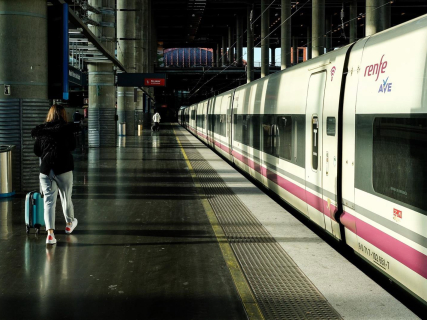
Close the AVE Madrid-Barcelona for up to two years? The consequences of the option that Puente is studying

Transport considers interrupting traffic to speed up the renewal of the line. The decision would force the reorganization of travel between both capitals and the intermediate connections, but there is still no calendar or alternative transport plan announced

fotonoticia 20261030122317 1920

fotonoticia 20261030122317 1920

Add DEMÓCRATA to Google

Ask FREN

Published

Last updated

4 minutes

Most read

Elecciones 29N · Encuestas

La media de las encuestas

Media a 27 de octubre de 2026 · 15 institutos

  • PP31,0 %
  • PSOE27,3 %
  • Vox18,9 %
  • Frente Amplio6,3 %
  • Podemos2,9 %
  • ERC2,3 %
010203040ene 2024jul 2024ene 2025jul 2025ene 2026jul 2026

Media del último estudio de cada instituto en 30 días y su evolución semanal desde el 23J. Partidos con al menos un 2 %.

Todas las encuestas

Elecciones generales del 29 de noviembre · Demócrata

Temporarily close the high-speed line between Madrid and Barcelona to finish the works sooner. That is the possibility Transport and Sustainable Mobility Minister Óscar Puente put on the table this Friday. An option that would alter business trips, getaways, and the rail connections of a corridor whose usefulness goes far beyond the journey between the two great cities.

No definitive closure or date to carry it out has been announced. The proposal consists of studying whether it would be advisable to concentrate the works during a service interruption or to keep traffic running while the work progresses more slowly.

Puente has explained that an intervention that could last five years using the available maintenance slots could be reduced to less than 24 months, or to 12 months under normal conditions, with the service suspended. These are scenarios set out by the minister, not an approved schedule for the line.

What Transport is studying and why

The dilemma affects the way major railway renewals are organized. Keeping trains running while work is carried out allows mobility to be maintained, but limits the time available to intervene. Interrupting the service offers more working room in exchange for temporarily depriving travelers of that connection.

Puente has pointed out that the closure during the remodeling is a formula used in Germany and that Transport is considering applying it to lines such as Madrid-Barcelona.

The minister has placed the proposal within the debate on works and punctuality, and has denied that it responds to safety reasons. His statements were made during the press conference after the Urda accident, but they do not amount to announcing that the Madrid-Barcelona line is unsafe.

The consequences would depend on which sections were closed

The territorial scope would be the first issue that would have to be clarified. A complete interruption of the corridor would not have the same consequences as section-by-section closures or phased execution.

The network allows services with Zaragoza, Lleida, Tarragona and extensions toward Girona and Figueres, in addition to trips between Madrid and Barcelona. Renfe includes those connections in its usual corridor schedule.

Without knowing where work would be carried out, it cannot be stated that all those cities would lose their services during the same period. Some connections could be maintained if their routes did not pass through the affected sections. Others would need transfers, alternative itineraries, or road replacements.

The map of the works would therefore be as important as their duration: it would make it possible to know which passengers would lose a direct train and which would retain part of the rail journey.

Greater potential demand for flights, buses, and cars

If the direct high-speed connection were suspended, some of its users would seek alternatives by plane, bus, or private vehicle. That shift in demand would be a foreseeable consequence, although it still cannot be quantified.

The plane could absorb part of the trips between Madrid and Barcelona. For intermediate cities, however, substitution would be more complex: an air connection between the two capitals does not solve the same trips as a train with stops.

Buses could cover complete routes or link stations on both sides of a closed section. Their capacity would depend on the vehicles, drivers, frequencies, and terminals available.

Nor can it be taken for granted that alternative fares would rise by a determined amount. The evolution of prices would depend on how many travelers changed transport and on the additional supply that companies could put into operation.

Work trips and getaways would have to be reorganized

For those who make frequent trips, the main change would be the total time needed to travel. Possible transfers, trips to airports, or road journeys would have to be added.

Companies could review their travel policies, group meetings, or replace some trips with remote meetings. Tourism would also have to adapt: the ease of arriving by train influences the organization of getaways, conferences, and short-duration visits.

To estimate the magnitude of the economic losses, it would be necessary to know the effective duration, the services that would continue running, and the quality of the alternatives.

The alternative plan would be decisive

An eventual decision to close would have to be accompanied by information that would make it possible to plan trips: dates, sections, affected services, and available solutions.

The issue would not be only about offering another means of transport. It would also matter to know how long it would take, what capacity it would have, how the connections would be organized and what assistance people with reduced mobility would receive.

At this moment, no alternative plan associated with this proposal has been presented in the cited reports. For that reason, it cannot be ensured that there would be buses for all connections nor that certain travel times would be preserved.

What those who already have tickets should do

Puente's proposal does not in itself mean the cancellation of the trains sold. Those who have a reservation should check the status of their service and their operator's communications, without interpreting this possibility as a stoppage already activated.

If Transportes finally adopts the measure, the announcement will have to specify when it would begin and which services would be affected. Until then, the debate is open: speed up the renewal through a prolonged interruption or maintain the journeys while the works extend for longer.

More key points, information and questions with FREN

AI-GENERATED CONTENT

At what parliamentary stage are the possible regulatory changes for the management of railway works in Spain?

As of October 30, 2026, the identified changes for the management of railway works are not all at the same stage. The main legislative reform, incorporated into the Sustainable Mobility Law, has already completed its parliamentary process; meanwhile, the new Railway Sector Regulation is in public consultation, a Government phase and not a Parliamentary one.

1. Legal reform: parliamentary process concluded

The Sustainable Mobility Bill, promoted by the Government, was processed with files 121/000009 in the Congress and 621/000019 in the Senate. Its sixth final provision modifies Law 38/2015, of September 29, on the railway sector, with provisions directly related to the planning and execution of infrastructures.

The located progress allows distinguishing these milestones:

Therefore, it would not be correct to place this reform today under Senate review: that was a previous stage, already surpassed. The amendments debated then should not be confused with new pending modifications.

2. What aspects of the works it covers

The parliamentary documentation of this reform addresses several relevant mechanisms to manage railway actions:

  • Planning and evaluation: adaptation of articles 5 and 6 of the Railway Sector Law to the investment evaluation system, with prior and subsequent analyses of infrastructures.
  • Affected services and facilities: removal or modification of elements that impede the works, with a maximum period of six months, coercive fines, and possibility of subsidiary execution by the railway administrator.
  • Collaboration between administrations: contracting assignments through agreements, without transferring project approval nor supervision and reception functions; also agreements to execute and finance urban railway integrations.
  • Suspension of actions: provisions reserving precautionary measures on works to judicial bodies in regulated cases.
  • Disruptions due to works: a contribution regime for certain freight services affected by significant capacity restrictions, included in the twenty-sixth additional provision.

These matters appear in the text sent by the Senate. To apply a specific obligation, the reference must be the final wording, not an intermediate version.

3. New regulation: public consultation open

The other central action is the Draft Royal Decree approving the Railway Sector Regulation, from the Ministry of Transport and Sustainable Mobility. After a prior consultation between October 28 and November 18, 2025, it moved to public consultation from September 25 to November 12, 2026.

This draft seeks to update the 2004 regulation regarding Law 38/2015 and its amendments. The accredited phase is, therefore, the receipt of observations on the draft: not a debate of amendments in the Cortes.

4. Technical control: an order already published

Additionally, the Order TRM/1072/2026, of September 30, on the scope and functions of the General Subdirectorate of Quality Control and Technical Inspection, was published in the BOE on October 12, 2026. Its preparation already passed public consultation and hearing.

In summary: legal reform approved, regulation in consultation, and technical control order published. The immediate participation opportunity identified is to submit observations on the regulation before November 12.

What are the competencies of the Minister of Transport and Sustainable Mobility according to Spanish legislation?

The Minister of Transport and Sustainable Mobility directs the state policy on infrastructures, transport, and sustainable mobility and exercises the general functions corresponding to any ministry head. It is advisable to distinguish his personal attributions from the competencies of the department, which are distributed among the Secretariat of State, the Undersecretariat, and their dependent bodies.

1. Functions of the minister as a Government member

Article 4 of the Law 50/1997, of the Government establishes four basic functions:

  • Develop the Government's action in his department, following the agreements of the Council of Ministers and the president's guidelines.
  • Exercise regulatory power in matters proper to the ministry, within legal limits.
  • Exercise other competencies attributed by laws and organizational and operational norms.
  • Endorse, when appropriate, the acts of the King related to matters within his competence.

This normative capacity does not equate to approving laws alone: the approval of bills and regulations reserved for the Council of Ministers corresponds to this collegiate body.

2. Material areas he directs

Article 7 of Royal Decree 829/2023 assigns the ministry the proposal and execution of policies on state infrastructures and land, air, and maritime transport to guarantee fair and sustainable mobility. Article 1 of Royal Decree 253/2024 develops this mandate:

  • Land infrastructures and transport: planning and investment in state roads and the General Interest Railway Network; regulation of road transport and state-competent railway services; monitoring highway concessions and coordination between infrastructures and services.
  • Air transport: direction of aeronautical policy, planning and regulation of civil aviation, air navigation, and state airports. Includes actions on international agreements, traffic rights, public service obligations, and air transport subsidies, through competent bodies.
  • Maritime transport: general regulation of the sector and its state infrastructures, maritime safety and rescue, as well as efficiency and emission reduction measures.
  • Sustainable mobility: promotion of safe, healthy, and sustainable mobility in its social, economic, and environmental dimensions, including active mobility. Includes decarbonization strategies, energy saving, innovation, and coordination with other administrations.
  • Logistics and intermodality: coordination between transport modes, trans-European networks, and cross-border connections, seeking an integrated system for people and goods.
  • Investments and financing: planning and programming of investments, coordination of European funds, and monitoring of Recovery Plan actions corresponding to the department.
  • Other matters: normative regulation of postal services and direction of state services of astronomy, geodesy, geophysics, and cartography.

3. Organization, representation, and limits

The minister directly oversees the Secretariat of State for Transport and Sustainable Mobility and the Undersecretariat. The former organizes the sectoral areas of land, air, and maritime transport and sustainable mobility; the latter directs common services. The international relations unit, which coordinates the department's representation, especially before the European Union, in collaboration with Foreign Affairs, also reports directly to the minister.

The structure was modified by Royal Decree 690/2025, affecting articles 2.5 and 8 of the organizational decree.

In short, the minister directs and is politically responsible for these areas but does not personally resolve all their files. He must respect the attributions of administrative bodies, the functional autonomy of safety agencies, and the competencies of other administrations and ministries. For example, traffic and road safety correspond to the Interior Ministry; housing and Urban Agenda to its specific department.

What legal requirements must the Ministry meet to temporarily suspend a high-speed railway service?

The Ministry cannot temporarily suspend a high-speed railway service by a simple discretionary decision: it needs a legal basis, an accredited cause, and the intervention of the competent body. The applicable procedure changes depending on whether it concerns unusable infrastructure, a safety problem of the company, or a modification of a service subject to public service obligations. High speed alone does not determine a unique procedure.

1. Identify what is suspended and who decides

The Railway Sector Law distinguishes between infrastructure, business license, and service provision. Therefore, temporarily canceling some runs should not be confused with suspending the operator's license, a measure that may affect a much broader activity.

  • Temporarily unusable infrastructure: the railway infrastructure administrator must act, not necessarily the Ministry.
  • License or safety certificate: the State Railway Safety Agency intervenes within its competencies.
  • Service with public service obligations: the Ministry can modify certain conditions, respecting authorization and legal guarantees.
2. Accredit a cause that allows interruption

For urgent interruption due to infrastructure, the law expressly establishes that, when for exceptional causes it has become temporarily unusable, the administrator may "suspend, without prior notice" the services to urgently carry out the necessary repairs. It must adopt the necessary measures to restore normality as soon as possible and apply the contingency plan. This exception does not equate to a general authorization to cancel services for economic convenience.

If license suspension is used, the legally provided causes must concur: opening of a file for a very serious infringement, imposition of a sanction, or interruption of operations for more than six months. Additionally, the measure must be convenient to guarantee safety and effective transport provision. Its maximum duration is twenty-four months; this term is not a general limit for any railway suspension.

3. Respect procedural guarantees

Regarding safety, Royal Decree 929/2020 allows proportionate provisional measures, including temporary suspension of the safety certificate, within the corresponding procedure. It requires motivation and contemplates notification to the company, with fifteen days to argue in the revocation procedure. Resolutions may be appealed administratively or judicially.

The decision must specify the cause, scope, and justification of the measure. There is no universal requirement for publication in the BOE for any interruption: the applicable regime may require notification and communication to the infrastructure administrator. It is also not appropriate to automatically transfer the guarantees of one procedure to another.

4. Check if there are public service obligations

It should not be presumed that every high-speed service is subject to them. When it is, the authorization must guarantee its continuity. The conditions resulting from the tender can only be modified to the extent provided therein.

The law allows the Ministry to adapt them to subsequent demand changes, after hearing the company and according to regulatory development. If they economically affect the operation, compensation must be updated. An interruption without administrative consent or other justified cause constitutes an infringement. Therefore, it must be checked whether modifying the conditions suffices or if the decision also affects the declaration approved by the Council of Ministers.

5. Protect travelers

The suspension does not eliminate the rights derived from sold tickets. The Railway Sector Regulation contemplates refund, alternative transport, and, depending on circumstances, assistance and compensation. It also requires maintaining equivalent accessibility conditions in the planned alternatives. The exclusion of compensation to operators for certain urgent repairs should not be confused with passenger rights.

Play

Test your knowledge with FREN!

How much do you know about this topic? Answer the following 3 questions.

What option is the Ministry of Transport studying for the works on the Madrid-Barcelona AVE line?

Question 1 of 3

How long could the works last if the Madrid-Barcelona AVE line is closed according to the scenarios presented?

Question 2 of 3

Which transport alternative could absorb part of the demand if the direct high-speed connection is suspended?

Question 3 of 3