

Artificial intelligence has fully landed this week at the United Nations General Assembly, which has gathered since this past Wednesday the world leaders at its headquarters in New York to exchange impressions on the concerns, challenges, and horizon of the States. However, the debate about its use has escalated. It is no longer about what but about who and how it should establish its limits.
The president of the European Council, António Costa, brought this debate to the United Nations plenary on Thursday with an explicit defense of international governance of AI. "The AI industry cannot be regulated by a few large companies," he warned,
And although his reading is shared among many leaders, it is not unanimous. Costa made these remarks just two days after the U.S. president, Donald Trump, rejected any attempt to create a global control system for this technology before the same Assembly.
And on that stage, the UN leaders are testing to see which formula will end up prevailing in a global scenario where AI is set to be one of the major protagonists of the technological landscape.
Featured story
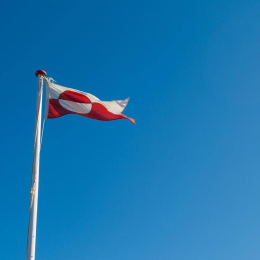
USA, Denmark, and Greenland seal a pact to strengthen Trump's military presence in the Arctic
4 minutes
Costa: "We must always be at the wheel"
On Thursday afternoon, Costa placed artificial intelligence alongside peace, climate emergency, and economic insecurity among the major challenges that require a multilateral response.
"No country" can regulate artificial intelligence on its own, defended the president of the European Council, who calls for a "responsible, transparent, and regulated" architecture.
His approach goes directly to the distribution of power that the new technology is generating. "We need AI that serves humanity, not that controls it. We must always be at the wheel", he stated.
Costa has called for establishing a "safe" pace of innovation and development and has rejected that the companies themselves should determine the rules of the sector alone. To this end, he advocates placing the United Nations at the center of the development of international standards through the Global Digital Pact, the Independent International Scientific Panel on AI, and the Global Dialogue on AI Governance.
The intervention places the European Union on one side of the debate that has crossed the week of the General Assembly: how to maintain the technological race without leaving its control exclusively in the hands of the countries and companies capable of developing the most powerful models.
Trump rejects global control of AI
The position expressed by Costa contrasts with that defended on Tuesday by Donald Trump from the same podium.
The U.S. president stated that the United States "rejects any attempt to build a globalist control scheme" of artificial intelligence and maintained that he is not willing to halt a technology whose impact, in his opinion, will be greater than that of the Industrial Revolution.
"I am not going to halt the growth of something that will be bigger than the Industrial Revolution," Trump stated, who even announced that the U.S. Administration will begin to use the term "superintelligence" to refer to AI.
Washington does not propose, however, a complete absence of oversight. Trump pointed out that his Government will closely monitor the sector through the Department of Justice. The difference lies in who sets the rules: the White House rejects that the United Nations or another supranational institution builds a global regulatory regime.
This position was reiterated the next day before the Security Council by the White House Science and Technology Advisor, Michael Kratsios. "You cannot govern a technology that is not understood," he noted, defending that the United Nations should focus on sharing best practices and increasing national capacities instead of establishing an international regulatory system.
Milei aligns with Trump and promises not to regulate AI "preventively"
Trump's position found an explicit ally in Javier Milei, who this Wednesday dedicated part of his speech before the General Assembly to questioning state control over artificial intelligence. The Argentine president maintained that, in the face of the most pessimistic scenarios, AI should be understood as a tool capable of multiplying productivity and transforming the economy, medicine, education, and public management itself.
Milei rejected that prudence in the face of the risks of technology automatically leads to more public intervention. "When we hear that the State must control artificial intelligence," he stated, it is worth remembering that granting that power also means giving officials and bureaucrats the ability to limit "what others can create."
Guterres warns of the power shifting from governments to companies
The Secretary-General of the United Nations, António Guterres, had opened the General Assembly by placing the issue of power at the center of his intervention.
Guterres warned of an "extraordinary transfer of power" from governments to a small number of private companies and individuals, whose influence already reaches politics, the economy, information flows, and technological development. He also warned that humans are beginning to hand over decision-making capacity to the machines themselves.
For the Secretary-General, the problem is not the technology itself, but "technology without accountability", capabilities without oversight, and decisions without transparency.
Featured story
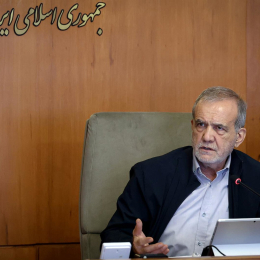
Pezeshkian assures that "he will firmly defend" Iran's position before the UN General Assembly
3 minutes
His proposal involves moving towards a multilateral framework for managing the risks of artificial intelligence, accompanied by independent oversight and common mechanisms for sharing information, assessing systems, and establishing safeguards.
"Life or death decisions should never be handed over to machines," Guterres has warned, who has made AI, along with peace, inequality, and climate change, one of the four major power challenges facing the international community.
Sánchez attacks the "techno-oligarchs"
Spain has also used the United Nations week to call for limits.
The President of the Government, Pedro Sánchez, participated on Tuesday in a high-level dialogue on artificial intelligence and the protection of minors alongside leaders such as Emmanuel Macron and Anthony Albanese. There he warned that "a small group of techno-oligarchs concentrates power and wealth" and has the ability to shape values and preferences.
The Spanish president stated that companies must be held accountable for the consequences of their products and summarized his position with a phrase: "A digital world without rules is not a playground; it is a lawless jungle."
Sánchez defended a national and European response, but also international, and called for cooperation between governments, multilateral organizations, companies, educators, and families.
His speech particularly affects minors, but shares with Costa and Guterres the same underlying issue, to prevent the ability to decide the rules of new technology from being concentrated in the companies that develop it.
The tech companies themselves raise the alarm to the Security Council
The division is more complex because even the large tech companies do not maintain a uniform position.
This Wednesday, the heads of some of the main AI companies appeared before the United Nations Security Council to warn of the risks that increasingly powerful technology can generate.
The CEO of Anthropic, Dario Amodei, stated that poorly managed AI could become "a risk to humanity as a whole" and called for international cooperation. "No leader, no company, and no nation can manage this alone," he assured.
Also, Sam Altman, CEO of OpenAI, argued that fundamental decisions cannot be made solely within tech laboratories.
"If AI is to be democratic, the most important decisions cannot be made solely by laboratories in San Francisco," Altman stated before the Security Council, calling for democratic processes and governments responsible to their citizens to intervene.
However, the position of both contrasts with other sector leaders. While Amodei, Altman, and Elon Musk have advocated for some type of coordination to contain certain risks, Mark Zuckerberg has leaned towards safeguards determined more by the market and Jensen Huang, CEO of Nvidia, has rejected the need for new regulations.
The US and China also clash over who sets the rules
The governance of AI also overlaps with the technological competition between the United States and China, the two countries that concentrate a good part of the development of the most advanced models.
While Washington rejects an international regulatory scheme, the Chinese ambassador to the United Nations, Fu Cong, defended before the Security Council the continuous improvement of regulatory frameworks, emergency mechanisms, and cross-border cooperation.
The differences do not eliminate some points of coincidence. Both recognize the strategic nature of artificial intelligence and its implications for security, although they diverge on how far the rules should be set internationally and which institutions should do so.
The debate takes on even more weight as Trump and Xi Jinping hold a summit in Washington where technological competition and artificial intelligence are among the key issues in the bilateral relationship.
The UN seeks a place in the AI race
The United Nations is trying to take advantage of this moment to establish itself as a governance forum for a technology whose development has advanced much faster than international agreements.
The organization already has the Global Digital Pact, the Global Dialogue on AI Governance, and an Independent International Scientific Panel, instruments that Costa and Guterres want to use as a basis to move towards shared standards.
But the General Assembly has made it clear that there is still a fundamental difference regarding the next step.