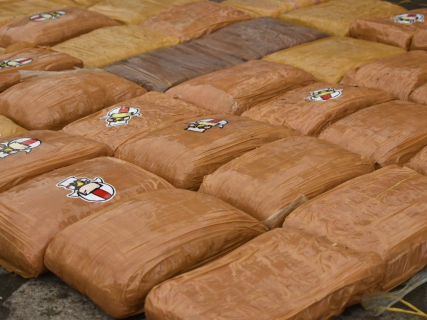

The National Police of Colombia has executed in the port of Cartagena what it has described as "the largest blow to drug trafficking in the last ten years," by locating and seizing more than 7.6 tons of cocaine hidden within a shipment of powdered panela. According to the institution, the drug was directly mixed with this food product to try to evade controls, as part of the so-called operation 'Emerald Strategy' and with the participation of agents from the Anti-Narcotics Directorate (DIRAN).
Brigadier General William Castaño Ramos, director of Anti-Narcotics of the Colombian National Police, explained to the local newspaper 'El Tiempo' that the discovery was achieved thanks to intelligence work and cargo profiling techniques, which allowed for the detection of anomalies in the merchandise and ordered a thorough inspection. The complexity of the procedure lay in the fact that the narcotic was not packaged but incorporated into the panela mixture itself, which required meticulous work to separate and confirm the presence of the illicit substance.
Castaño Ramos emphasized that this result "reflects the commitment" of the Police and the effectiveness of the tactics deployed against the new forms of concealment used by international trafficking networks. The institution has highlighted that the operation represents an estimated economic impact of more than 42 billion Colombian pesos (a little over 11.8 million euros) for criminal structures, by preventing more than 19 million doses from reaching international markets.
After the seizure, the evidence and samples collected were sent to the Criminal Investigation Directorate and Interpol (DIJIN), responsible for conducting the corresponding technical analyses. So far, it has not been revealed what the destination country of the shipment was nor has the organization responsible for the shipment been publicly identified, according to the information published by the aforementioned newspaper.
The president of Colombia, Abelardo de la Espriella, celebrated on social media this "forceful result" and sent a direct message to the drug cartels: "Let it be clear to the drug traffickers: it doesn't matter how they hide the drugs or what methods they use to try to deceive our authorities. We are going to find them and we are going to hit them where it hurts the most: in their structures and in their finances!". "In Colombia, complacency with drug trafficking is over!", emphasized the president while assessing the scope of the operation.