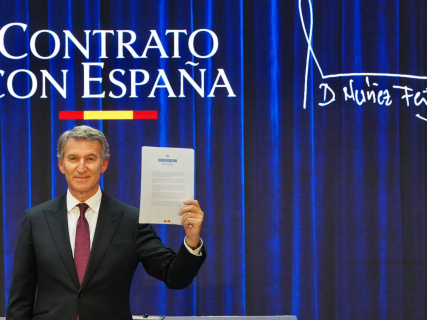

This Monday, Alberto Núñez Feijóo has gathered about 550 leaders of the Popular Party in an emblematic setting for Spanish journalism: the Espacio Larra, which pays tribute to the writer and journalist who almost 200 years ago published that anthological piece titled Vuelva usted mañana, in which he criticized the bureaucratic inefficiency of the time and portrayed the contradictions of Spanish public life.
Years later, the leader of the PP has chosen this space, where the old printing presses of El Sol and La Voz once operated and whose newsrooms were linked to such prominent figures as Mariano Cavia, Ortega y Gasset, Ramón J. Sender, Rafael Sánchez Mazas, or Serrano Anguita, among other great names in journalism.
A contract with the Spaniards
The occasion was not the presentation of a new media outlet. Feijóo gathered the top brass of his party to stage his commitment to oversee political change through a "Contract with Spain," which he symbolically signed after outlining twelve major commitments. Among them, lowering taxes, revaluing pensions according to the CPI, hiring more doctors, building at least one million homes, and allowing judges to choose the judges of the General Council of the Judiciary (CGPJ).
However, the event was not conceived to leave a long list of major headlines. Much of Feijóo's announcements had already been previewed days earlier at various events. The interest of the gathering also lay in the image of support, loyalty, and commitment that the popular leader wanted to project before his own.
DEMÓCRATA was there, spoke with attendees, and could observe some nervousness among some of the politicians sitting in the front row. Among the reasons that could explain this unease is the uncertainty about the candidacies that will run in the elections on November 29, some of which are barely known yet, as is the case with Madrid.
The event also allowed for a visualization of a front row and several more behind it in which, according to political sources consulted by DEMÓCRATA, were some of the profiles that could be part of Feijóo's future Government. In political circles, that front line was identified as that of possible ministers.
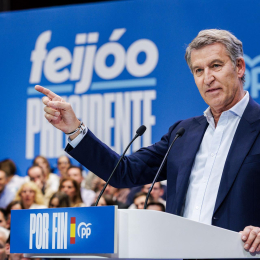
Featured story
Feijóo reserves the announcement of the PP lists while anxiety increases among his parliamentarians
5 minutes
the twelve commitments that Alberto Núñez Feijóo
-
Defend national sovereignty and territorial integrity.
-
Recover the quality of our democracy and respect for the separation of powers.
-
A cleaner and lighter State.
-
Effectively address the first problem of Spaniards: housing.
-
Regulate immigration.
-
Guarantee current and future pensions.
-
Strengthen Public Health: more doctors and better conditions.
-
Raise the educational level.
-
More security in the streets.
-
End the fiscal hell that suffocates families.
-
Raise the average salary.
-
Recover Spain's international prestige.
A front row of 14 names
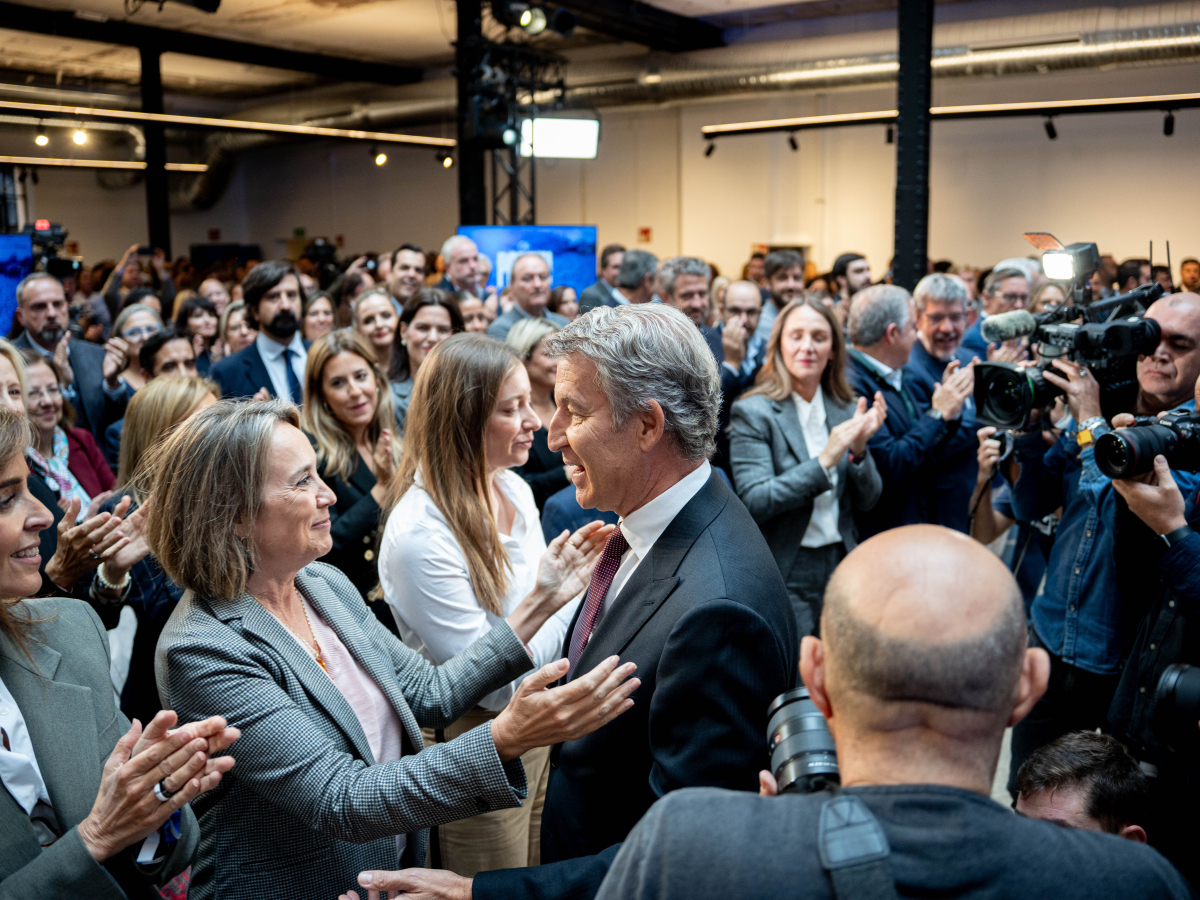
In the Larra Space, the so-called barrier, in bullfighting slang, was formed by Ignacio Dancausa, Idelfonso Castro, Cayetana Álvarez de Toledo, Alfonso Serrano, Pedro Manuel Rollán, Alberto Nadal, Elías Bendodo, Alma Ezcurra, Cuca Gamarra, Carmen Fúnez, Borja Sémper, Javier de Andrés, Sergio Sayas, and Alejandro Fernández. Feijóo greeted each of them before starting his speech.
In total, fourteen people, the same number of ministries that Alberto Núñez Feijóo has committed to configure his Council of Ministers if he wins the elections on November 29 and manages to form a Government.
However, sources consulted by DEMÓCRATA warn that not all members of that front row will end up being ministers.
In the subsequent rows, there are also politicians with profiles that they consider likely to hold a portfolio, while some names that are mentioned in the betting were not present. Our sources also point to leaders situated in further back rows and in lateral positions who, in political circles, take for granted, themselves, or at least promote themselves as such, that they will be part of Feijóo's next cabinet.
This eventual ministerial team, the same sources add, would have to share space with representatives of Vox if a coalition Government is finally constituted.

"Nothing is celebrated here"
But Feijóo does not like to talk about these matters. Nothing is further from his public discourse than distributing positions before the elections. The Galician leader insists every time he has the opportunity that we must wait until 29N to know who wins at the polls.
In that line, he has left several warnings to his own: "Nothing is celebrated here until the last polling station closes"; "No election is declared won nor do we declare any vote lost"; "Elections are not won by polls or the environment, they are won vote by vote, person by person on election day"; and "Work at full capacity, travel around Spain, listen, explain, respond, convince and, finally, win democratically at the polls".
Meanwhile, Feijóo tries to instill strength in his team so that they do not get carried away by emotion or premature optimism. The priority, at this moment, is to prepare a solid campaign, with good programs and the fewest possible mistakes.
The objective of the leader of the PP is to bring his contract closer to the Spaniards with a country proposal in which the president always tells the truth, respects the institutions, and ensures that the effort of the citizens is worthwhile. Feijóo proposes that judges choose judges, that the middle class recovers its role as the engine of the economy, and that the average salary of workers increases while productivity grows. He also promises to build housing, make young people a priority with the best aid in history, respect property, and revalue pensions according to the CPI. "They will increase every euro according to the CPI," he assured.
A contract with the Spaniards versus a declaration of love
Another of the comments that circulated among the gathered leaders was the contrast between the declaration of values of Alberto Núñez Feijóo and his consequent "Contract with Spain" and the event led last weekend by the president of the Government and leader of the socialists, Pedro Sánchez.
In this sense, the popular criticize Sánchez for centering part of his message on expressions of love and support for his wife. According to the consulted popular sources, that approach overflows with frivolity, displaces the debate from the substantive political issues, and contributes to diverting attention from the management of the Government and the judicial procedures affecting the president's family environment and his party.