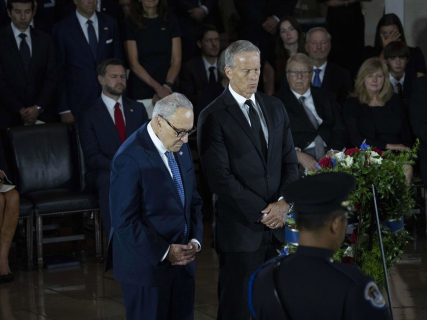

The two big parties of the United States have begun today to shape the distribution of power in the new Congress, even as it is still taking shape after the broad victory achieved by the Democratic Party on November 3. The upper house is expected to remain under the leadership of the current party leaders in the Senate, the Democrat Chuck Schumer (New York) and the Republican John Thune (South Dakota), although both will have to win over the most radicalized sectors of their formations in view of the result at the ballot box.
In Thune’s case, who in principle should be confirmed this Tuesday in the traditional closed-door vote of Republican senators, the internal context is especially tense. Donald Trump’s MAGA movement faces the president’s last two years with the aim of deepening the agenda of the president—who has appointed, for example, one of his main ideologues, the ultranationalist Stephen Miller, as chief of staff—and considers Thune a representative of the Republican “establishment,” for which it holds him partly responsible for the Democratic wave that has left them without control of the two chambers.
For that reason, senators positioned on the party’s far-right wing, such as Mike Lee (Utah), Rick Scott (Florida), or Ron Johnson (Wisconsin), are pressing to delay the vote scheduled for this afternoon because “we need a fairly deep reflection,” in the words of the latter. “This kind of defeat calls for a change, because we can’t keep going as if nothing had happened,” he criticized this past Monday to the media in brief statements, while at the same time acknowledging the lack of clear alternatives. “Doesn’t any of you want the job, right?” he joked, visibly annoyed, with the journalists.
Thune theoretically counts on Trump’s approval—who usually takes no interest in the internal procedures of Congress—but he has clashed on several occasions with the president over a controversial law requiring voters to provide proof of citizenship. The Republican leader, who tried unsuccessfully to convince the president that there weren’t enough supporters to move it forward, ended up suffering the president’s anger on social media.
The favorite so far to assume leadership of the Republican minority in the Senate, in any case, faces two decisive years to set the party’s future. Trump cannot seek a third term and the force of the electoral setback has led one of the most influential figures in Republicanism, Florida Governor Ron DeSantis, a possible candidate for 2028, to warn that they are facing an “existential” crisis.
PROGRESSIVES AGAINST SCHUMER
Schumer’s dominance over the Democratic ranks is, for the time being, much more entrenched: less than a minute after the sweeping Democratic victory was confirmed, he named Hakeem Jeffries as the new leader of the majority in the House of Representatives. However, he also cannot ignore the generational shift under way, driven by a progressive current that has mobilized the electorate with social-democratic platforms and a sharp denunciation of the genocide of Palestinians in Gaza.
Schumer, a key figure in the Jewish community within the Democratic Party and a steadfast supporter of Israel, received this weekend a first warning from Senator Chris Van Hollen (Maryland), who rejected a possible “coronation” of the Democratic leader without any kind of internal debate. Senator Elissa Slotkin (Michigan) has also warned that she will not back Schumer unless he has a detailed action plan on the strategy for the next one hundred days. “And I think many of us think the same,” she added.
In addition, one of the major winners of election night, Michigan’s newly elected senator Abdul El Sayed, has not closed the door to supporting any aspirant who takes on Schumer, to whom it took months to publicly express his support for the person who will be the first Muslim Democratic senator. “I’m ready to vote for whoever gets to work on day one,” he said this past weekend to ABC, “and what I’ve seen so far doesn’t impress me at all.”