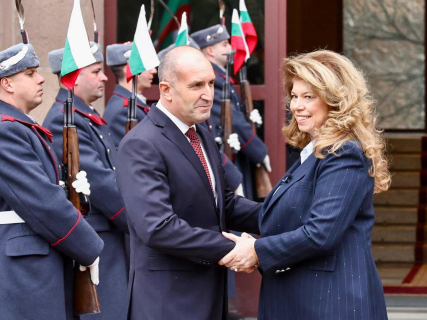

Bulgaria returns this Sunday, November 1, to the polls to elect its next president in elections that have placed relations with Russia and the war in Ukraine at the center of the political debate. The vote pits Iliana Yotova, current head of state and backed by the party of the prime minister, Rumen Radev, and Andrey Gyurov, former interim prime minister supported by several pro-European opposition parties. Both reach the second round after a very close first round, in which neither managed to gather the votes needed to declare victory.
The elections are being held at a particularly delicate moment for the country, a member of the European Union and NATO, due to the increase in tension in the Black Sea and the drone attacks against commercial ships recorded over the last few weeks. The campaign has also been conditioned by economic difficulties, rising energy costs, and the discontent of part of the electorate with the political class.
Abstention has become one of the main concerns of these elections. In the first round, held on October 25, only 23% of the electorate went to vote, the lowest turnout recorded in a Bulgarian presidential election since the arrival of democracy. The result of this Sunday will determine who will hold the Presidency during the next five years and what relationship the head of state will maintain with Radev's Government, which has an absolute majority in Parliament since April.
Who are Iliana Yotova and Andrey Gyurov, the two candidates for the Presidency
Iliana Yotova, current president of Bulgaria, took office on January 23, 2026, after Rumen Radev resigned from the Presidency to participate in the parliamentary elections. Until then, Yotova had served as vice president since 2017 and had a long political career linked to the Bulgarian Socialist Party.
The head of state was also a member of the European Parliament and a deputy in the National Assembly, in addition to developing part of her professional career as a journalist. Her candidacy is backed by Progressive Bulgaria, the formation founded by Radev, and the Bulgarian Socialist Party, among other organizations. Yotova is running alongside vice-presidential candidate Kiril Valchev, director of the public news agency BTA.
During the campaign, the president has defended the need to preserve institutional stability and maintain a foreign policy that combines Bulgaria’s membership in the European Union with a greater willingness to dialogue with Moscow. Yotova is opting for a negotiated solution to end the war in Ukraine and has shown herself favorable to improving relations with Russia, including the review of sanctions.
Opposite her is Andrey Gyurov, an economist and former deputy governor of the National Bank of Bulgaria, who served as interim prime minister between February and May 2026. Previously he had been a deputy and parliamentary leader of the Continuamos el Cambio formation.
Gyurov has the backing of Continuamos el Cambio, Bulgaria Democrática and other reformist forces, in addition to the support of center-right leaders, among them former prime minister Boiko Borisov. His vice-presidential candidate is Georgi Kandev, a former senior police official.
The main axis of his campaign is the defense of a Bulgaria closely linked to European institutions and NATO, with a firmer stance toward Russia and explicit support for Ukraine.
What happened in the first round: less than three points of difference
The first round of the presidential elections, held last 25 October, ended without a definitive winner. According to the official results published by the Central Electoral Commission of Bulgaria, Yotova obtained 34.76% of the votes, while Gyurov got 31.95%, a difference of just 2.81 percentage points.
In absolute terms, the president received 528,951 votes compared with her opponent’s 486,232, so the two were separated by 42,719 ballots. The gap was smaller than some polls published before the vote had anticipated.
The third place went to Kostadin Kostadinov, leader of the nationalist party Revival (Vazrazhdane), who obtained 12.55% of the votes. Other candidates then placed with considerably lower percentages.
These results make the voters of the eliminated candidacies a relevant group for the second round, although it cannot be taken for granted that their support will automatically shift to one candidate or the other. Part of that electorate could change option, abstain, or cast a blank ballot, while those who did not participate in the first round can also influence the result.
Participation will therefore be one of the main data points to watch when the polling stations close.
Russia and Ukraine mark the electoral campaign in Bulgaria
The war in Ukraine and relations with Moscow have become one of the main elements of confrontation between the candidates. Bulgaria maintains historical, cultural, and economic ties with Russia, although its membership in the European Union and NATO places it within the Western political and security structures.
Yotova defends a diplomatic approach to the conflict and has insisted that the way out of the war must come through conversations between Russia and Ukraine. The president has also proposed a meeting of the Black Sea littoral countries to address regional security and explore an agreement that would make it possible to reduce hostilities.
Gyurov, on the other hand, has defended firmer support for Kiev and greater coordination with European and Atlantic allies. During his time as interim prime minister he signed a security cooperation agreement with Ukraine and has criticized the current Government for not identifying Russia with sufficient clarity as responsible for the military aggression.
Tension has increased after several drone attacks against commercial vessels in the Black Sea, some of them near the coasts of Bulgaria and Romania. These incidents have generated concern about the security of maritime transport and the possible consequences of the war on neighboring countries.
Both candidates have condemned the attacks, but they differ in the approach that Sofia should adopt. While Gyurov calls for a firmer stance and greater involvement of the allies, Yotova insists on negotiation and on avoiding an escalation of the conflict.
The election will not directly decide whether Bulgaria continues in the EU or NATO, an exit that is not part of the official proposals of the two candidates. What is at issue is the orientation of its foreign policy and the role that the Presidency must play in the face of Russia and the war in Ukraine.
Low participation, one of the major challenges of the second round
The first round left a particularly significant datum: only around 23% of citizens entitled to vote went to the polls. Of the approximately 6.58 million registered voters, a little more than 1.5 million participated, a figure that reflects the strong erosion of trust in political institutions.
The abstention comes after several years of parliamentary instability, government changes, and early electoral calls. Bulgaria has held eight legislative elections since 2021, a succession of elections that has contributed to electoral fatigue among part of the citizenry.
The first round also showed territorial differences. Yotova obtained better results in numerous provinces, while Gyurov secured a more favorable position in the capital, Sofia, and in the city of Plovdiv. Among voters residing abroad, Gyurov was the most supported candidate, with 45.8% of the votes, compared with 22.8% for Yotova.
These territorial contrasts add uncertainty to the outcome. The ability to mobilize voters in the large cities, residents abroad, and those who abstained last Sunday may alter the distribution of support between the two contenders.
Rumen Radev and control of the institutions: what is at stake
The presidential elections also represent a test for Rumen Radev, current prime minister and one of the most influential figures in Bulgarian politics. The leader left the Presidency in January to create his own formation, Bulgaria Progresista, with which he achieved a parliamentary victory in April.
In those elections, Bulgaria Progresista won 131 of the 240 seats in the National Assembly, achieving an absolute majority. Radev later assumed the head of government, while Yotova remained at the head of the Presidency after having succeeded him in the post.
The holding of these elections now raises an institutional question: whether the Presidency will remain in the hands of a leader backed by the ruling party or pass to a candidate supported by the opposition.
The reformist parties that support Gyurov consider it necessary to maintain an institutional counterweight to Radev's Executive. For their part, Yotova's supporters defend the continuity of a policy that, according to their approach, favors stability and avoids new political crises.
The concern over the balance of powers has also sparked a mobilization of former leaders. Three former prime ministers, Boiko Borisov, Ivan Kostov and Nikolai Denkov, signed a manifesto of support for Gyurov on October 30, along with other political figures, in which they called for a firmer stance toward Russia and greater defense of European security.
The result will make it possible to gauge electoral support for these two positions, although it will not directly alter the parliamentary majority held by the Government.
What power does the president of Bulgaria really have
Although the Bulgarian Presidency has a primarily institutional role, the head of state has powers that can prove decisive during a political crisis.
Bulgaria is a parliamentary republic, so ordinary executive power belongs to the prime minister and his Government. However, the president represents the country internationally, serves as commander-in-chief of the Armed Forces, and takes part in certain institutional appointments.
He also has a suspensive veto over laws passed by Parliament, which allows him to return a measure so that it can be debated again. That veto is not absolute, since the National Assembly can approve the text again with the majority constitutionally required.
One of his most important powers appears when it is not possible to form a Government. In certain circumstances, the president intervenes in the procedure to appoint an interim Executive and call early elections, which explains the prominence that the head of state has acquired during years of political instability.
Therefore, although the presidential elections do not serve to directly elect the Government or change the composition of Parliament, their result can influence the balance between the institutions and Bulgaria's international position.
The economy and entry into the euro also weigh on the vote
Foreign policy is not the only concern of voters. The evolution of prices, wages and the cost of energy has also occupied much of the electoral debate, in a country that has spent several years facing economic difficulties and successive political crises.
Bulgaria joined the eurozone on January 1, 2026, becoming the twenty-first country in the European Union to adopt the common currency. The measure culminated a long process of economic integration, although it was also accompanied by concern among some consumers over its possible effects on prices.
The adoption of the euro cannot be considered solely responsible for inflation, but concern over the rising cost of basic products remains among the issues influencing the political climate.
Added to this is the energy tension linked to the war in Ukraine and the international situation, which affects households' purchasing power and companies' costs.
What time do the polls close and when will the results be known
Bulgaria's polling stations opened this Sunday at 7:00 a.m. and will remain open until 8:00 p.m., local time. This means that the ordinary closing time is scheduled for 7:00 p.m. in mainland Spain, although voting may be extended if there are citizens still waiting at the polling centers.
The law establishes that in the second round the candidacy that obtains the most valid votes wins, without again requiring that more than half of the electorate participate. Therefore, the low turnout that prevented the elections from being decided in the first round does not require them to be repeated if it happens again this Sunday.
The first exit polls may be released after the polls close. Counting will then begin, while the official results are expected starting Monday, November 2.
The next president will serve for five years, in a term that will be marked by relations with Radev's Government, the economic situation, and the evolution of the conflict between Russia and Ukraine.
The second round this November 1 will not only decide who occupies the head of state, but also what role Bulgaria will play within the EU and NATO in the face of rising tension in the Black Sea. With a margin of less than three points in the first round and unprecedented abstention, the keys to the result will lie in voter mobilization and in the support that Yotova and Gyurov manage to gather beyond their initial electorates.