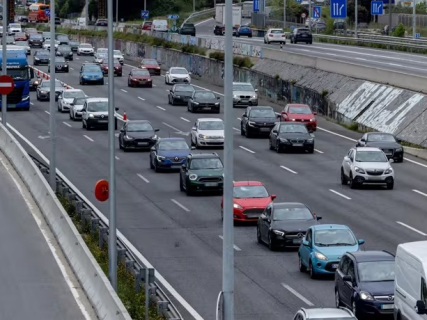

The return operation of the All Saints’ bridge begins this Sunday, November 1, with thousands of drivers preparing their return home. The Directorate-General for Traffic (DGT) has launched a special operation in view of the 5.34 million long-distance journeys expected between Friday, October 30 and Monday, November 2, to which are added the short trips related to visits to cemeteries, second homes, and tourist destinations.
This year, the return will be divided between Sunday and Monday, since All Saints’ Day falls on Sunday and several autonomous communities have moved the holiday to November 2. The DGT anticipates an increase in traffic during the afternoons of both days, especially on the access motorways to large cities and on the main corridors that connect the coast and mountain areas with urban centers.
The most difficult time slot will be between 15:00 and 24:00 hours, both on Sunday and Monday, according to the official forecasts. However, congestion may appear earlier or last longer depending on weather conditions, accidents, and the volume of vehicles on each road. For this reason, Traffic recommends checking the state of traffic before setting out and reviewing possible alternative routes.
At what time will there be the most traffic jams on Sunday, November 1
Sunday, November 1 will be the main return day in the communities where Monday is a working day. The DGT expects an increase in traffic starting in the first hours of the afternoon, especially on the roads giving access to large cities.
Among the territories where this first return will be concentrated are Catalonia, Valencian Community, Galicia, Cantabria, Balearic Islands, Murcia, La Rioja and Basque Country, in addition to the autonomous cities of Ceuta and Melilla. In these areas, numerous travelers will bring forward their return in order to go back to work or to their usual activities on Monday.
The DGT points to the least favorable hours for driving as between 15:00 and 24:00 hours on Sunday. During that interval, congestion could occur on the main highways and motorways, especially on urban access roads and on roads that connect with tourist destinations.
In addition, All Saints' Day usually generates short-distance trips to cemeteries, which can increase traffic on secondary roads and entrances to certain localities.
Monday, November 2: where it will be a holiday and when the return begins
Monday, November 2 will be a holiday in Andalucía, Aragón, Asturias, Canarias, Castilla-La Mancha, Castilla y León, Extremadura, Comunidad de Madrid and Navarra. Therefore, those who have taken advantage of the three-day long weekend may extend their trips until that day.
In the first eight communities, the DGT will maintain its special operation until 24:00 hours on Monday, while Navarra will also have a holiday in accordance with its labor calendar.
The forecast points to short trips during the morning toward leisure areas, second homes and nearby destinations. However, return traffic will begin to intensify from 15:00 hours, especially on the highways leading into the cities.
The DGT again identifies the period between 15:00 and 24:00 hours as the least favorable for travel. Therefore, those who have schedule flexibility may consider an earlier return, as long as traffic and weather conditions allow it.
In the communities where Monday is a working day, the usual work-related trips will be added, especially during the early hours of the morning.
How to check traffic jams and closed roads in real time
The DGT offers an official map that allows you to check the traffic status and incidents that occur on Spanish roads. The tool is updated with information provided by the Traffic Civil Guard and traffic management centers, which makes it possible to know about accidents, closures, delays and other circumstances that may affect travel.
The map can be consulted on the official DGT website, within the section "Traffic information and incidents", or directly in its road information service.
Drivers have several official channels to stay informed:
-
Real-time traffic map: infocar.dgt.es.
-
DGT incidents page: www.dgt.es.
-
Telephone 011: information service about the state of the roads.
-
Social networks: official DGT accounts on X, especially @informacionDGT.
-
Radio and television bulletins: information on bottlenecks, accidents and alternative roads.
The consultation makes it possible to identify problems that were not necessarily anticipated before the start of the trip. A road may have fluid traffic in the morning and register bottlenecks several hours later, so it is advisable to check updates as the time to set out approaches.
In Catalonia and Basque Country, the information can also be consulted through the autonomous services competent in matters of traffic, which offer data on their respective road networks.
The roads with the greatest risk of bottlenecks during the return
The DGT warns of possible complications on the main entry corridors to the cities, especially in those communities where the holiday ends on Monday. One of the points that requires the greatest attention is the A-1 dual carriageway, inbound toward Madrid, due to the works being carried out between kilometers 51 and 59, at the level of Venturada and Cabanillas de la Sierra.
The repair works on three viaducts oblige keeping one lane closed in the direction of the capital, which may cause significant bottlenecks during Monday afternoon. To reduce circulation problems, Traffic is considering enabling an additional lane from kilometer 74, provided that weather and safety conditions allow it.
The DGT has also announced that it will pay special attention to the roads that connect Madrid with Andalusia, given the possibility of an increase in road journeys as a consequence of the suspension of rail services after the Urda accident (Toledo).
This transfer of travelers could increase the circulation of private vehicles and buses on the main routes toward the southern part of the peninsula. However, the DGT has not confirmed that all these roads will experience traffic jams, but rather maintains special vigilance in view of the possible increase in traffic.
In general, bottlenecks could also occur on access roads from coastal areas, mountain destinations and towns with numerous second homes.
How to avoid traffic jams and organize the return trip
To reduce the risk of running into major traffic jams, the DGT recommends planning the route before setting out and avoiding, whenever possible, the hours with the highest traffic intensity. On this long weekend, the recommendation takes on special importance because the return journey is concentrated over two different days.
Before starting the trip, it is advisable to consult the incident map and check whether there are roadworks, accidents, or restrictions on the planned route. It is also useful to review the available alternatives, although a secondary road is not always faster or safer than a highway with heavy traffic.
Traffic advises adjusting speed to traffic conditions, respecting safe distances, and avoiding sudden maneuvers when traffic jams begin. In the event of a jam, it is important to keep attention on the road and not use a mobile phone while driving.
In addition, the DGT reminds that since October 1 the obligation to facilitate the formation of an emergency corridor has been in force when vehicles are traveling at very low speed or remain stopped on highways and expressways. This space allows ambulances, firefighters, and police vehicles to pass when they need to access the scene of an incident.
On roads with two lanes in each direction, vehicles must move to the edges to leave space between both lanes. On those with three or more, the corridor must be formed between the lane farthest to the left and the adjacent one.
Attention to rain, fog, and night driving
Weather conditions can also complicate travel during the long weekend. The DGT warns that autumn is a time when heavy rain, fog, and other adverse phenomena can appear suddenly, especially on mountain roads and exposed stretches.
For this reason, it recommends consulting the forecasts of the State Meteorological Agency (AEMET) before setting out on the return journey. If significant rainfall is forecast, it may be advisable to change the departure time or delay the trip until conditions improve.
The reduction in daylight hours during November also increases the time many drivers spend behind the wheel at night. Under these circumstances, it is especially important to check the lighting, the condition of the tires, and the operation of the windshield wipers.
In the event of a breakdown or accident, drivers must use the connected V-16 beacon, mandatory from January 1, 2026 to signal immobilized vehicles in the cases provided for by the regulations.
How long does the DGT special operation last
The All Saints special operation began on Friday, October 30 at 15:00 hours and will end at two different times depending on the territory.
The special return operation will conclude at midnight on Sunday, November 1 in the communities where Monday is a working day, while in Andalucía, Aragón, Asturias, Canarias, Castilla-La Mancha, Castilla y León, Extremadura and Madrid it will be extended until 24:00 hours on Monday the 2nd.
During this period, Tráfico keeps active its surveillance, regulation and assistance resources, including Guardia Civil officers, management centers, cameras, helicopters and drones. It also contemplates the use of additional lanes and special measures to facilitate the return to the large cities.
The main recommendation for those returning from the long weekend is to check traffic just before leaving, pay attention to urban accesses and avoid, as far as possible, Sunday and Monday afternoons, especially between 15:00 and 24:00 hours. The forecasts make it possible to anticipate the most complicated time slots, but the real state of each road must be checked through the official channels.